Support

Busuanga Airport

About the Airport

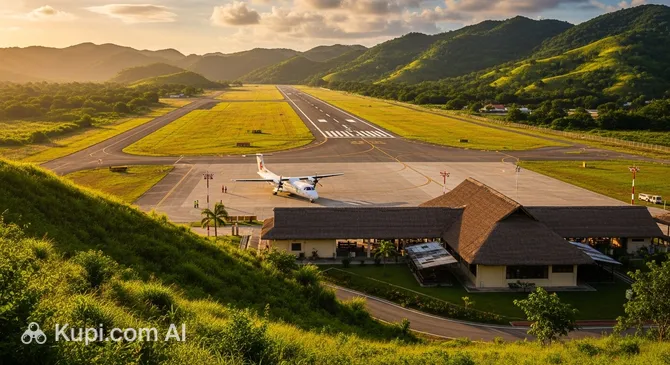
Busuanga Airport. Source: Kupi.com Binoculars

Busuanga Airport, officially named Francisco B. Reyes Airport, is not just a transport hub, but an atmospheric introduction to your journey through exotic Palawan. From the first minutes after landing, you can feel the special rhythm of island life here: instead of the glass and concrete of megacities, you are greeted by green hills, pastures, and warm tropical air. The approach to landing at this air harbour is often called an attraction in itself — the plane descends over the turquoise surface of the sea and whimsical islets, offering passengers breathtaking views even before leaving the cabin.

IATA Code USU
ICAO Code RPVV
City Coron (Busuanga Island)
Distance to center ~20 km (30-40 minutes by car)
Status Domestic
Passengers per year Over 300,000 people
Schedule Check airline websites

Scenic Location and Views

The airport's main pride is its surroundings. The runway is situated amidst picturesque plains, and during takeoff or landing, an incredible panorama of the Calamian Archipelago opens up. Many tourists specifically try to get a window seat to capture the emerald lagoons and karst cliffs from a bird's-eye view.

Compactness and Speed of Service

Thanks to the small size of the terminal, all procedures here are much faster than in major hubs like Manila. The absence of long walkways and complex navigation allows travelers to collect luggage and exit to their transfer literally 15–20 minutes after landing, which is especially valuable after a flight.

Authentic Atmosphere

Busuanga Airport lacks the hustle and sterility of large international airports. A calm, almost rural atmosphere reigns here, which immediately sets a relaxed mood. This is the ideal place to begin a detox from city life, as the roads leading to hot springs, lakes, and the region's best dive spots start right outside the airport gates.

Contact Information

Finding direct contacts for a small regional airport like Busuanga (USU) can be difficult, as most issues are resolved through airlines. Nevertheless, here is the basic contact information that may be useful for travelers.

  • Official Website: Busuanga Airport does not have its own separate website. It is managed by the Civil Aviation Authority of the Philippines (CAAP), on whose official portal general information can be found.
  • Information Desk Phone: A direct public telephone number for the airport is not published. For information on flight status, schedules, or transport rules, it is strongly recommended to contact your airline directly.
  • Airport Address: Francisco B. Reyes Airport, Coron-Busuanga Rd, Coron, Palawan, Philippines.
  • Email: There is no specialized email for passenger inquiries. Please use your airline's support channels for communication.
  • Social Media: The airport does not maintain official pages on social networks.
  • Lost Luggage Information: If your luggage has been lost or damaged, you must immediately contact the counter of your airline in the airport arrivals hall. It is the air carrier that is responsible for tracing luggage.
  • Passenger Support Contacts: For all questions related to tickets, booking, and onboard service, you should contact the support service of the airline you are flying with.

How to Get to the Airport

Getting to Busuanga Airport (USU), which serves the tourist-popular island of Coron, is quite simple, although transport options in the Philippines have their own specifics. The airport is located approximately 30-45 minutes by road from Coron Town — the main tourist center of the island, where most hotels are located.

Public Transport and Shuttles

The most common and economical way to travel between the town and the airport is via shared shuttle vans. These minibuses usually await arriving flights or pick up passengers directly from hotels before departure. It is recommended to book a seat in a shuttle in advance through your hotel or one of the local travel agencies. The cost of the trip is about 150-250 Philippine pesos per person one way. This is an ideal choice for solo travelers and small groups who do not wish to overpay.

Taxi and Private Transfer

There are practically no classic metered taxis on Busuanga island. An alternative is a private transfer, which can be organized through a hotel. This will be the same minibus, but reserved exclusively for you and your group. The cost will be higher, but you get comfort, time flexibility, and a non-stop journey. Local tricycles (motorcycle taxis) are great for short trips around town, but they are not the best option for an airport transfer with luggage due to the distance.

Car Rental and Parking

Car rental on the island is not very popular among tourists; scooters or motorbikes are rented more often for exploring the surroundings. If you do rent a car, note that road quality can vary. There is a small parking area at the airport, but since most travelers rely on transfers, it is rarely overcrowded.

Recommendations and Features

  • Book in advance: To avoid unnecessary stress, order your airport transfer at least a day before departure.
  • Have cash ready: You will need cash in the local currency (Philippine pesos) to pay for shuttles and tricycles. Card payments are not widely accepted.
  • Allow extra time: Despite the short distance, always leave with time to spare, especially if your flight is during daytime hours.

If you are planning a combined trip around the region, consider flying via other airports. For example, from the airport in El Nido or San Jose, you can reach Coron by a scenic ferry, which will be an adventure in itself.

Terminals and Map

Busuanga Airport (USU), officially known as Francisco B. Reyes Airport, is a small regional airport serving as the main gateway to Coron Island and nearby islands. Its structure is extremely simple and clear, making it convenient even for first-time visitors.

The airport has only one passenger terminal. It is a small, often single-story building that handles both arriving and departing flights. There is no complex layout, long corridors, or transitions between terminals here — everything is in one place. The departure area and arrival area are located in close proximity to each other, making it impossible to get lost.

Procedures at Busuanga Airport usually proceed quite quickly. Immediately upon entry, you reach the check-in counters. After receiving a boarding pass and checking in luggage, passengers pass through security screening and enter a small waiting hall. Due to the airport's compact size and limited number of flights, the entire process from entry to boarding gate rarely takes much time. Nevertheless, during the peak tourist season, queues may arise, so it is recommended to arrive at the airport 1.5-2 hours before departure.

Navigation within the terminal is intuitive. Signs, if present, are hardly needed — it is practically impossible to get lost here. After landing, you immediately proceed to the baggage claim area, and from there — to the exit, where hotel transfers are already waiting. The simplicity and compactness of Busuanga Airport are its distinguishing features, allowing travelers to quickly and stress-free begin or end their holiday on the paradise islands.

Airport History

Busuanga Airport (USU), officially known as Francisco B. Reyes Airport, began its history as a modest airstrip serving the needs of the local population. Its development is inextricably linked to the growing popularity of the Calamian Islands as a world-class tourist destination. Initially, the airport could only accommodate small propeller planes, but with the increase in the flow of travelers wishing to see the beauties of Busuanga and Coron, an urgent need for its modernization arose.

A key moment in the airport's history was 2008, when it was officially renamed in honor of Francisco B. Reyes, the former mayor of Coron (1936-1939), who donated the land for the construction of the municipal municipality. This event highlighted the importance of the air harbour for the region. However, the most massive changes were still ahead. The transformation from a simple airfield into a modern transport hub began in the 2000s.

The first major modernization was completed in 2007 with the opening of a new terminal building, which replaced the old one that could no longer cope with passenger traffic. Later, around 2017-2018, an even more ambitious expansion and reconstruction project was launched. Within its framework, the runway was lengthened and widened, allowing for the reception of larger aircraft, such as the Airbus A320. Work was also carried out to improve the terminal and navigation equipment to enable night flights and, prospectively, the reception of international flights.

Besides its primary function, the airport has repeatedly played an important humanitarian role. For example, after the devastating Typhoon Haiyan (known in the Philippines as Yolanda) in 2013, it was through Busuanga Airport that humanitarian aid was delivered and victims were evacuated. Interesting fact: due to its location, the approach to landing at Busuanga is considered one of the most scenic in the Philippines, offering passengers breathtaking views of islands, emerald hills, and turquoise waters.

Services and Facilities

Busuanga Airport (USU), also known as Francisco B. Reyes Airport, is a small regional airport that serves as the main gateway to Coron Island and its famous diving spots. It is important to understand that its infrastructure is oriented towards the basic needs of arriving and departing tourists, and it is significantly simpler than in large international hubs.

Restaurants, Shops, and Lounges. At the airport, you will find several small kiosks where you can buy simple snacks, soft drinks, and souvenirs. There are no full-service restaurants or cafes here. The waiting area is common for all passengers; no special VIP lounges are provided.

Wi-Fi and Device Charging. Stable connection to free Wi-Fi at the airport is generally absent. It is recommended to use mobile data. The number of power outlets for charging gadgets is very limited, so it is better to bring a portable charger (power bank) with you.

Financial and Medical Services. There are no banks, ATMs, or currency exchange points within the terminal territory. All financial operations are best done in advance or upon arrival in Coron Town. Medical services are limited to the provision of basic first aid; there is no pharmacy or medical center at the airport.

Additional Amenities. The airport is not equipped with special mother-and-child rooms or play areas. Passengers with reduced mobility are recommended to notify their airline in advance to organize assistance, as special infrastructure is minimal. There are no hotels, business centers, or conference halls directly on the airport grounds — all accommodation options and business services are located in Coron Town itself, which can be reached by shuttle or taxi.

Where to Eat

When planning a departure from Busuanga Airport (USU), it is important to remember that this is a small regional airport, and dining options here are quite modest, though sufficient for a snack before a flight. You will not find a wide selection of restaurants here as in large international hubs, yet you will not go hungry.

All food establishments are concentrated in the single compact terminal, so finding them will not be difficult. They are mostly located in the general area before security control (landside). Several small kiosks and snack bars operate here, where you can buy simple dishes and drinks. The assortment usually includes packaged sandwiches, chips, local pastries, instant coffee, tea, bottled water, and soft drinks. After passing security (airside), the selection is typically very limited or non-existent.

For a full lunch or dinner, it is better to eat at one of the numerous cafes in Coron Town before traveling to the airport. The options at the airport itself are more suitable for a quick snack. If you are lucky, you might be able to try some local Philippine snacks sometimes sold in local stalls — this is a great way to experience local cuisine at the last moment.

Regarding special dietary requirements, finding dishes with "Vegan", "Gluten-free", or "Halal" certification here is practically impossible. Travelers with strict dietary restrictions are recommended to bring food with them. Prices in the airport snack bars are quite affordable. Opening hours are usually tied to the flight schedule: they open shortly before the first departure and close after the last plane leaves.

Travel Tips

Francisco B. Reyes Airport (USU), serving the island of Busuanga, is a small regional airport. Despite its compact size, we recommend arriving here at least 1.5–2 hours before your domestic flight. This will give you enough time for a calm check-in and security screening, especially during peak season when several flights may depart simultaneously. Online check-in, if available with your airline, will help save time, but you will still need to check luggage and pass through security.

When preparing for a flight from Busuanga, pay attention to carry-on luggage rules. Standard restrictions on liquids (no more than 100 ml in one container) and a ban on carrying sharp objects apply here as well. Always keep power banks and spare batteries in your carry-on luggage, not in checked baggage. Since flights are often operated on small turboprop planes, try to book a window seat. Views of the archipelago and turquoise waters during takeoff and landing are an unforgettable sight that will be a wonderful beginning or end to your journey through the Philippines.

It is important to remember that Busuanga Airport serves primarily domestic flights. If you have a connection to an international flight, it will likely be in major hubs such as Manila (MNL) or Cebu (CEB). At Busuanga, you will not go through customs or immigration control upon departure. These procedures await you at the airport from which you will leave the country. Allow sufficient time for connections in large airports, as you will need to collect luggage, transfer to another terminal, and go through all pre-flight formalities again.

To save money, book flight tickets in advance, especially if traveling during the high season. The choice of food and drinks at the airport itself is limited, and prices may be higher than in town, so you can bring a small snack with you. For trips to and from the airport, the most popular transport is tricycles and private vans. Be sure to agree on the trip cost with the driver in advance to avoid misunderstandings upon arrival. Traveling light, with only carry-on luggage, will also help save both time and money on baggage fees.

Flight delays, especially in the rainy season, are not uncommon for regional airports. In case of a delay, remain calm and monitor information on the departure board or via your airline's mobile app. Given the modest size of the terminal and limited amenities, be prepared to wait. Ensure your carry-on luggage has everything necessary: water, snacks, a portable charger, and any important medications. If the delay is significant, contact an airline representative to learn about your rights to compensation or provision of services.

Reached the end of the page?

That means the route is fully explored