Support

Alcazaba of Málaga

About

The Alcazaba in Málaga is an impressive Moorish fortification that is one of the main attractions in southern Spain. The fortress stands majestically on the slopes of Mount Gibralfaro, offering breathtaking views of the city and the Mediterranean Sea. It is one of the best-preserved Moorish citadels in the country, making it a must-see on any traveler's itinerary.
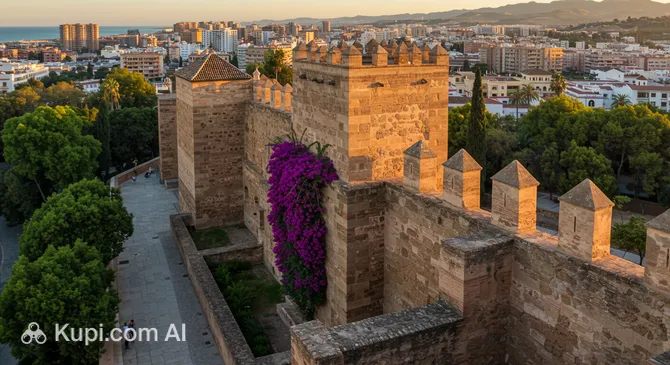
Alcazaba of Málaga. Illustration.
Source: Kupi.com AI

Traveler photos:

This structure represents a unique combination of a powerful defensive fortress and an elegant palace complex, showcasing the skill of 11th–14th-century Muslim architecture. During the Emirate of Granada, the Alcazaba served as a residence for the city's rulers. Walking along its walls, towers, and courtyards with trickling fountains, you can easily immerse yourself in the atmosphere of medieval Al-Andalus.

The historical layering of this site is of particular interest. At the very foot of the fortress lie the ruins of an ancient Roman theater dating back to the 1st century. Notably, stones from this ancient structure were used by the Arabs in the construction of the Alcazaba, creating an amazing intertwining of eras and serving as a clear testament to Málaga's rich history.

Contacts

Since the Alcazaba of Málaga is primarily a major historical and archaeological site, the best way to get up-to-date information on opening times, ticket prices, and special events is to consult official tourism resources. The fortress is located in the very heart of the city and is easy to reach. Below are the main contact details.

How to contactContact
AddressC/ Alcazabilla, 2, Distrito Centro, 29012 Málaga, Spain
Websitealcazabaygibralfaro.malaga.eu

What to Do

A visit to the Alcazaba is a true immersion into history. You can walk along the massive fortress walls and climb the towers, which offer views of the internal courtyards and gardens. The main activity here is exploring the impressive complex of defensive structures, which includes not only walls but also elegant palace buildings.

The architectural ensemble of the fortress demonstrates the full skill of 11th-14th century Muslim architects. Notice the unique synthesis of cultures: you can see Roman columns and stone blocks taken from ancient structures built into the walls. Its strategic location on Gibralfaro Hill gives visitors the chance to enjoy breathtaking panoramic views of the port, Málaga's city rooftops, and the endless Mediterranean Sea.

At the entrance to the fortress, another discovery awaits you—the ruins of a 1st-century ancient Roman theater, which create a striking contrast with the Moorish citadel. This allows you to trace the centuries-long history of this unique place, where different eras and dynasties, from the Hammudids to the Nasrids, left their mark. Thus, a visit to the Alcazaba is not just a sightseeing tour, but a journey through time.

Getting There

Reaching the Alcazaba of Málaga is easy, as the fortress is located in the very heart of the city, at the foot of Mount Gibralfaro. Due to its central location, the simplest and most pleasant way to get there is on foot, especially if you are in the historical center. The walk allows you to enjoy the atmosphere of ancient streets and see other iconic sites nearby, such as the ruins of the Roman Theater, which are right by the entrance to the fortress.

For those who prefer public transport, there are several bus stops near the Alcazaba. You can use numerous city routes that pass through the center. The most convenient stops are Paseo del Parque — Ayuntamiento or Alameda Principal, which are just a few minutes' walk from the entrance. Suitable buses include routes No. 1, 3, 11, 32, 33, 34, 35, and others passing through these key points in the city.

If you want to avoid walking uphill, there is a convenient alternative: a special lift (ascensor) that takes you up to the entrance of the palace section of the complex. The entrance to the lift is on Calle Guillén Sotelo, at the back of the Málaga City Hall (Ayuntamiento). Additionally, you can always take a quick and comfortable taxi ride to the fortress from anywhere in the city, which is especially convenient if you are traveling with children or are short on time.

Nearest city: Malaga

History & Facts

The history of the Alcazaba of Málaga dates back to the 8th century, during the reign of the Umayyad dynasty. The first mentions of this strategic fortification in historical sources date to 755, when a decree was issued to build a mosque within the fortress walls. This indicates that from the very beginning, the Alcazaba was intended not only as a military site but also as an important administrative and religious center for the city of Málaga.

The main construction phase took place in the mid-11th century, when rulers from the Zirid dynasty significantly expanded and strengthened the fortress. It was during this period, under the leadership of Badis ben Habus, that the powerful walls and towers were built, forming the structure's recognizable appearance. Later, in the 14th century during the Nasrid dynasty, the Alcazaba underwent further modernization: defensive structures were improved and new towers were added. Over the centuries, the fortress constantly evolved, reflecting changes in ruling dynasties and adapting to new realities, including the period of the Christian Reconquista.

One of the most intriguing facts about the Alcazaba is its building material. During its construction, Arab architects actively reused elements from earlier structures, specifically stones and columns from the 1st-century ancient Roman theater, the ruins of which can still be seen at the foot of the hill today. This unique architectural symbiosis, where Islamic military architecture intertwines with Roman heritage, is a clear testament to the rich and multi-layered history of Spain. This continuity of engineering traditions creates a unique look for the fortress, making it a living history textbook.

Time Needed

For a complete and leisurely tour of the Alcazaba of Málaga, it is recommended to set aside about 1.5–2 hours. This time is usually enough to walk through all the main parts of the complex without rushing: explore the massive fortress walls, climb the towers, enjoy views of the city and port, and study the elegant courtyards and palace buildings. This pace will allow you to fully immerse yourself in the atmosphere of this historical site and appreciate its architectural details.

If you are short on time, a quick tour of the most iconic parts of the fortress can be done in an hour, though this will be a rather superficial introduction. Many travelers prefer to combine a visit to the Alcazaba with a trip to the Gibralfaro fortress located higher up the hill. In this case, you should plan at least 3–4 hours for both monuments, which will effectively take up half a day. This will allow you to not only explore both fortresses but also enjoy the walk between them, which offers some of the best panoramic views in Málaga.

Working Hours

The Alcazaba of Málaga is open to visitors year-round, but its opening hours change depending on the season. During the summer period, from April 1 to October 31, the fortress can be visited from 9:00 to 20:00, with last entry at 19:15. In winter, from November 1 to March 31, the schedule is shorter—from 9:00 to 18:00, with entry no later than 17:15. Please note that the attraction may be closed on major public holidays, such as December 24, 25, 31, and January 1.

While tickets can be purchased directly at the ticket offices by the entrance, it is recommended to buy them online to save time and avoid queues, especially during high season. Pre-booking a visit is not mandatory for standard entry, but it may be required for guided tours. A nice bonus for tourists is that entry to the fortress is free every Sunday after 14:00. As schedules are subject to change, it is highly recommended to check for up-to-date information on Málaga's official tourism portal or the Alcazaba's own website before planning your trip.

9:00 – 20:00

Nearby

Visiting the Alcazaba is just the beginning of discovering the rich historical and cultural heritage of Málaga. Thanks to the fortress's location in the heart of the city, exploring its surroundings becomes an exciting journey where every step reveals new sights. A walk through the adjacent streets allows you to dive deeper into the Andalusian atmosphere and see how closely different historical eras are intertwined.

Just a few minutes' walk from the Moorish citadel, world-famous museums, majestic cathedrals, and lively squares await you. This proximity makes the Alcazaba an ideal starting point for exploring central Málaga, allowing you to easily combine a tour of the fortress with other iconic city locations.

NameDistance
El Pimpi0.2 km
Picasso Museum Málaga0.2 km
Centre Pompidou Málaga0.4 km
Picasso Birthplace Museum0.4 km
Barsovia Club0.4 km
Gibralfaro Castle0.5 km
La Tasquita de en Medio0.5 km

Have you reached the end of the page?

So the route has been studied inside and out