Support

Italica Amphitheatre

About

The Italica Amphitheatre is an impressive ancient Roman structure located in the Italica archaeological complex near the city of Seville, in Spain. It is an iconic historical site that allows you to touch the greatness of the Roman Empire and imagine the gladiatorial games and other spectacles that took place in its arena.
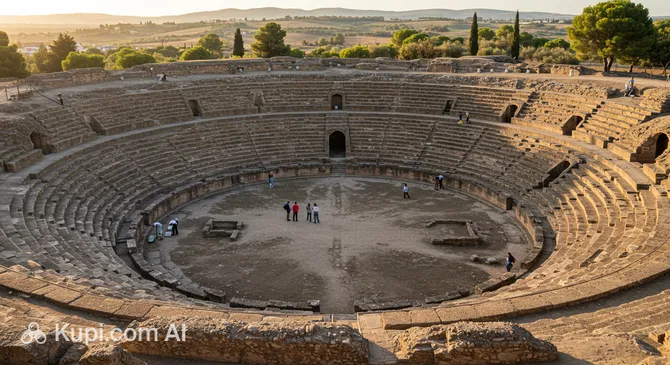
Italica Amphitheatre. Illustration.
Source: Kupi.com AI

Traveler photos:

This amphitheatre was one of the largest in the entire Roman Empire, capable of seating up to 25,000 spectators. Its grand dimensions, measuring 156 by 134 meters, capture the imagination even today and testify to the former power and engineering skill of the Romans. It was built in the 2nd century AD during the reign of Emperor Hadrian, who was himself born in Italica.

Today, the Italica Amphitheatre consists of picturesque ruins that form the central part of a vast archaeological complex — the ancient city of Italica. This city was the third largest in Roman Spain and played an important role in the life of the empire, being the birthplace of Emperors Trajan and Hadrian. Although mostly ruins remain of the amphitheatre, it is better preserved than many other structures in the city and offers visitors a unique opportunity to imagine the scale and splendor of Roman architecture and feel the atmosphere of ancient spectacles.

Contacts

Italica Amphitheatre is an impressive historical site located near Seville. Since it consists of ancient ruins, it may not have direct contact information such as a telephone number or email address. To get to the Italica Amphitheatre, it is most convenient to take a bus from Seville or rent a car.

For up-to-date information on opening hours, ticket prices, and travel options, it is recommended to check the official tourism portals of Seville or the Andalusia region, as well as websites dedicated to the historical heritage of Spain.

How to contactContact
AddressAv. Extremadura, 2, 41970 Santiponce, Sevilla, Spain
Phone number+34 600 14 17 67
Websitewww.italicasevilla.org

What to Do

A visit to the Italica Amphitheatre is a true journey through time, immersing you in the atmosphere of Ancient Rome. Once here, you can walk through the impressive ruins of one of the largest amphitheatres in the Roman Empire. Imagine the roar of the crowd and the clashing of weapons, as it was in this very arena that thrilling gladiatorial games and other public spectacles once took place. You can walk on the same stones trodden by legionnaires and emperors, feeling the breath of history.

While exploring the amphitheatre, look for the preserved structural elements: the seating areas, the arena, and the underground galleries where gladiators and wild beasts once waited to make their entrance. Walking through the ruins, you can see the foundations of buildings and imagine the layout of the streets and houses of the ancient city of Italica. For a better understanding of the history of this unique place, information boards are installed throughout the complex, providing detailed accounts of the past of Italica and its famous amphitheatre.

In addition to the amphitheatre itself, the Italica archaeological complex offers other significant sites to explore. Walk along the ancient paved streets, examine the remains of residential houses with beautifully preserved mosaics, and see the ruins of temples and public baths. This will help you form a more complete picture of the scale and daily life of this once-prosperous Roman city, the birthplace of Emperors Trajan and Hadrian. Visiting Italica is a unique opportunity to connect with ancient history and see how people lived nearly two thousand years ago.

Getting There

The Italica Amphitheatre is located not in Seville itself, but in the small town of Santiponce, about 10 kilometers northwest of the Andalusian capital's center. This makes it easily accessible for a day trip from Seville. You can reach this impressive archaeological complex in several ways, including public transport and by car, allowing you to choose the most convenient option for your journey.

The most budget-friendly and popular way to reach Italica is by public transport. Buses regularly depart from Seville to Santiponce. Generally, they leave from the Plaza de Armas bus station located in Seville. The bus ride usually takes about 30-40 minutes, depending on traffic. This is not only an economical but also an authentic way to travel, allowing you to observe the life of the local suburbs.

If you value comfort and speed, or are traveling in a small group, you can take a taxi. A taxi ride from the center of Seville to the Italica Amphitheatre will take approximately 15-20 minutes but will cost more than the bus. Another convenient option is to rent a car. This will give you complete freedom of movement, independence from public transport schedules, and the possibility to visit other interesting places around Seville on the way to or after exploring the ruins.

Nearest city: Seville

History & Facts

The Italica Amphitheatre, located near modern-day Seville, is one of the most impressive testaments to the Roman presence on the Iberian Peninsula. Its construction took place during the reign of Emperor Hadrian, who, notably, was a native of Italica himself. Built between approximately 117 and 138 AD, the amphitheatre became an embodiment of the power and cultural scale of the Roman Empire at its peak.

The city of Italica, where the amphitheatre was built, had a rich history of its own. Founded by the Romans, it quickly grew into one of the largest and most important cities in what is now Spain, ranking as the third largest on the Iberian Peninsula. However, like many other great cities of antiquity, Italica could not escape decline. Its twilight began with the arrival of the Visigoths, and during the era of Moorish rule, the city was finally abandoned. Today, the ancient ruins, including the majestic amphitheatre, serve as silent witnesses to former glory.

In its time, the Italica Amphitheatre was a true hub of social and cultural life. Like other Roman amphitheatres, it served as an arena for thrilling and often brutal spectacles. Gladiatorial games were held here, where warriors fought for their lives, as well as wild beast hunts, attracting huge crowds of spectators. The amphitheatre's arena had a wooden floor which, according to accounts, was often soaked with the blood of the participants in these gory performances, reflecting the harsh customs of that era.

Time Needed

When planning a visit to the Italica Amphitheatre near Seville, it is worth setting aside approximately 1-2 hours for exploration. This is usually enough time to walk around the arena, climb the stands, imagine the gladiatorial games, and soak in the atmosphere of the ancient Roman structure. The amphitheatre is one of the main attractions of the Italica archaeological complex, the first Roman city founded in Spain.

However, if you have a deep interest in the history of Ancient Rome, enjoy leisurely exploring ruins, and taking photographs, your stay may take longer. Keep in mind that the Italica Amphitheatre is only part of a large archaeological park, which also includes the remains of residential houses with mosaics, baths, and other buildings. If you plan to tour the entire Italica complex, you will need at least 3-4 hours or even half a day.

It is recommended to check the complex's opening hours in advance, especially during the summer, when they may be adjusted due to the heat. In any case, a visit to the Italica Amphitheatre promises to be a fascinating dive into history and will leave a lasting impression.

Working Hours

The Italica Amphitheatre, located near Seville, is a significant historical attraction. Unfortunately, exact information regarding opening hours may vary depending on the season and the day of the week. Typically, such archaeological complexes have summer and winter schedules and may be closed on certain holidays.

It is recommended to check the current opening hours and ticket prices in advance on the official website of the Italica Amphitheatre or at tourist information centers in Seville. During high tourist season or for group visits, it may be advisable to book tickets in advance to avoid queues and guarantee entry. It is also worth checking if any special events or tours are being held on the day of your planned visit.

DayOpening hours
MondayClosed
Tuesday9:00 – 18:00
Wednesday9:00 – 18:00
Thursday9:00 – 18:00
Friday9:00 – 21:00
Saturday9:00 – 21:00
Sunday9:00 – 15:00

Nearby

A visit to the Italica Amphitheatre is undoubtedly an immersion into ancient history, but exploring its surroundings can significantly enrich your experience. Not far from this majestic structure are other interesting sites that will allow you to gain a deeper understanding of the culture and history of Seville and the region.

Exploring nearby attractions will provide a more complete picture of the life and significance of the ancient city of Italica, while also allowing you to enjoy other facets of Spain. Below is a list of some interesting sites located relatively close to the amphitheatre.

NameDistance
Archaeological Ensemble of Italica0.2 km
Isla Mágica6 km
Sala Even6.4 km
Kaminature Aquarium6.7 km
Alameda de Hércules6.8 km
Espacio Eslava6.8 km
Dos de Mayo Bar7 km

Have you reached the end of the page?

So the route has been studied inside and out