Support

Archaeological Ensemble of Italica

About

The Italica Archaeological Ensemble offers a unique opportunity to touch the history of Ancient Rome without leaving sunny Spain. These impressive ruins of an ancient Roman city are located just a few kilometers north of Seville, in the town of Santiponce. Italica was once one of the largest and most important cities of the Roman Empire on the Iberian Peninsula, ranking as the third-largest in the region.
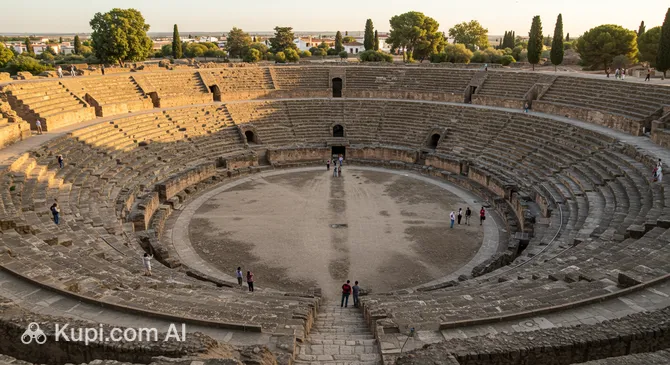
Archaeological Ensemble of Italica. Illustration.
Source: Kupi.com AI

Traveler photos:

Today, Italica is an extensive archaeological park where visitors can walk through ancient streets, examine the foundations of houses and public buildings, and admire the surviving elements of Roman architecture. It is a true journey through time, allowing you to imagine the bustling life of this thriving Roman settlement many centuries ago.

Special attention should be paid to the grand amphitheater of Italica—one of the largest in the entire Roman Empire. It could hold up to 25,000 spectators, which speaks to the scale and importance of the city. Although time has not been kind to many structures and the ruins are generally fragmentary, the majestic amphitheater still makes an indelible impression and remains the crown jewel of the complex.

Visiting Italica is not just about looking at old stones; it's a chance to feel the breath of history and learn more about Roman heritage on Spanish soil. This site is sure to interest lovers of antiquity, history, and anyone looking for a unique and memorable experience during a trip to Andalusia.

Contacts

To clarify information about visiting the Italica Archaeological Ensemble, including booking options, you can try using contact details found in open sources. However, as it's not always clear whether the phone numbers listed below belong to the official administration or private tour services, it is highly recommended to check the attraction's official website or contact tourist information centers in Seville for the most accurate and up-to-date information.

How to contactContact
AddressAv. Extremadura, 2, 41970 Santiponce, Sevilla, Spain
Phone number+34 600 14 17 67
Websitewww.museosdeandalucia.es

What to Do

Visiting the Italica Archaeological Ensemble is a true immersion into the atmosphere of the ancient Roman era. Walking through its ancient streets and observing the ruins, you can vividly imagine what the houses and public spaces once looked like and feel the rhythm of life in this prosperous city. For a deeper understanding of its history, there are information boards throughout the complex to help you decode Italica’s past and learn more about its famous residents and events.

One of the main highlights will undoubtedly be the exploration of the grand amphitheater. Its impressive size and well-preserved elements allow you to imagine the spectacles that took place here many centuries ago. This place literally breathes history, and standing in its arena or stands, it is easy to imagine yourself as a witness to gladiator fights or theatrical performances held within the walls of this ancient structure.

In addition to the amphitheater, other interesting finds await you at the Italica Archaeological Ensemble. Look out for the beautifully preserved mosaic floors that once decorated the homes of noble citizens, as well as the ruins of residential buildings and the remains of ancient thermal baths. Every detail here tells its own story, creating a unique atmosphere steeped in the spirit of Ancient Rome. For anyone interested in ancient history, this place will be a true discovery and provide unforgettable impressions.

Getting There

The Italica Archaeological Ensemble is located in the town of Santiponce, just 10–20 kilometers north of bustling Seville. This makes it an excellent destination for an educational day trip from the Andalusian capital. Although the complex is not in the very center, reaching it is quite straightforward if you plan your route in advance.

One of the most popular and budget-friendly ways to reach Italica is by bus. Regular buses run from Seville to Santiponce. For the latest information on route numbers, schedules, and departure points in Seville, it’s best to contact a local tourist information center. They can provide precise details and help you plan your journey.

If you prefer a faster and more comfortable mode of transport or are traveling in a small group, you can use taxi services. A trip from the center of Seville to the Italica Archaeological Ensemble will take approximately 20–30 minutes, depending on traffic conditions. This is a convenient option that saves time, though it is more expensive than public transport.

Nearest city: Seville

History & Facts

The history of the Italica Archaeological Ensemble dates back to antiquity. This ancient Roman city was founded in 206 BC on the initiative of the prominent general Publius Cornelius Scipio Africanus. During the Roman Empire, Italica reached its peak, becoming one of the key centers of Roman culture and influence on the Iberian Peninsula. It was during this period, under the reign of Emperor Hadrian between approximately 117 and 138 AD, that the grand amphitheater—the crown jewel of the complex today—was built.

However, like many great cities of antiquity, Italica could not escape decline. With the arrival of the Visigothic era, its glory began to fade, and during the Moorish rule, the city was eventually abandoned. For centuries, Italica lay deserted, and only thanks to the painstaking work of archaeologists, which began much later, was it possible to partially reconstruct its former grandeur and lift the veil of mystery from the lives of its inhabitants.

Today, the Italica Archaeological Ensemble stands as an important historical monument, offering a first-hand look at what a thriving Roman city looked like over two millennia ago. Many valuable artifacts discovered during excavations in Italica are carefully preserved in the Seville Archaeological Museum. This museum, founded in the second half of the 19th century, is rightfully considered one of the most prestigious archaeological institutions not only in Spain but in the world, and its collection perfectly complements the experience of visiting the ruins themselves.

Time Needed

When planning a visit to the Italica Archaeological Ensemble, you should set aside at least 2–3 hours for the tour. This is usually enough time to walk leisurely through the main sections of the ancient city, including the impressive amphitheater, and get a general sense of the scale of this historical site. However, if you have a deep interest in Roman history and archaeology, or simply enjoy thoughtfully exploring ancient ruins, you might need more time—up to half a day.

The duration of your visit will depend on several factors. Seeing the grand amphitheater, examining the remains of residential houses with their famous mosaics, and walking through the ancient streets all take time. If you want to carefully read the information boards, take photos, and simply soak in the atmosphere of this unique place, 2–3 hours will fly by. For a more superficial tour, 1.5–2 hours might suffice, but to truly appreciate the Italica Archaeological Ensemble, it's best not to rush.

Given that the complex is quite extensive and there is much to see, it is recommended to allocate a sufficient time block so that your immersion into the history of the ancient Roman city near Seville is comfortable and rewarding. This will allow you to fully enjoy the unique atmosphere and rich heritage of Italica.

Working Hours

The Italica Archaeological Ensemble is generally open to visitors year-round, but its opening hours may vary depending on the season (e.g., summer and winter schedules) and the day of the week. The complex may be closed or operate on a reduced schedule during certain holidays. Since specific opening hours and the need for advance ticket booking can change, it is highly recommended to check the most up-to-date information on the official website of the Italica Archaeological Ensemble or at tourist information centers in Seville before your trip.

Often, for visiting such popular historical sites—especially during the peak tourist season—it may be advisable to purchase tickets online in advance to avoid queues and guarantee entry. Checking official resources will help you plan your visit in the best way possible and find out about potential guided tours or special events held within the complex.

DayOpening hours
MondayClosed
Tuesday9:00 – 17:30
Wednesday9:00 – 17:30
Thursday9:00 – 17:30
Friday9:00 – 17:30
Saturday9:00 – 17:30
Sunday9:00 – 15:00

Nearby

A visit to the Italica Archaeological Ensemble is undoubtedly a highlight, but exploring Seville and its surroundings can make your trip even more fulfilling and memorable. By expanding your itinerary, you can dive deeper into the rich history and culture of Andalusia, discovering other unique sites located near this ancient Roman city.

Exploring nearby attractions will allow you to get a more complete picture of the region, seeing the contrasts and connections between different eras and cultural layers. Near the ancient Roman ruins, you will find both other historical monuments and modern entertainment centers, each interesting in its own way and well worth a visit.

NameDistance
Italica Amphitheatre0.2 km
Isla Mágica5.8 km
Sala Even6.2 km
Kaminature Aquarium6.6 km
Alameda de Hércules6.7 km
Espacio Eslava6.7 km
Dos de Mayo Bar6.9 km

Have you reached the end of the page?

So the route has been studied inside and out