Support

Plaza de España

About

The Plaza de España (Plaza de España) is one of the most impressive and recognizable architectural ensembles not only in Seville but in all of Spain. This grand complex, located in the famous Maria Luisa Park, consists of a vast semi-circular square crossed by a picturesque canal with ornate bridges. This place is rightfully considered a jewel of Andalusian architecture and a must-visit for all guests of the city.
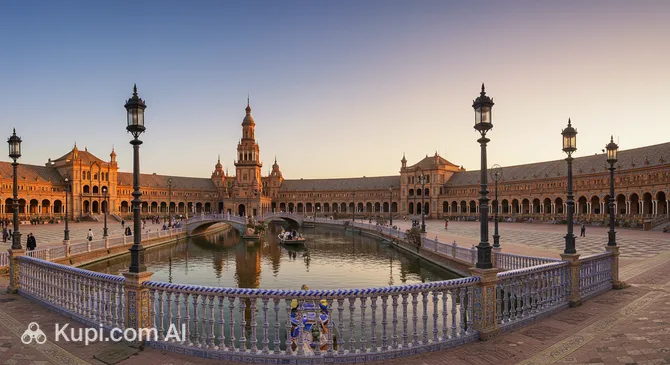
Plaza de España. Illustration.
Source: Kupi.com AI

Traveler photos:

The project was designed by the famous Spanish architect Aníbal González for the Ibero-American Exposition of 1929. At the center of the composition is a majestic palace whose facade combines Baroque and Renaissance styles. Two elegant towers rise at the ends of the square, connected by galleries with semi-circular arches, and a large fountain is located in the center. The architectural style combines the grandeur of the Renaissance with typically Sevillian elements.

One of the most memorable details of the square is the painted tile benches (azulejos), each dedicated to one of the provinces of Spain. Here you can take a journey across the country by looking at the coats of arms, maps, and iconic historical events of each region. The decoration of the buildings harmoniously combines brick, bright ceramics, and wrought iron, creating a unique and colorful appearance beloved by both locals and tourists.

Contacts

Plaza de España is an open public space, so it does not have a single contact center like a museum or a theater. Access to the square is free and open 24/7, although Maria Luisa Park, through which it is convenient to reach the square, may close at night. For the latest information on events or temporary restrictions, it is best to check the official tourism portal of Seville.

The square is located at: Avenida de Isabel la Católica, 41004, Seville. You can reach it on foot from the city center, by public transport to the Prado de San Sebastián stop, or by tourist bus. To contact the city's tourism office, which can provide additional information, you can use the following contact details:

How to contactContact
AddressAv. Isabel la Católica, 41004 Sevilla, Spain
Websitewww.andalucia.org

What to Do

At the Plaza de España, everyone will find something to their liking while enjoying the splendor of the architecture. Visitors can stroll leisurely along the galleries with elegant semi-circular arches and admire the central fountain. The famous painted tile benches, each dedicated to one of the provinces of Spain, attract special attention. This is a unique opportunity to take a symbolic journey across the entire country by studying the coats of arms and maps of the regions.

For more active recreation, you can rent a boat and take a short trip along the picturesque canal surrounding the square. This is one of the most popular activities, which provides unforgettable impressions and allows for beautiful photographs. You can also simply relax by the fountain, enjoying the sunny weather and the atmosphere of this historic site. The central building with exhibition pavilions is open to the public, where various exhibitions are periodically held.

Plaza de España is a wonderful starting point for exploring the cultural heritage of Seville. In the immediate vicinity are the Archaeological Museum of Seville and the Museum of Arts and Traditions, which will introduce you to the history and traditions of the region. Also nearby is the monumental building of the former Royal Tobacco Factory, which now houses the rectorate of the University of Seville.

Getting There

Getting to the Plaza de España is quite simple, as it is located in the famous Maria Luisa Park, near the historical center of Seville. If you are in the area of the Cathedral or the Alcázar, a pleasant walk to the square will take about 15–20 minutes. The route passes through picturesque streets and gardens, which is a great opportunity to get to know the city in itself.

The most convenient way to get there by public transport is to use the metro or tram. The nearest metro station to the square is Prado de San Sebastián, located on line L1. This station is a major transport hub. The T1 tram line also stops here, connecting the city center (Plaza Nueva stop) with the San Bernardo station. After getting off at the Prado de San Sebastián stop, you will be just a few minutes' walk from the entrance to the park and the square itself.

In addition, the square is easily accessible by bus. The Prado de San Sebastián stop serves many city routes, including C1, C2, 34, 37, and others. You can also take a bus to the "Avenida La Borbolla" stop, located in the immediate vicinity. For those who prefer comfort, taxis or ride-hailing services are always available to quickly bring you from any point in the city. Another popular option for tourists is the Hop-On Hop-Off double-decker sightseeing buses, one of whose routes always includes a stop at this iconic landmark.

Nearest city: Seville

History & Facts

The history of the Plaza de España is inextricably linked to one of the largest events in the history of Seville — the Ibero-American Exposition of 1929. This grand project, conceived as the central structure of the exhibition, was commissioned in 1914 by King Alfonso XIII. According to the vision of the chief architect, Aníbal González, the ensemble was to demonstrate the greatness of Spain and strengthen its ties with former American colonies. The very shape of the square is full of symbolism: a vast semi-circle 200 meters in diameter personifies the embrace with which the country meets the peoples of Latin America, and its orientation toward the Guadalquivir River points to the route that once led to the New World.

Architect Aníbal González sought to create a masterpiece that would reflect the "Golden Age" of Spanish history while using modern approaches of his time. As a result, the square became a unique example of a blend of several styles: the grandeur of the Renaissance and elements of the then-popular Art Deco are harmoniously intertwined with Neo-Mudéjar — a style characteristic of Andalusia that uses Moorish motifs. Traditional regional materials were used in construction and decoration: shaped brick, bright ceramic tiles (azulejos), and elegant wrought iron created under the guidance of master Domingo Prida.

The square is filled with many hidden details and interesting facts. For example, the four bridges crossing the canal symbolize the four ancient kingdoms from which a unified Spain was formed: Castile, León, Aragon, and Navarre. It was originally planned that after the exhibition, the main building would house a university, but it was ultimately occupied by government offices, including the Seville City Hall. Furthermore, due to its cinematic quality, the square has repeatedly served as a filming location for Hollywood movies, including the famous scene from the "Star Wars: Episode II – Attack of the Clones" saga, where it appeared as the planet Naboo.

Time Needed

When planning a visit to the Plaza de España, it is worth setting aside 1.5 to 2 hours to fully enjoy its atmosphere and architectural details. This time will be sufficient for a leisurely stroll along the semi-circular building, viewing the central fountain, and examining the famous ceramic panels dedicated to the provinces of Spain. If you just want to quickly see the square and take a few photos, 30-40 minutes might be enough, but you risk missing many interesting details.

The time you spend at the square largely depends on your interests. If you want to examine each of the 48 azulejo niches representing the country's provinces in detail, this alone could take about an hour. Photography enthusiasts will find countless angles here, especially in the morning or evening hours when the light is most favorable. Additionally, you can add a boat trip along the picturesque canal to your visit, which will take another 20-30 minutes. Since the square is part of the large Maria Luisa Park, many visitors combine their tour with a walk through its shaded alleys, which also increases the total time spent in the area.

Working Hours

Plaza de España is a public space open to visitors all year round. Entry to the square itself is free, and no prior ticket booking is required. However, it is worth noting that the square is part of Maria Luisa Park, which has its own opening hours. As a rule, the park is open to visitors daily from 8:00 AM to 10:00 PM, so it is best to plan your actual access to the square during this time.

It is important to note that recently, the city authorities of Seville have been discussing the possibility of introducing a paid entrance for tourists to raise funds for the maintenance and restoration of this iconic site. Although entry remains free at the moment, rules may change. Therefore, before your trip, it is strongly recommended to check the most up-to-date information regarding opening hours and possible changes on the city's official tourism portal or other reliable sources.

8:00 – 12:00

Nearby

A visit to the magnificent Plaza de España is just the beginning of your acquaintance with the treasures of Seville. Thanks to its location at the heart of the city's cultural life, you will be within walking distance of many other iconic places that will help you gain a deeper understanding of the history and atmosphere of the capital of Spain.

Exploring the surrounding area will enrich your journey with new impressions. A walk through the shaded alleys of neighboring parks, a visit to ancient palaces, or an introduction to unique museum collections — all this will allow you to form a more complete picture of this amazing Andalusian city. Below is a list of attractions located in the immediate vicinity.

NameDistance
Royal Alcázar of Seville0.7 km
Seville Aquarium0.8 km
Puerta de Jerez0.9 km
Tower of Gold1 km
General Archive of the Indies1 km
Bar Postiguillo Tapas1.2 km
Filo1.3 km

Have you reached the end of the page?

So the route has been studied inside and out