Support

Barrio de Triana

About

Crossing the majestic Bridge of Isabella II, you enter the Triana District — the most authentic and colorful place Seville has to offer. This historic neighborhood on the right bank of the Guadalquivir is a world away from the formal city center, with its narrow cobbled streets, multi-colored facades, and ornate wrought-iron balconies.
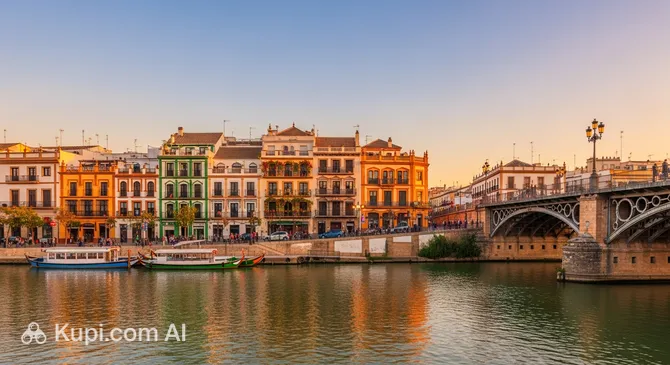
Triana District
Triana District. Иллюстрация. Источник: Kupi.com AI

Triana is rightfully considered the cradle of flamenco culture and traditional crafts. For centuries, this part of Spain was home to sailors, potters, and Roma communities. To this day, the "corrales" — historic communal houses with shared inner courtyards where many legendary traditions of the Andalusia region were born — have been preserved here.

The main symbols of the district are the famous Church of Santa Ana, built back in the 13th century, and the ruins of San Jorge Castle, which once served as the headquarters of the Inquisition. Today, Triana is a living open-air museum, where a bustling local market sits alongside cozy ceramic workshops, and the air is filled with the aroma of fried fish and the sounds of guitar strumming.

Contacts

To plan a visit to specific cultural centers in the district, you can use the following address. Please note that there is no single official website for the entire residential neighborhood, so it is best to check with the city's tourist offices for details.

How to contactContact
AddressC. San Jacinto, 10-16, 41010 Sevilla, Испания

What to Do

Start your exploration of the district with a visit to the Triana Market (Mercado de Triana). It is the perfect place to get an insider's view of city life: the stalls here are overflowing with fresh seafood and vibrant vegetables, while small shops sell the famous local ceramics. Be sure to stop by the pottery workshops to pick up a unique handmade souvenir decorated with traditional patterns.

Foodies should head to the waterfront or deeper into the neighborhood to try pescaíto frito (assorted fried fish) and the refreshing tinto de verano. Triana is the birthplace of flamenco, so the best way to spend an evening is at one of the local "tablaos," where dancing and singing are performed with special passion and authenticity, far from the overly touristy routes.

Don't forget to take time for the architectural landmarks: cross Spain's oldest iron bridge, see the Chapel of El Carmen with its recognizable dome, and visit the Cartuja Monastery, which now houses a contemporary art center. And if you find yourself here at sunset, stop in the middle of the Bridge of Isabella II — at this time, the city is painted in incredible golden tones, reflected in the waters of the Guadalquivir.

Getting There

This picturesque corner is located on the right bank of the Guadalquivir River. The most pleasant and popular way to get here from the historic center is on foot. The walk from Seville Cathedral or the Alcázar across the Bridge of Isabella II takes only 10–15 minutes, offering magnificent views of the waterfront along the way.

If you prefer public transport, take tram line T1 to the Plaza de Cuba stop or buses C1, C2, C3, and C4. You can also take the metro (Line 1) to the Plaza de Cuba or Nervión station (with a subsequent transfer). A special EA bus runs from the city's airport, taking you to the center, from where the district is an easy walk away.

For those who value comfort, taxis are always available. The main landmark for a driver or navigator is C. San Jacinto, 10-16. Please note that the streets inside the district itself are very narrow, and parking spaces are extremely difficult to find, so exploring on foot remains the best solution.

Ближайший город: Seville

History & Facts

The history of this place dates back to the era of Ancient Rome, but its true flourish began under Arab rule, when a castle was built here to serve as a western defensive outpost. Later, from 1481 to 1785, this same fortification — San Jorge Castle — became the somber residence of the Inquisition tribunal. Today, you can visit a museum on its ruins that tells the story of those difficult times.

Traditionally, the district was considered the home of craftsmen, sailors, and Roma communities. It was here that unique techniques of Andalusian ceramics, such as "Cuerda Seca," were born. In the 15th century, the Italian Francesco Nicoloso Pisano brought new trends to local workshops, revolutionizing the production of the tiles that decorate Spain's finest palaces today.

The Bridge of Isabella II, built in the mid-19th century, deserves special attention. It is the oldest surviving iron bridge in the country and is recognized as a national monument. Walking across its spans, it's hard not to think of Rodrigo de Triana — a local sailor who, according to legend, was the first to see the shores of the Americas during Columbus's expedition.

The spiritual heart of the quarter remains the Church of Santa Ana, built in the 13th century. It combines features of early Gothic and Mudéjar styles. There is a local belief that children baptized within the walls of this church are destined to possess an outstanding talent for flamenco — an art form that is practically in the air here.

Time Needed

To simply soak up the atmosphere of the neighborhood, peek into the market, and walk along the waterfront, you will need about 2 hours. This is enough time for a leisurely look at the main squares and a cup of coffee with a river view.

If your plans include visiting the Ceramics Museum, exploring the ruins of San Jorge Castle, and visiting the Church of Santa Ana, you should set aside 4 to 5 hours. A full immersion, including lunch at one of the local taverns and an evening flamenco show, will turn your walk into a fascinating day-long journey.

Working Hours

As the Triana District is a residential city neighborhood, it is open for visiting 24/7 every day. You can wander its streets at any time, enjoying a morning coffee or the festive evening atmosphere.

However, individual sites have their own schedules. For example, the Church of Santa Ana is typically open from 10:00 to 14:00 and from 17:00 to 20:00, and the local market is most active in the first half of the day. To visit the Ceramics Museum or exhibitions at the Cartuja Monastery, it is recommended to check their official pages in advance, as opening hours can change depending on the season and holidays.

Круглосуточно

Nearby

Exploring the surroundings of the Guadalquivir allows you to see the city from different perspectives — from ancient monasteries to modern theme parks. After a stroll through the authentic streets, you can easily reach popular family locations and exhibition pavilions.

NameDistance
Seville Apartments0.2 km
Plaza de Toros de la Maestranza0.4 km
Tower of Gold0.7 km
Bar Postiguillo Tapas0.7 km
Puerta de Jerez0.9 km
General Archive of the Indies0.9 km
Museum of Fine Arts of Seville0.9 km

Reached the end of the page?

That means the route is fully explored