Support

Seronera Airstrip

About the Airport

Imagine your plane landing not on the concrete runway of a metropolis, but on a landing strip in the very heart of the African savannah, where instead of buildings, you are surrounded by acacia trees, and the first to greet you might be a passing giraffe. These are precisely the impressions offered by Seronera Airstrip — the aerial gateway to the legendary Serengeti National Park. This is not merely a transport hub, but the beginning of your unforgettable safari adventure in Tanzania.
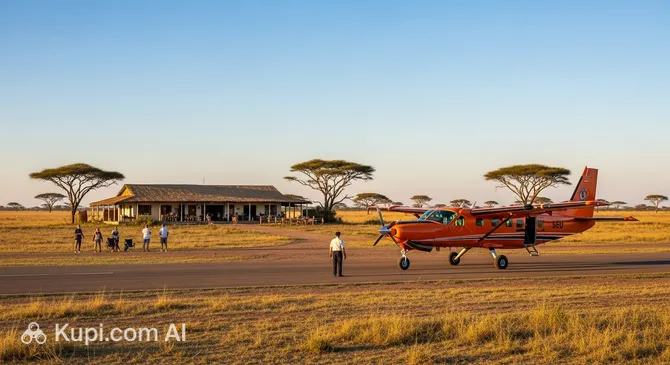
Seronera Airstrip. Source: Kupi.com Binoculars
IATA Code SEU
ICAO Code HTSN
City Seronera
Distance to Centre Located in the central part of the park
Status Domestic
Passengers per Year Approximately 150,000
Popular Airlines Auric Air, Coastal Aviation, Regional Air, Flightlink, Safari Air Link

The main advantage of Seronera airstrip is its strategic location. It is situated in the central part of the Serengeti Park, known as the Seronera Valley, which is famous for its high concentration of wildlife year-round, especially predators. By landing here, you save many hours of tiring travel from Arusha and immerse yourself in the world of wildlife almost immediately.

The flight itself on a small plane designed for safari is already part of the adventure. From a bird's eye view, breathtaking vistas of endless plains open up, and sometimes you can spot herds of zebras or wildebeests right from the window. It is worth noting that this is a typical bush airstrip: do not expect terminals with Duty-Free shops here. The infrastructure is minimal and functional — a small building for waiting and a runway. Everything is subordinated to one goal: to deliver you as quickly and safely as possible to the start of your African safari.

Contact Information

It is important to understand that Seronera Airstrip (SEU) is a small airfield primarily serving charter and safari flights in the heart of the Serengeti National Park in Tanzania. It does not have the infrastructure and centralised services of major international airports. All coordination usually takes place through airlines or tour operators.

  • Official Airport Website: Seronera airstrip does not have its own official website. Information about flights, schedules, and rules should be sought on the websites of the airlines operating flights (e.g., Coastal Aviation, Auric Air, Regional Air).
  • Help Desk Phone: There is no direct public telephone line for the airstrip. To resolve all flight-related issues, it is recommended to contact your airline or your travel agent directly.
  • Airport Address: Seronera Airstrip (SEU), Serengeti National Park, Tanzania. The airstrip is located in the central part of the Serengeti Park, close to the main lodges and camps of the Seronera area.
  • Email: There is no public email address for general inquiries. Communication is conducted through air carriers.
  • Airport Social Media: The airstrip does not maintain official pages on social networks.
  • Lost Luggage Information: Issues related to lost or damaged luggage are resolved exclusively by representatives of the airline you flew with. Please contact your carrier's support service.
  • Passenger Support Contacts: Passenger support is also provided by the airlines operating flights to Seronera. Please contact them for assistance.

How to Get to the Airport

Seronera Airstrip (SEU) is located in the very heart of the Serengeti National Park in Tanzania, making it a unique transport hub. It is important to realize that this is not an ordinary city airport, and access to it differs fundamentally from the methods we are used to. There is no public transport here, such as buses or trains. All movements are connected with safaris and are organised in advance.

The most common and convenient way to get from the runway to your lodge or camp is a pre-booked transfer. As a rule, upon arrival, a representative of your hotel or safari company will already be waiting for you in a 4x4 off-road vehicle. This service is almost always part of your travel package. The journey from the airstrip to your accommodation in the Seronera area becomes a mini-safari in itself, as you will almost certainly encounter wild animals along the way. Travel time can vary from 15 minutes to an hour or more, depending on the remoteness of your camp.

Car rental for self-driving is theoretically possible but comes with a number of difficulties. You will need a reliable 4x4 vehicle, off-road driving experience, and excellent navigation skills. Additionally, all park fees must be paid. A much more popular and safer option is to rent a car together with a driver-guide. This not only relieves the stress of navigating the savannah but also significantly increases your chances of seeing animals, as local guides know the territory and the habits of its inhabitants perfectly.

As for taxis in the classic sense, such a service does not exist at Seronera Airstrip. You will not be able to hail a car upon arrival. All transport services must be organised in advance through your tour operator or lodge. The cost of the transfer is usually included in the total price of the safari tour. If booked separately, the price will be quite high, as it includes not only transportation but also park fees for the vehicle.

Parking at the airstrip consists of a simple dirt area where safari jeeps wait for arriving tourists. It is not a guarded car park and is not intended for long-term storage of private vehicles. The main advice for all travellers arriving in Seronera is to coordinate all details of your arrival and departure with your safari operator. This will ensure a comfortable and hassle-free start and end to your adventure in the Serengeti.

Terminals and Map

When speaking of the airport in Seronera, it is important to understand that this is not a standard major aviation hub, but rather a busy airstrip in the very heart of the Serengeti National Park. Its main task is to receive and dispatch small planes delivering travellers on safari. Therefore, its structure is as simple and functional as possible, which is part of the authentic African adventure.

Seronera Airstrip (SEU) consists of one small terminal building. There is no division into Terminals 1, 2, or 3 here, as in major metropolises. Everything happens in one place. This building is more like a pavilion or a spacious lobby where passengers wait for their flights. Inside, there is usually a waiting area with benches, a small counter where check-in takes place, and possibly a small shop with souvenirs and beverages.

The scheme of the airstrip is extremely simple: a runway and the adjacent terminal building. Departure and arrival zones are not actually separated. Arriving passengers are met by representatives of their lodges or safari guides right at the plane or in the building. Departing passengers check in for their flight and wait for boarding in the same hall. It is practically impossible to get lost here, as everything is within direct line of sight.

Check-in and control procedures here are very quick and have a less formal character than in large airports. You will not have to stand in long queues. Usually, check-in consists of checking your name against the passenger list and weighing luggage, which takes only a few minutes. The main waiting time is for the arrival of your plane.

The main advice for navigation is to relax and enjoy the atmosphere. Listen carefully to announcements from airline representatives or pilots, who often personally collect their passengers. This is not a place where you need to worry about complex transfers or finding the right boarding gate. Everything is intuitive and is an integral part of your unforgettable journey through Tanzania.

Airport History

The history of Seronera (SEU) airstrip is not a tale of constructing a gigantic transport hub, but rather a chronicle of the development of safari tourism in the heart of Africa. This airstrip does not have an exact founding date, as it grew organically from a simple landing strip initially used by park rangers and researchers. Its history is inextricably linked with the development of the Serengeti National Park, when, with the growing popularity of this destination in the mid-20th century, an urgent need arose for the fast and convenient delivery of travellers to the central part of the reserve.

The main stages of the airstrip's development lay not in large-scale construction projects, but in the gradual improvement of infrastructure to accommodate the growing number of small tourist aircraft. Initially, it was simply a cleared dirt strip. Over time, it was strengthened and levelled to ensure the safety of landings at different times of the year. A modest "terminal" building also appeared — essentially a small pavilion where tourists can shelter from the sun while waiting for their flight or transfer to a lodge. The main historical event for the airstrip was its transformation into one of the busiest safari airstrips in Tanzania, making the wonders of the Serengeti accessible to thousands of travellers from all over the world.

The main achievement of Seronera airstrip is its key role in the tourism ecosystem. It does not break records for passenger traffic on a global scale, but it is a vital artery feeding the region's economy and allowing for unforgettable journeys with minimal impact on the environment. An interesting fact: there are no usual fences or barriers here. Often, grazing zebras, giraffes, or antelopes can be seen right next to the runway, which immediately immerses arrivals in the atmosphere of the wild. Landing at Seronera is in itself the beginning of an adventure, with breathtaking views of the endless Serengeti plains from the window.

Services and Facilities

Seronera Airstrip (SEU) is, in essence, a runway in the very heart of the Serengeti National Park, designed to serve tourists arriving for safaris. It is important to understand that this is a small airstrip, not a major international airport, so the range of services here is basic and corresponds to its main task — the fast and convenient delivery of travellers to their lodges and the start of their adventures.

In the modest terminal building, you will find a small café offering refreshments and light snacks, as well as a souvenir shop with works by local artisans. The waiting area here is simple, often semi-open, allowing passengers to enjoy the views and sounds of the savannah before departure. There are no specialised business or VIP lounges at the airstrip.

Technical amenities are extremely limited. Wi-Fi is generally unavailable, and the number of sockets for charging devices is minimal. It is recommended to have a fully charged portable power bank with you. Banking services, including ATMs and currency exchange points, are not provided here. All financial transactions are best completed in advance in major cities such as Arusha.

Passengers with children and people with disabilities should take into account that specialised facilities (mother and child rooms, ramps, special toilets) are absent. For comfortable movement and boarding the plane, it is necessary to arrange assistance in advance with representatives of your airline or safari operator. Basic first aid may be available at the airstrip, but a full medical centre is not provided.

There are no hotels on the territory of the airstrip itself. The nearest accommodation options are the numerous safari lodges and camps located within the Serengeti Park, to which transfers are organised from the landing strip. Conference halls and other business services are completely absent here, as the airstrip is oriented exclusively towards tourism.

Where to Eat

When planning a departure from Seronera Airstrip (SEU), it is important to understand that this is not a large international airport, but a small airfield located in the very heart of the Serengeti National Park. Its infrastructure is created for the functional service of tourists travelling on safari, so dining options here are very limited and differ significantly from those offered by large aviation hubs.

There are no restaurants, cafes, or bars in the usual sense on the airstrip territory. As a rule, one or two kiosks operate in the small terminal building. In them, you can purchase basic items for a snack: bottled water, carbonated drinks, juices, as well as packaged snacks such as chips, biscuits, or nuts. Hot meals or freshly prepared food are not offered here.

Due to the limited assortment, it is practically impossible to find options for special dietary needs (vegetarian, vegan, gluten-free, or specific Halal meals) at the airstrip itself. Travellers with strict dietary restrictions are strongly advised to bring food with them. Having a full lunch or dinner before departure will also not be possible — the restaurant of your safari lodge is best suited for this. Many hotels offer their guests packed lunches (lunch boxes), which is the most convenient solution.

Thus, the best advice for travellers flying out of Seronera is to plan your meals in advance. Eat at the lodge before the transfer to the airport or ask for food to be prepared for your journey. The airstrip should be viewed exclusively as a point of departure, and not a place for gastronomic discoveries or long waits in comfort.

Traveller Tips

Travelling through Seronera airstrip is an adventure in itself and an important part of your safari. To ensure everything goes smoothly, it is worth considering a few features of this unique place. Unlike major international airports, everything here is simpler and more atmospheric. We recommend arriving at the airstrip approximately 60-90 minutes before departure. This time will be more than enough to complete all formalities without rushing.

The check-in and control procedure here is significantly simplified. Instead of the usual counters, you will most likely be met by an airline representative with a passenger list. The main attention is paid to weighing luggage, as flights are operated on small planes with strict weight restrictions (usually up to 15 kg per person, including hand luggage). Use soft bags rather than hard suitcases. Security control is minimal, but standard rules for carrying liquids and sharp objects are best observed. And remember, there is a ban on plastic bags in Tanzania, so ensure there are none in your luggage.

When boarding the plane, seats are generally not assigned. Passengers take seats on a first-come, first-served basis, or the pilot asks you to take specific seats for the correct balancing of the aircraft. Try to take a window seat — the views of the savannah and wild animals from a bird's eye view are simply unforgettable! Essentially, a beautiful view opens up from any seat, but it will be best by the window.

If you have a transfer to another flight planned, do not worry. The process is very simple: you get off one plane and wait for boarding the next in a small waiting area. Be sure to clarify details with ground staff or the pilot. It is important to understand that Seronera Airstrip serves only domestic flights, so customs control is absent here. You will go through all customs and immigration formalities at the international airport of arrival in the country (for example, in Kilimanjaro or Dar es Salaam).

Flight delays at safari airstrips are not uncommon. The reason could be weather, waiting for connecting passengers, or even animals on the runway. Remain calm and patient. Amenities in the airstrip building are minimal, so bring a book, a charged power bank, and a bottle of water with you. You can save money by bringing light snacks with you, as the selection on-site will be limited and expensive. The main advice is to treat everything as part of an unforgettable African adventure.

Reached the end of the page?

That means the route is fully explored