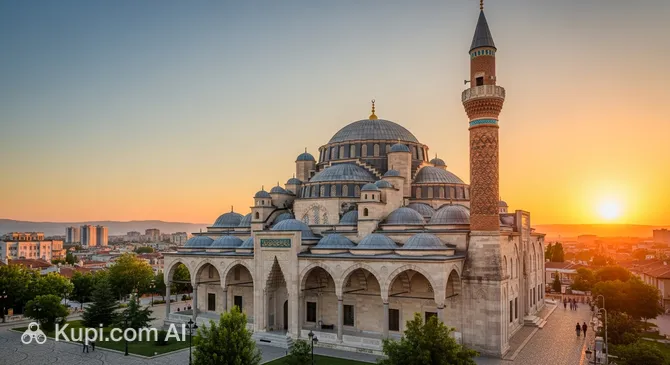
One of the most striking architectural gems that ancient Siirt has to offer is the Great Mosque (Ulu Cami). It is more than just a place of worship; it is a monumental landmark from the Great Seljuk era, embodying the austerity and grandeur of early Islamic art in Turkey. Its appearance is a living testament to the region's rich history, where every stone is steeped in the spirit of antiquity.
Great Mosque of Siirt. Illustration.
Source: Kupi.com AI
Traveler photos:
The mosque's main visual symbol is its unique leaning minaret. Due to its noticeable tilt from the vertical axis, it is often called the "Leaning Tower of the East." Built of brick and decorated with intricate masonry, the minaret gives the entire complex a distinctive silhouette, recognizable far beyond the city. The architecture of the building itself follows the canons of early Anatolian mosques, with a characteristic division of the prayer hall into aisles and an emphasis on the central axis.
Visitors appreciate this site for its authenticity and the chance to touch the legacy of the Seljuk era. Inside, the mosque impresses with its simplicity and an atmosphere of deep tranquility, while its layout with transept elements brings to mind the great structures of Diyarbakir and Damascus, making it an important point on the region's cultural map.
Contacts
To plan your visit to this architectural monument, it is useful to have the exact coordinates on hand. Since the site is an active mosque, there may not be a dedicated inquiry phone number, but it is easy to find in the very center of the historic district.
The highlight of visiting this site is undoubtedly seeing the famous leaning minaret. Travelers often spend time finding the best angle for a photo to capture its unusual tilt, reminiscent of famous European monuments. Studying the complex brickwork and decorative patterns on its surface allows you to appreciate the skill of ancient architects.
Inside the building, the layout of the prayer hall is worth noting. Walking beneath the mosque's vaults, you can see how the arcades support the ceilings, creating a rhythmic spatial pattern. History buffs will be interested in studying the mihrab area and the domed structures, which were added in later periods and reflect changes in architectural tastes and technologies.
The area surrounding the mosque is conducive to quiet contemplation. Here you can take a break from the city bustle, observing the daily life of locals, for whom Ulu Cami remains an important spiritual center. It is an ideal place to feel the slow rhythm of the historical part of the city and enjoy moments of silence in the shadow of ancient walls.
Getting There
Getting to this iconic location is easy, as it is located in the heart of the city of Siirt at Karakol, 56100 Siirt Merkez. Thanks to its central position, the mosque is within walking distance of most of the city's administrative buildings and markets.
If you are arriving from other regions via Siirt Airport, a taxi ride to the center will take about 20–30 minutes (a distance of approximately 15–20 km). You can also use local buses or minibuses (dolmuş), which run regularly between the airport and the central districts. From the main bus station (Siirt Otogar), the trip by public transport will take no more than 15 minutes.
For those who prefer to travel by car, you can use the coordinates 41.945386, 37.925153. There are parking areas near the mosque, though traffic in the center can be quite heavy during the day, so walking is often the most pleasant way to experience the local flavor.
Nearest city: Siirt
History & Facts
This majestic structure is one of the rare surviving examples of Great Seljuk architecture in Anatolia. Its history is inextricably linked to the early stage of Islamic architecture's spread in the region, when masters drew upon the traditions of the famous Great Umayyad Mosque in Damascus. Architecturally, the building echoes the features of the Ulu Cami in Diyarbakir, built at the end of the 11th century.
During the reign of the Artuqids, the mosque underwent significant changes. It was then that a massive dome over the mihrab area was included in the layout, with a diameter exceeding 10 meters. This innovation was an important milestone in the development of the Anatolian style, marking the transition from simple flat ceilings to more complex and grand spherical forms that became the dominant feature of the interior space.
The brickwork of the minaret is of particular value, demonstrating the superior skill of Seljuk builders. Over the centuries, this mosque has become more than just a religious center; it is a true history textbook, tracing the evolution of Islamic architecture from Syrian courtyard types to classic Turkish basilicas.
Time Needed
To leisurely explore the interior of the mosque, study the details of its famous minaret, and take atmospheric photos, 1–2 hours is usually enough. This is sufficient time to feel the tranquility of the ancient walls and observe the play of light in the prayer hall.
If you also plan to stroll through the adjacent streets of the old city or browse local shops, it’s worth setting aside a bit more time—about half a day. It is best to visit between prayer times to be able to quietly view the interior decorations without disturbing worshippers.
Working Hours
As the Great Mosque of Siirt is an active religious site, it is open to visitors daily. Access inside is usually possible from early morning until late evening, though the prayer schedule (salah) should be taken into account. Tourists are recommended to visit between prayers to freely explore the interior.
Official visiting hours for tours may vary, so it is advisable to check current information on-site or through the city's official tourism resources before visiting. Remember to observe the dress code when entering the sanctuary.
Nearby
Exploring the central districts of Siirt isn't limited to just the mosque. A walk through the surrounding area will allow you to dive deeper into the local culture and see how history intertwines with the city's modern life.