Support

Diyarbakir Castle

About

The majestic Diyarbakir Fortress is one of the most magnificent defensive structures in the world, located in Turkey. Rising on the steep bank of the Tigris River, this ancient citadel serves as the historical heart of the city of Diyarbakir and is a recognized masterpiece of fortification art.
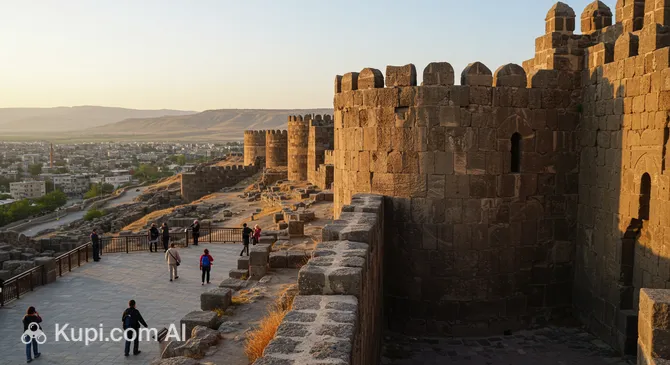
Diyarbakir Fortress
Diyarbakir Fortress. Иллюстрация. Источник: Kupi.com AI

One of the main features of the fortress is the material from which it was built. The use of local basalt gives the walls a characteristic dark hue, which is why the fortification is often called "Kara Kale" or the "Black Fortress". Together with the adjacent Hevsel Gardens, this site is included in the UNESCO World Heritage list, highlighting its exceptional cultural value.

The scale of the construction is staggering: the total length of the massive city walls is more than 5.8 kilometers. Along the way, you can find numerous towers, fortified gates, and dozens of historical inscriptions left by rulers of different eras. It is not just an architectural monument, but a living witness to the succession of civilizations in Upper Mesopotamia.

Contacts

For those planning a visit to this historical complex, it's helpful to have up-to-date contact information on hand. Although the Diyarbakir Fortress is an open monument, general administrative inquiries can be handled through official channels.

How to contactContact
AddressCevat Paşa, Karaman Sk. No:60, 21300 Sur/Diyarbakır, Türkiye
Phone+90 412 224 67 40

What to Do

Walking along the impressive city walls is a must for every visitor. While exploring the towers and ancient gates, you will be able to see unique bas-reliefs and inscriptions that decorate the masonry. From the heights of the defensive lines, breathtaking panoramic views of the city and the winding ribbon of the Tigris River unfold.

Inside the fortress complex itself, many treasures are hidden. Be sure to visit the Great Mosque (Ulu Camii), built on the site of an ancient Byzantine church. Its architecture, combining elements from different eras, makes a strong impression, especially after extensive restorations that preserved the spirit of the Seljuk period.

It is equally interesting to descend to the Hevsel Gardens. These fertile lands have provided the city with food and water for thousands of years. Today, a walk through the gardens allows you to feel the connection between the man-made grandeur of the fortress and the natural harmony of the river valley, creating a complete impression of visiting this UNESCO site.

Getting There

Reaching the historical center of the city, where the fortress is located, is quite straightforward. The site is situated in the Sur district, which is the historical core of the city. Municipal buses and shared taxis, known as dolmuses, run from most districts and stop in the immediate vicinity of the main gates.

If you prefer comfort, the fastest way is by taxi. The journey from central residential areas or from the airport takes a relatively short time. Simply tell the driver "İç Kale" or "Dağ Kapı" to be dropped off at one of the key entrances to the fortress complex.

Ближайший город: Diyarbakir

History & Facts

The history of this site is rooted in deep antiquity, long before the Romans erected powerful fortifications here in the 4th century AD to protect their eastern frontiers. However, even earlier, in 77 BC, the Armenian King Tigranes the Great planned to make this place the center of his empire, establishing the capital of Tigranocerta here.

Over the centuries, the fortress changed hands many times, absorbing features of Hellenistic, Roman, Sassanid, and Byzantine cultures. The Byzantine period left behind the İç Kale citadel, which later became the core for subsequent Islamic and Ottoman reconstructions. The city walls literally serve as a stone chronicle of the region, preserving traces of repairs and reinforcements from many eras.

A turning point was the Arab conquest in 639. It was then that the construction of the first mosque began on the site of the Orthodox Church of St. Thomas the Apostle. The current appearance of the legendary Great Mosque (Ulu Camii) was finally formed under the Seljuk Sultan Malik-Shah, marking the beginning of a new chapter in the history of this majestic "black city."

Time Needed

To fully appreciate the scale and detail of this colossal structure, we recommend setting aside at least 3–4 hours for your visit. The fortress walls are quite extensive, and a thoughtful exploration of the main towers and gates, combined with studying the historical inscriptions, takes time.

If you plan to include a visit to the Great Mosque and a walk through the Hevsel Gardens in your itinerary, it is better to allocate half a day or even a full day to get to know the complex. This will allow you not only to see all the architectural monuments but also to enjoy the atmosphere of the ancient city without rushing.

Working Hours

Access to the architectural complex is open to visitors daily. The standard operating schedule allows you to plan your visit in both the morning and afternoon hours to catch the soft pre-sunset light on the basalt walls.

Diyarbakir Fortress is open from 08:30 to 18:30, Monday through Sunday. Please note that the opening hours of individual exhibitions or mosques within the complex may differ slightly from the general schedule for the walls.

8:30 – 18:30

Nearby

Exploring the surroundings of the fortress walls can significantly enrich your travel experience. Many iconic sites are within walking distance, forming a single historical route that reveals different facets of life in this ancient region.

NameDistance
Diyarbakır Archaeological Museum0.2 km
Mountain Gate0.4 km
Diyarbakır City Walls0.4 km
Sülüklü Han0.5 km
Hasan Pasha Caravanserai0.5 km
Hurrem Sultan Mansion0.5 km
Cahit Sıtkı Tarancı Museum0.5 km

Reached the end of the page?

That means the route is fully explored