Support

Diyarbakır Walls

About

Imagine a monumental ring of dark stone that has reliably guarded the peace of an ancient settlement for centuries. Diyarbakir is proud of its main treasure — the Diyarbakir City Walls. This unique fortification system in Turkey is recognized as one of the largest and most significant UNESCO World Heritage sites.
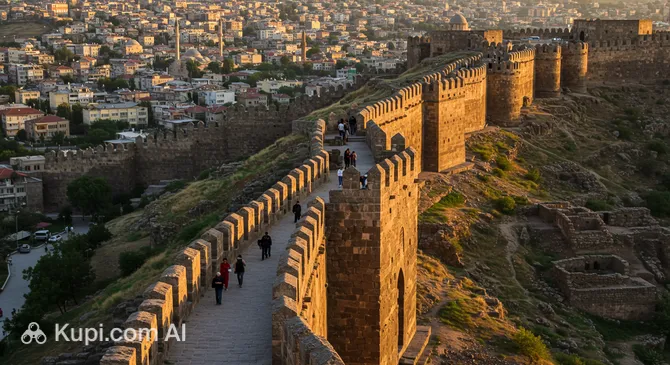
Diyarbakır City Walls
Diyarbakır City Walls. Иллюстрация. Источник: Kupi.com AI

The walls are built from massive blocks of black basalt, giving them a stern and majestic appearance. From a bird's-eye view, the fortress outlines resemble a giant fish, and their architectural complexity is breathtaking: the system consists of two defensive belts reinforced by numerous towers and massive gates.

This is not just a historical monument, but a living testament to the changing of eras and civilizations. A walk along these walls allows you to literally touch the thousand-year history of the region and feel the power of the ancient builders' engineering prowess.

Contacts

To plan your visit to this monumental fortress, you can use the following contact details:

How to contactContact
AddressCami Nebi, Gazi Cd. No:1, 21300 Sur/Diyarbakır, Türkiye

What to Do

The main impression provided by the Diyarbakir City Walls is the opportunity to walk along the crest of history. Visitors can climb certain sections of the fortifications to enjoy breathtaking panoramic views of the city and the Tigris River valley. Special attention should be paid to the four main gates: Mountain, Mardin, New, and Urfa, each of which is decorated with unique bas-reliefs.

Inside the perimeter of the walls, be sure to visit the historic Sur district. Here you can wander for hours through narrow streets, admiring traditional architecture, entering cozy courtyards of caravanserais, and visiting the shops of local artisans. The atmosphere of this place allows you to feel the true flavor of an Eastern city, where ancient mosques sit alongside bustling markets.

Don't miss a visit to the Inner Castle (İçkale). For many centuries, it served as an administrative center, and today you can see interesting archaeological finds and architectural monuments reflecting the influence of the various cultures that ruled this territory.

Getting There

To reach this unique attraction, you first need to arrive in the city of Diyarbakir. This is a major transport hub in the southeast of the country, with regular domestic flights from Istanbul, Ankara, and other major Turkish metropolises. Diyarbakir Airport is located just 6 kilometers from the center, making the journey to the city quick and comfortable.

From the airport to the historic Sur district, where the walls are located, it is most convenient to take a taxi or use municipal buses. Since the walls encircle the old city, you will easily spot them from the vehicle window. It is best to move around the Sur district itself on foot to fully experience the ancient atmosphere.

If you are already in the city center, you can reach the nearest fortress gates by any bus heading toward the old city or by taxi. Many tourists prefer to start their route from the Urfa Gate or the Mountain Gate, which are the most recognizable entry points to the historical zone.

Ближайший город: Diyarbakir

History & Facts

The history of this grandiose structure is rooted in deep antiquity. Although the city itself is thought to have existed for about 5,000 years, the Diyarbakir City Walls began to take their current shape in 349 AD. It was then, by decree of the Roman Emperor Constantius II, that massive fortifications were built to protect the empire's eastern borders.

These walls are rightfully considered among the longest and best-preserved in the world, second in scale only to the Great Wall of China. The total length of the surviving outer line is about 5 kilometers. The height of the walls varies from 10 to 12 meters, and the powerful basalt foundation is up to 5 meters thick, making the fortress practically impregnable in ancient times.

Over the millennia, the walls have seen many civilizations: from Romans and Byzantines to Arabs and Ottomans. Each era left its mark in the form of unique bas-reliefs, inscriptions, and architectural additions to the 82 towers of the system. In 2015, this outstanding monument of fortification art was officially included in the UNESCO World Heritage list.

Time Needed

To leisurely explore the main sections of the walls and take beautiful photos, it is recommended to allocate 2 to 4 hours. This is quite enough time to walk along the most interesting stretches of the fortifications and study the main gates.

If you plan to delve into the labyrinths of the historic Sur district, visit the İçkale inner castle, and stop by local mosques or caravanserais, a full exploration of this area may take an entire day.

Working Hours

Since the Diyarbakir City Walls are an open architectural monument and an integral part of the city landscape, they are accessible for viewing 24/7. This allows tourists to see the fortress both in the rays of the morning sun and under evening lighting.

According to the official schedule, the site operates as follows:

  • Monday: Open 24 hours
  • Tuesday: Open 24 hours
  • Wednesday: Open 24 hours
  • Thursday: Open 24 hours
  • Friday: Open 24 hours
  • Saturday: Open 24 hours
  • Sunday: Open 24 hours

Please note: access to some internal museums or certain towers may be limited by standard working hours (usually from 09:00 to 17:00).

Круглосуточно

Nearby

The area around the fortress walls is the heart of the ancient city, where literally every step opens a new page of history. A walk through the adjacent quarters will allow you to see not only the power of stone but also the living culture of the region.

Below are interesting sites located in the immediate vicinity of the city walls that are worth including in your itinerary:

NameDistance
Mountain Gate0 km
Hurrem Sultan Mansion0.3 km
Hasan Pasha Caravanserai0.4 km
Diyarbakir Fortress0.4 km
Cahit Sıtkı Tarancı Museum0.4 km
Ahmet Arif Literature Museum0.4 km
Diyarbakır Old City (Suriçi)0.4 km

Reached the end of the page?

That means the route is fully explored