Support

Avoncliff Aqueduct

About

Imagine a massive stone structure that has held the waters of a canal over a river and a railway for over two centuries—this is the Avoncliff Aqueduct. Located in a picturesque village near the city of Bath, this engineering masterpiece is one of the most recognizable landmarks that Great Britain is proud of.
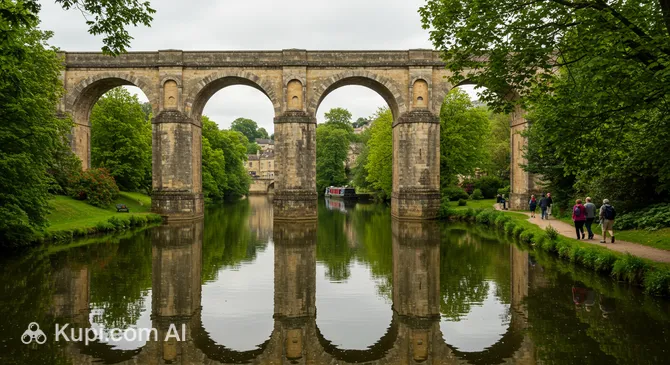
Avoncliff Aqueduct
Avoncliff Aqueduct. Иллюстрация. Источник: Kupi.com AI

Built at the turn of the 18th and 19th centuries under the guidance of the famous engineer John Rennie, the aqueduct is about 100 meters long and consists of three arches. Its classical neoclassical style, with Doric friezes and massive pilasters, blends harmoniously into the landscape. The structure holds a prestigious Grade II* status, confirming its exceptional historical and architectural value.

Today, the Avoncliff Aqueduct is more than just an industrial monument; it is also a popular spot for walks. Here, you can watch modern narrowboats glide slowly along the Kennet and Avon Canal directly over the heads of passengers on the trains passing below, creating a striking contrast between different eras of transport.

Contacts

For those planning a visit to this historic site, it is useful to have the official contact details. The aqueduct is managed by the Canal & River Trust, which looks after the waterways in this region.

You can find more details on the official website or use the navigation address to easily find your way to this engineering monument.

How to contactContact
AddressCanal Cottage Dundas Aqueduct, Avoncliff, Bath BA2 7BL, Великобритания
Websitecanalrivertrust.org.uk

What to Do

The primary pleasure of visiting the aqueduct is taking a walk across its top. Following the towpath along the canal, you can watch the River Avon flow on one side and the trains pass below on the other. It is a unique spot for photography: panoramic views of the rolling Wiltshire landscape and the historic architecture of the bridge are especially beautiful in the light of the setting sun.

Engineering enthusiasts will enjoy looking for ancient masonry marks on the stones and examining signs of large-scale restoration, including bronze commemorative plaques. After exploring the engineering details, you can head down to the riverbank for a small picnic or visit the famous Cross Guns Inn pub, whose terrace faces the water, offering a perfect view of the aqueduct's arches.

Active travelers should take advantage of the network of cycle routes or rent a boat in nearby Bradford-on-Avon to pass under the aqueduct's spans by water. Watching the wildlife and the slow movement of narrowboats creates an atmosphere of exceptional peace and tranquility.

Getting There

There are several ways to reach this picturesque spot near Bath, but the railway is considered the most convenient. The tiny Avoncliff station is located literally a hundred meters from the site. Trains from central Bath take only about 10 minutes to get here, and from nearby Bradford-on-Avon, no more than five. A short, well-maintained path leads from the platform to the canal and the aqueduct itself.

If you are traveling by car, take the A36 or A363 from Bath towards Bradford-on-Avon, following signs for Avoncliff. Please note that parking in the village itself is very limited, so it is better to leave your car in designated areas near the local pubs or on streets where parking is permitted.

For those who value comfort and speed, a taxi from Bath Spa station is an excellent option. The ride takes about 15–20 minutes, and the driver can drop you off as close as possible to the pedestrian area. For active tourists, walking or cycling along the Kennet and Avon Canal towpath, which connects nearby towns to the aqueduct, is also an option.

Ближайший город: Bath

History & Facts

The history of this majestic structure began in 1797 under the leadership of the prominent engineer John Rennie. The aqueduct became a vital link in the Kennet and Avon Canal, designed to connect Bath with Newbury. The construction process was fraught with serious difficulties: due to unstable ground, builders had to manually construct a complex foundation using inverted arches and cofferdams.

Interestingly, local stone was initially used for the facing, but it proved too brittle and cracked in the frost. This led to partial collapses, and engineers had to quickly switch to more durable stone from Bathampton Down. The aqueduct was officially completed in 1801 by John Thomas. Shortly after construction, the central arch sagged slightly under the weight of the water, and traces of old repairs are still visible today through the different shades of masonry.

In the 19th century, the canal flourished, successfully competing with horse-drawn transport until the era of the railways arrived. In 1852, the Great Western Railway company bought the canal, which led to its gradual decline. It was only in the 1980s that a large-scale restoration saved the structure from ruin: a special concrete "cradle" lining was installed inside the aqueduct, ensuring it was fully waterproof and durable for future generations.

Time Needed

To leisurely explore the Avoncliff Aqueduct, take beautiful photos, and enjoy the views, 1–2 hours is usually enough. This is plenty of time to walk across the structure itself, head down to the river, and perhaps stop by the local pub for a short break.

If you plan to combine your visit with a bike ride along the canal or a boat rental, you should allow about 3 hours for the trip. The site is open 24/7, making it a convenient spot for a short stop at any time of day while traveling through Wiltshire.

Working Hours

The Avoncliff Aqueduct is an open public site and is accessible 24/7 any day of the week. There are no entrance gates or ticket offices, so you can plan your visit for early morning or evening.

However, it is recommended to check the official Canal & River Trust website before your trip to ensure there are no scheduled maintenance works on this section of the canal that might temporarily restrict access to the footpaths.

Круглосуточно

Nearby

The area surrounding the Avoncliff Aqueduct is rich with interesting locations that allow for a deeper immersion into the atmosphere of historic England. Exploring nearby villages and estates will be a great addition to your walk along the canal.

NameDistance
Iford Manor Gardens1.2 km
Tithe Barn1.9 km
Farleigh Hungerford Castle2.5 km
Warleigh Weir4.4 km
Fairfield Animal Centre5.5 km
Bath Skyline5.9 km
Great Chalfield Manor and Garden6.4 km

Reached the end of the page?

That means the route is fully explored