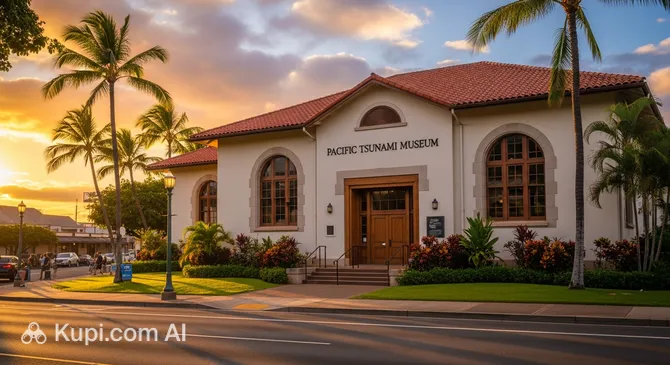
On the bayfront in Hilo is a unique place where science meets human stories. The Pacific Tsunami Museum is not just an exhibition space, but an important educational and memorial center telling the story of the power of nature and the resilience of residents in the USA and the Pacific region as a whole.
Pacific Tsunami Museum. Illustration.
Source: Kupi.com AI
Traveler photos:
The museum occupies a historic building in the heart of the city, which is itself recognized as a cultural heritage site. Here, visitors can see rare photographs, interactive models, and artifacts left behind after major natural disasters. The main goal of the exhibition is not only to preserve the memory of past events but also to educate people on prevention measures for such catastrophes.
Thanks to its high ratings and deeply developed programs, this museum is considered a must-visit for anyone interested in geography, the history of the Hawaiian Islands, and coastal safety. This place leaves a lasting impression, making one reflect on the fragility of human life in the face of the elements.
Contacts
To plan your visit to this important educational center, it is worth checking the contact details in advance. It is recommended to confirm current information before your visit to ensure your experience with the exhibition is as comfortable as possible. This will help you navigate the city center and quickly find the museum building.
In the museum halls, you will find an immersion into the world of oceanography and history. Be sure to spend time exploring the interactive displays and simulations that vividly show how giant waves are born and move. Visitors can see detailed models explaining the physics of tsunamis, which is particularly engaging for students.
Pay special attention to the collection of personal belongings and photographs salvaged after historic floods. Reading real survivor stories allows you to feel the scale of the events much deeper than dry statistics. The museum also regularly screens educational films and video reports that complement the visual experience.
For those interested in modern technology, it is useful to learn about local early warning systems. You can see how scientists today monitor the safety of the Pacific coast and what steps must be taken in the event of a real threat. This is a valuable experience that combines education with emotional empathy.
Getting There
The museum is located in the heart of Hilo, right across from picturesque Hilo Bay. If you are traveling by car, follow the HI-19 highway into the center; you can leave your vehicle at one of the city parking lots located within walking distance of the building.
For those arriving at Hilo International Airport, the journey is only about 4 kilometers. A taxi or rental car ride will take no more than 10–15 minutes. You can also use local public transportation: the Hele-On Bus network (routes #1 or #4) will take you to stops in the center, from where the museum is just a 5–10 minute walk.
Its walking distance from most downtown hotels makes this site an excellent stop for a walking route. You will easily find the building at 130 Kamehameha Ave, enjoying the atmosphere of the historic district along the way.
Nearest city: Hilo
History & Facts
The history of the museum is inextricably linked to the tragic events that forever changed the face of Hilo. The idea for creating this place arose as a way to honor the victims of destructive tsunamis, especially the 1946 disaster. Back then, a giant wave caused by an earthquake in the Aleutian Islands struck the coast, serving as a harsh lesson for Hawaii's residents.
The museum's documentary archives cover a vast period—from the arrival of the first Polynesians around 1100 AD to the modern development of coastal settlements. In the 1960s, the city began to actively recover and expand, turning into a cultural center where the Pacific Tsunami Museum took a key place in shaping the city's identity.
The exhibits clearly demonstrate the evolution of local warning systems and safety measures. Scientific data is intertwined here with personal stories of survivors, creating a profound understanding of how natural challenges have influenced the development of Hawaiian society over decades.
Time Needed
To explore all the halls, study the photographs, and watch the educational videos without rushing, most visitors need about 1–2 hours. This is plenty of time to absorb the history and understand the basic principles of warning systems.
If you plan to study the interactive displays in detail or are traveling with children who might enjoy the simulations, it is worth setting aside a bit more time. Overall, a visit to the museum fits easily into a stroll through the city center.
Working Hours
Please note that the museum follows a fairly concise schedule. It is open to visitors only on weekends: Saturday and Sunday from 10:00 to 14:00. On weekdays (Monday through Friday), the museum is closed.
As the schedule may change depending on holidays or internal events, we strongly recommend checking the organization's official website before visiting.
Day
Opening hours
Monday
Закрыто
Tuesday
Закрыто
Wednesday
Закрыто
Thursday
Закрыто
Friday
Закрыто
Saturday
10:00–14:00
Sunday
10:00–14:00
Nearby
Exploring the museum's surroundings will allow you to dive deeper into the atmosphere of this historic region and learn more about Hawaiian culture. Most interesting locations are within walking distance, which is very convenient for a busy tourist day.