Support

The National Memorial for Peace and Justice

About

Located in the heart of Montgomery, the National Memorial for Peace and Justice is a unique and profound monument to the history of the USA. It is the country's first institution fully dedicated to the memory of victims of racial terror and lynching, serving as an important symbol of an honest acknowledgement of the past.
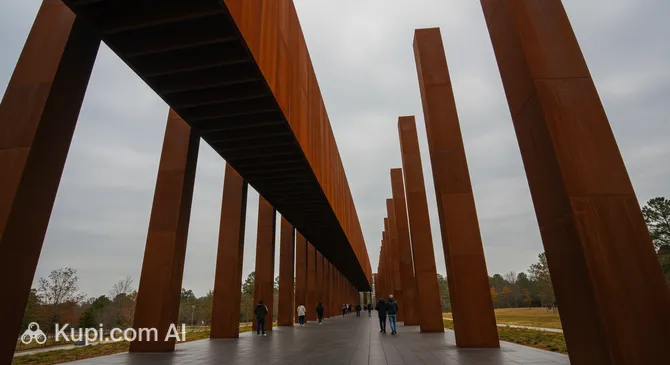
The National Memorial for Peace and Justice. Source: Kupi.com AI

The memorial, often referred to as the "Lynching Museum," was established by the Equal Justice Initiative under the leadership of Bryan Stevenson. Its mission goes far beyond a simple museum—it is a space for enlightenment, designed to promote national reconciliation and restorative justice.

Visitors will find a powerful architectural installation and educational resources that help them understand the tragic legacy and its impact on modern society. It is a place of historical truth-telling that leaves a lasting impression on every guest.

Contacts

For information regarding visits, group tours, or special events, you can use the institution's official contact details. The memorial is located in the central part of the city and is easily recognizable.

Address 417 Caroline St, Montgomery, AL 36104, USA
Phone +1 334-386-9100
Official website legacysites.eji.org
Google Maps View on map

What to Do

At this memorial complex, visitors can engage with history through unique installations and interactive exhibits. The main part of the memorial is an open-air gallery featuring suspended steel columns, each symbolizing a specific county in the country and serving as a reminder of the scale of the tragedy. A walk through the grounds becomes a deep exploration of the past, where every document and artifact tells its own story.

Inside the museum itself, you can explore extensive materials dedicated to the history of the slave trade and the struggle for civil rights. This place is intended for reflection and education, featuring exhibitions that help better understand the social and historical context of racial relations. The memorial provides a space for dialogue, fostering processes of healing and an awareness of the importance of human rights in the modern world.

Getting There

The National Memorial for Peace and Justice is located in the heart of the city at 417 Caroline Street, Montgomery. Travelers can reach the city via the regional airport or use the extensive network of federal highways connecting Alabama with other states.

For getting around the city itself, the most convenient option is using a personal car or a taxi. The memorial is located in the central district, so if you are staying nearby, you can reach it on foot while enjoying the architecture of the old city. City public transportation also runs in this area, but to save time, tourists more often choose taxi services or car-sharing.

History & Facts

The history of Montgomery is incredibly multifaceted. Founded in 1819, it quickly became a significant political hub and was named the state capital in 1846. Interestingly, in 1861, this city was chosen as the first capital of the Confederate States of America, making it a key location for understanding the dramatic events of the Civil War.

In the 20th century, Montgomery transformed into the cradle of the civil rights movement. It was here in 1955 that the legendary Bus Boycott began in response to the arrest of Rosa Parks. This peaceful action lasted over a year and, under the leadership of a young Martin Luther King Jr., led to significant changes in the country's legislation, marking a turning point in the struggle for equality.

The National Memorial for Peace and Justice itself was opened as a tribute to the victims of racial terror. Its creation was an important step for modern society in acknowledging the difficult chapters of the past and striving for national reconciliation, turning Montgomery into a place of deep historical dialogue.

Time Needed

To fully explore the memorial grounds and thoughtfully examine all the exhibits in the museum, visitors are recommended to set aside 2 to 3 hours. This site requires a slow pace, as many installations carry a deep emotional and meaningful message.

If you plan to study archival documents in detail or participate in educational programs, your visit may take half a day. Given the significance of the site, it is best not to plan a rushed visit, allowing time for reflection in the quiet of the memorial park.

Working Hours

The National Memorial for Peace and Justice is open to the public five days a week. From Wednesday to Sunday, the complex's doors are open to guests from 9:00 AM to 4:30 PM.

Please note that Monday and Tuesday are closed days, and access to the grounds is unavailable at these times. Plan your visit in advance to ensure you have enough time to view the exhibits before the museum closes.

Nearby

Exploring the surroundings of the memorial will allow you to dive deeper into the history of the struggle for equality and see iconic sites that witnessed great changes. Many important landmarks are within walking distance, making a walk through the city center very rewarding.

Below are the most interesting sites located near the National Memorial for Peace and Justice:

Attraction Name Distance (km)
Freedom Rides Museum 0.4
United States Post Office and Courthouse—Montgomery 0.4
Rosa Parks Bus Stop 0.7
Court Square Fountain - Artesian Basin 0.7
Kress 0.8
Dexter Avenue King Memorial Baptist Church 1.1
Historic Rosa Parks Home 1.1
Old Alabama Town 1.3
Hank Williams Memorial & Gravesite 2.5
City of St. Jude Catholic Church 2.5

Reached the end of the page?

That means the route is fully explored