Support

Brooklyn Bridge

About

The Brooklyn Bridge is not just an engineering structure but one of the most recognizable symbols of New York and the entire USA. As one of the oldest functioning suspension bridges in the country, it connects two of the city's famous boroughs, Manhattan and Brooklyn, crossing the East River. Walking across it is a must-do for any traveler wishing to feel the spirit of the city.
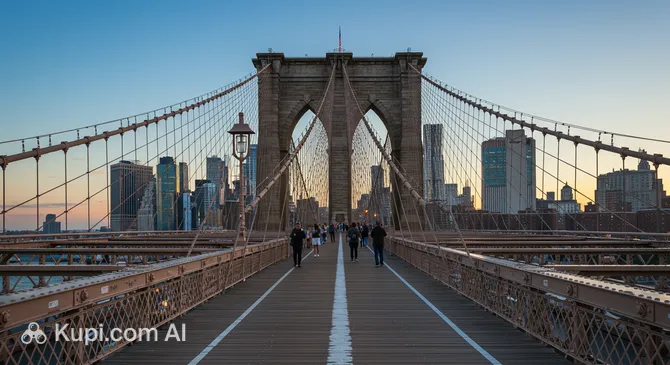
Brooklyn Bridge. Illustration.
Source: Kupi.com AI

Traveler photos:

The bridge's uniqueness lies in its innovative design for its time. It is an outstanding example of engineering that combines elements of both suspension and cable-stayed bridges, and it was the first to use steel cables in its construction. Its roadway is supported by four massive main cables, each consisting of thousands of steel wires, providing the structure with incredible strength.

The dimensions of the structure are impressive: its total length is 1,834 meters, and its width is 26 meters. The pedestrian walkway, elevated above the traffic lanes, allows visitors to enjoy breathtaking views of Manhattan, the Statue of Liberty, and the river itself. The bridge's maximum height above the water reaches over 41 meters, opening up a magnificent panorama for unforgettable photographs.

Visiting the Brooklyn Bridge is an opportunity to touch history, admire the scale of human ingenuity, and take stunning photos against one of the most cinematic backdrops in the world. No matter what time of day you choose to cross it, the impressions will stay with you for a long time.

Contacts

For up-to-date information regarding the Brooklyn Bridge operations, such as potential closures or scheduled maintenance, it is recommended to contact the New York City Department of Transportation (NYC DOT), which manages the bridge. For general tourist inquiries, you can consult the city's specialized travel portals.

How to contactContact
AddressNew York, NY 10038, USA
Websitewww.nyc.gov

What to Do

The main activity on the Brooklyn Bridge is, of course, a leisurely stroll along its famous pedestrian walkway. It is located one level above the flow of traffic, making it safe and comfortable for pedestrians and cyclists. The walk itself, about 1.8 km long, usually takes 30 to 60 minutes, but time will fly by as you stop to take photos. Many travelers recommend starting from the Brooklyn side so that as you move, the increasingly impressive view of the Manhattan skyscrapers unfolds before you.

The bridge offers some of the most breathtaking panoramic views in New York. From here, you can fully appreciate the scale of Manhattan, see the Statue of Liberty in the distance, and admire the harbor. This place is a real find for photographers, especially at sunrise or sunset when the sun paints the skyscrapers in warm tones, creating a truly magical atmosphere. As you walk, you can also get a close-up look at the bridge's famous Gothic arches and its complex system of steel cables.

While walking, don't forget to look down at the East River, where ferries and pleasure boats constantly cruise under the bridge. Crossing the bridge is easily combined with a visit to the surrounding neighborhoods. On the Brooklyn side, the trendy DUMBO district and the picturesque Brooklyn Bridge Park await, which also offer magnificent views. On the Manhattan side, the bridge will lead you directly to City Hall Park, from where it is convenient to continue exploring the city center.

Getting There

Getting to the Brooklyn Bridge is quite simple thanks to its central location and New York’s extensive transportation network. The most convenient way is to use the subway. If you are starting from the Manhattan side, the nearest stations are Brooklyn Bridge/City Hall (lines 4, 5, 6), Chambers Street (lines J, Z), and City Hall (lines N, R, W). The pedestrian entrance to the bridge is just a few minutes' walk from any of these.

For those planning to start their walk from the Brooklyn side to enjoy the Manhattan skyline along the way, aim for the High Street (lines A, C) or York Street (line F) subway stations. Besides the subway, the bridge can be easily reached by city buses with nearby routes or by taxi. Additionally, many Hop-On-Hop-Off tour buses include a stop at the Brooklyn Bridge in their itinerary, making it a convenient option for visitors.

Pedestrian access to the bridge is open from both sides, allowing you to choose the most convenient direction for your walk. For active travelers, there is a great opportunity to rent a bike and ride along the dedicated bike lane while enjoying the city views. This is not only a fast but also a very scenic way to cross the bridge and take unforgettable photos.

Nearest city: New York City

History & Facts

The history of the Brooklyn Bridge is a true saga of innovation, tragedy, and unyielding will. The idea of connecting Manhattan and Brooklyn with a bridge across the busy East River strait had been in the air since the beginning of the 19th century but seemed technically impossible. The ambitious project was undertaken by talented pioneering engineer John Roebling, who proposed using steel cables—a material that was viewed with skepticism at the time. The project was approved in 1869, but tragedy struck almost immediately: while surveying the site, John Roebling suffered a fatal injury and died of tetanus without ever seeing the start of construction.

His son, Washington Roebling, continued his father's work, and construction began on January 3, 1870. Building the bridge was one of the greatest engineering feats of its era, but it was fraught with immense difficulties and dangers. During the construction of the underwater foundations, workers suffered from caisson disease (the bends), which also severely affected Washington himself, leaving him bedridden. For the next 10 years, he supervised the construction from his apartment window, with his wife, Emily Roebling, serving as the link between him and the construction site. She studied engineering and effectively took over the project's management. It was she who was the first to cross the finished bridge in a carriage, holding a rooster as a symbol of victory.

The grand opening of the bridge took place on May 24, 1883, and was a massive event for the entire city. Originally called the "New York and Brooklyn Bridge," it received its current name only in 1915. At the time of its completion, it was the longest suspension bridge in the world, and its majestic Neo-Gothic towers were among the tallest structures in North America. To dispel public doubts about its strength, 21 circus elephants were led across the bridge a year later. In 1964, the Brooklyn Bridge was officially designated a National Historic Landmark of the USA, forever securing its status not just as a vital transport artery, but as a legendary symbol of New York.

Time Needed

To fully enjoy a visit to the Brooklyn Bridge, it is recommended to set aside approximately 1 to 2 hours. This will be enough time to leisurely walk its entire length, which is nearly two kilometers, take famous photos against the Manhattan skyline, and stop at the information plaques that tell the story of this grand structure. While the walk from one end to the other can take 25 to 60 minutes, the extra time will allow you to truly soak in the atmosphere and admire the views of the East River and the Statue of Liberty without rushing.

You should increase the planned time if you want to combine the bridge walk with exploring the adjacent neighborhoods. For example, the scenic park and the trendy DUMBO district await you on the Brooklyn side, while City Hall Park is on the Manhattan side. In this case, you can safely allocate half a day for the entire excursion, including the bridge and its surroundings. This approach allows you not only to cross one of the world's most famous bridges but also to get a fuller picture of two contrasting and uniquely charming districts of New York.

Working Hours

One of the main advantages of the Brooklyn Bridge is its accessibility. It is open to the public 24 hours a day, year-round, 7 days a week. Access to the pedestrian walkway is completely free, so you don't need to buy tickets or book a time for your visit in advance. You can include a walk across the bridge in your itinerary at any time of the day or night.

To get the most enjoyment out of your walk and avoid large crowds, it is recommended to come early in the morning or on weekdays. Especially picturesque views open up at sunrise and sunset when the soft light colors the Manhattan skyscrapers. The evening is also a wonderful time to visit, as that is when the bridge's famous lighting turns on, creating a truly magical atmosphere.

Nearby

A walk across the Brooklyn Bridge is an unforgettable event in itself, but exploring its surroundings will make your trip even more fulfilling. Within a few minutes' walk from the bridge, on both the Manhattan and Brooklyn sides, are many iconic spots that will perfectly complement your excursion.

Exploring nearby attractions allows you to dive deeper into the city's atmosphere, combining the experience of the legendary bridge with visits to other cultural and historical sites. Below is a list of interesting places located within walking distance.

NameDistance
The Dead Rabbit1.2 km
9/11 Memorial1.5 km
9/11 Memorial & Museum1.5 km
One World Trade Center1.6 km
McSorley’s Old Ale House2.6 km
Smalls Jazz Club3.2 km
Jersey Jet Ski4 km

Have you reached the end of the page?

So the route has been studied inside and out