Support

The Palestra

About

Imagine a place where every bounce of the ball on the hardwood and every cheer from the fans creates an atmosphere steeped in sporting history. In the heart of the University of Pennsylvania campus in Philadelphia sits the legendary Palestra — an arena deservedly known as the "Cathedral of College Basketball."
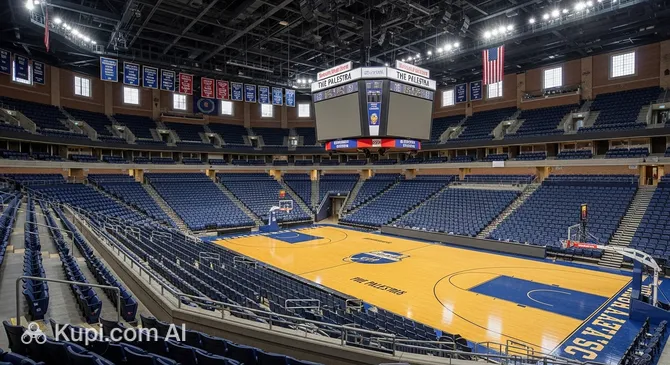
The Palestra. Source: Kupi.com AI

This historic venue, opened in 1927 in the USA, is the home arena for the Penn Quakers men's and women's teams. The Palestra is unique for its design: the stands are located so close to the court that spectators feel like full participants in the game, and the absence of interior columns guarantees a perfect view from any of the 8,725 seats.

The name of the facility comes from the Ancient Greek term for a place for athletic competition and wrestling. Today, it is one of the oldest active university arenas, preserving the spirit of the golden era of sports and serving as a must-visit spot for any basketball fan.

Contacts

If you're planning to attend a game or just want to see the legendary arena for yourself, we recommend checking the event schedule on official resources in advance. Below are the main contact details for The Palestra.

Address 223 S 33rd St, Philadelphia, PA 19104, USA
Phone +1 215-898-6151
Official Website pennathletics.com
Social Media @PennAthletics (Twitter, Instagram, Facebook)

What to Do

Visiting The Palestra is primarily a chance to dive into the incredible energy of live basketball. The most vivid emotions can be found at the Philadelphia Big 5 series games, where the city's top university teams face off. Thanks to the lack of barriers between the crowd and the court, you will find yourself in the very center of the sporting intensity, feeling every moment of the game.

In addition to basketball, it is worth seeing the volleyball or wrestling competitions that also take place within these walls. As you walk through the arena, take note of the lack of pillars and the incredible acoustics — this place was designed so that the energy of the crowd puts maximum pressure on opponents and supports its own players.

Even during the quiet periods between seasons, The Palestra attracts history buffs. In their time, world-class stars such as LeBron James and Chris Paul have stepped onto this hardwood. For any tourist, this is an ideal opportunity to see where the traditions of one of the world's most popular sports were forged.

Getting There

Reaching this "temple of basketball" is quite easy, as it is located in the vibrant University City district. The most convenient way is to use SEPTA public transport. The nearest subway stations (Market-Frankford Line) and trolley lines (routes 34, 36) are within a 5–10 minute walk, and the trip from downtown Philadelphia takes no more than 20 minutes.

If you prefer a taxi or Uber/Lyft services, it is best to plan your trip to the intersection of 33rd and Walnut Streets. For those traveling by car, keep in mind that parking spaces in campus garages (such as Lot 8 or 44) fill up very quickly on game days, so it is worth arriving early.

For those who enjoy walking, the route from the center of the city takes about 40 minutes along pleasant streets. You can also use the Indego city bike-share system, which has stations located in the immediate vicinity of the entrance to The Palestra.

History & Facts

The history of this sports facility began in 1926, when a time capsule containing coins, newspapers, and historical documents was placed in its foundation. The official opening took place on January 1, 1927: the University of Pennsylvania team defeated Yale in front of 9,000 spectators — a record attendance for the East Coast at the time.

For a long time, The Palestra was closely associated with the management of Madison Square Garden, which allowed it to host top-tier teams. Over the decades of its existence, the arena has hosted more NCAA games and tournaments than any other sports facility in the history of college basketball, firmly establishing its status as the "Cathedral" of the game.

The building's architectural design, made of steel and concrete without interior columns, was revolutionary for the 1920s. This construction created a space with an unobstructed view that forever changed the standards for sports arena design. In 2027, The Palestra prepares to celebrate its 100th anniversary, remaining a living monument to Philadelphia's sporting history.

Time Needed

When planning a visit to The Palestra, you should base it on the average duration of a basketball game. Usually, attending a game takes about 2–3 hours, including time for security checks, looking at the historical displays, and the sporting event itself.

If you decide to combine your visit to the arena with a walk around the University of Pennsylvania campus, it is better to set aside half a day (up to 4 hours). This will allow you to explore the university's architecture without rushing and soak in the student life atmosphere of one of the country's oldest universities.

Working Hours

The Palestra's operating schedule depends directly on the schedule of sporting competitions and university events. The arena opens its doors to visitors exclusively on game days or during official events.

To ensure your visit is successful, we strongly recommend checking the current match schedule on the official Penn Athletics website before your trip. There is no information regarding fixed opening hours for tourist walks outside of game days.

Nearby

Exploring the campus surroundings can significantly enrich your trip. The area around the arena offers many interesting locations — from modern adventure parks to unique themed zones.

Check out the list of popular attractions located near The Palestra:

Name Distance (km)
Adventure Aquarium 4.9
Thrillz High Flying Adventure Park 20.1
Urban Air Trampoline and Adventure Park 23.6
Clementon Park & Splash World 23.8
Topgolf Mount Laurel 24.3
Funcity Adventure Park 25.2
The Funplex 25.3
Sahara Sam's Water Park formerly Big Kahuna's 26.8
Diggerland USA 27.4
Sesame Place Philadelphia 37.4

Reached the end of the page?

That means the route is fully explored