Support

Australian War Memorial

About

The Australian War Memorial is not just a landmark, but one of the most important cultural and historical institutions of Canberra and all of Australia. This majestic complex is both a touching monument and one of the world's leading military museums. It is dedicated to the memory of all Australians who served their country or died in military conflicts.
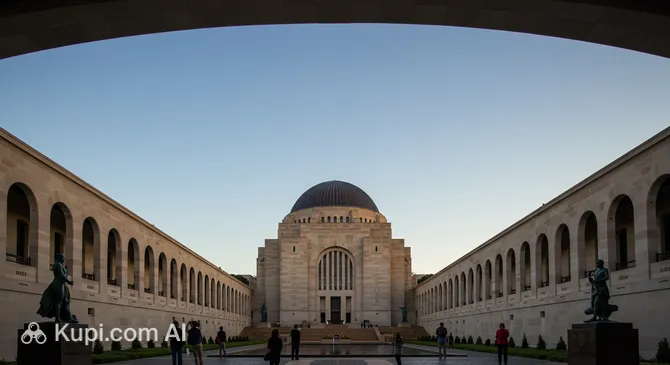
Australian War Memorial. Illustration.
Source: Kupi.com AI

Traveler photos:

Located on the grand ANZAC Parade, which symbolically connects it to Parliament Hill, the memorial impresses with its monumentality. The building is designed in a Byzantine style, which gives it a special solemnity and significance. It is a place where architecture and landscape design merge to create an atmosphere of reverence and remembrance.

Inside the complex, visitors will find not only the memorial Hall of Memory with the Tomb of the Unknown Soldier, but also extensive museum galleries. The exhibitions cover the history of Australia's participation in various military conflicts, presenting personal stories, artifacts, and military equipment. There is also a major research center open to anyone wishing to study the country's military history.

Contacts

For the most up-to-date information on opening times, special exhibitions, or visit planning, it is recommended to contact the Australian War Memorial directly. You can reach the memorial representatives by phone, email, or by visiting the official website.

How to contactContact
AddressTreloar Cres, Campbell ACT 2612, Australia
Phone number+61 2 6243 4211
Websitewww.awm.gov.au

What to Do

A visit to the Australian War Memorial offers a deep and multifaceted immersion into the country's history. You can explore numerous exhibition halls featuring displays dedicated to Australian participation in various conflicts, including the First and Second World Wars. Thousands of unique items are collected here: from soldiers' personal letters and diaries to military uniforms, weapons, and large-scale equipment such as aircraft in the Aircraft Hall. In addition to permanent exhibitions, the memorial regularly hosts temporary displays, lectures, and educational programs that provide a deeper understanding of specific chapters of military history.

The central and most moving part of the complex is the memorial area. After passing through the courtyard with the Pool of Reflection and the eternal flame, you will enter the majestic Hall of Memory. Its walls are adorned with unique mosaics, and in the center lies the Tomb of the Unknown Australian Soldier—a place for quiet reflection and remembrance. The atmosphere here encourages stopping to pay tribute to those who sacrificed their lives. Also in the courtyard, you can see the Roll of Honour with the names of more than 102,000 fallen Australians inscribed on bronze plates.

Beyond exploring the main halls, visitors can join one of the regular guided tours to learn more about the stories behind the exhibits. For those interested in genealogy or conducting historical research, the Research Centre is open with an extensive archive of documents, photographs, and official records. Don't forget to stroll through the Sculpture Garden located on the memorial grounds, where each composition tells its own story of valor and sacrifice.

Getting There

The Australian War Memorial is located in the nation's capital, Canberra, at Treloar Crescent, Campbell, making it easily accessible for visitors. Thanks to its location within walking distance of the central city areas, it can be reached during a leisurely stroll. This is a great opportunity to combine a visit to the memorial with exploring the capital's architecture and other iconic landmarks.

For those who prefer public transport, buses run regularly from the center of Canberra to the memorial. This is a convenient and cost-effective way to reach your destination. Additionally, you can always use taxi services or arrive by private car. For the convenience of drivers, parking is provided near the memorial, which is especially important for tourists traveling by car.

Of particular note is the route to the memorial along the famous ANZAC Parade, which leads directly to the main entrance. Walking down this wide boulevard is part of the experience itself, as you can see other monuments along the way and enjoy panoramic views of the capital. This route allows you to better sense the significance of the place even before arriving at the complex itself.

Nearest city: Canberra

History & Facts

The idea of creating this grand complex belongs to Charles Bean, Australia's official historian during the First World War. While on the battlefields of France in 1916, he was deeply moved by the sacrifice of the soldiers and became passionate about creating a memorial that would honor their memory. As early as 1917, the first practical step was taken with the founding of the war records section, which became the foundation for the future museum. This archive was intended to preserve not only official records but also the personal stories of those who participated in the war.

The journey from idea to realization was a long one. An architectural competition for the best memorial design was announced in 1927, but construction had to be postponed due to economic difficulties caused by the Great Depression. Work was only completed many years later, and the complex was officially opened on November 11, 1941, on the symbolic Remembrance Day. The opening ceremony was performed by Governor-General Alexander Hore-Ruthven, while the world was already engulfed in the flames of the Second World War.

Interestingly, since its opening, the Australian War Memorial has never been a static monument. It is constantly evolving, and its collections are regularly updated to reflect the country's contribution to later military conflicts and peacekeeping missions. This makes it not just a historical archive, but a living institution that continues to tell the stories of Australian service members to new generations and serves as an important center for research and education.

Time Needed

When planning a visit to the Australian War Memorial, it is recommended to allocate at least 2–3 hours for its inspection. This time will be enough to get a general overview of the complex, visit the memorial section with the Hall of Memory and the Tomb of the Unknown Soldier, and briefly familiarize yourself with the main exhibits in the museum galleries. During this time, you can feel the special atmosphere of this iconic place.

However, for those deeply interested in military history or wishing to carefully study the rich collection of artifacts, it is worth planning up to half a day for the visit. This time allowance will permit an unhurried exploration of all exhibition halls, including the Aircraft Hall, familiarization with the personal stories of soldiers, and perhaps a look into the research center. Some visitors note that even an entire day may not be enough to fully immerse oneself in all the details of this large-scale complex.

Working Hours

The Australian War Memorial is open to visitors year-round, making it accessible for a visit at any time. The complex is open daily from 10:00 AM to 5:00 PM. The only closing day is Christmas Day, December 25th, when the memorial is closed. This schedule allows tourists to easily include this important site in their Canberra itinerary.

One of the main advantages for visitors is that entry to the Australian War Memorial is free, and no advance booking is required for general viewing of the galleries and the memorial area. This allows for spontaneous visits, although separate registration may be required to attend special events, such as the Last Post Ceremony, which takes place daily. For the most accurate information on temporary exhibitions and events, it is recommended to check the memorial's official website.

10:00 – 16:00

Nearby

A visit to the Australian War Memorial is just the beginning of discovering the attractions of Canberra. The memorial's strategic location makes it an ideal starting point for further exploration of the capital of Australia. A walk through the surrounding area will allow you not only to dive deeper into the country's history and culture but also to see how harmoniously commemorative sites, parks, museums, and modern entertainment venues blend into the urban landscape.

Very close to the memorial are other iconic landmarks that will complement your experience of the city. From observation decks with panoramic views to cozy bars and galleries—everyone will find something to their taste. Below is a list of some attractions located in the immediate vicinity.

NameDistance
Canberra Centre1.4 km
Kingpin Canberra1.5 km
Mount Ainslie Lookout1.5 km
Akiba1.6 km
Canberra Museum and Gallery1.6 km
Hippo Co1.6 km
Civic Square1.6 km

Have you reached the end of the page?

So the route has been studied inside and out