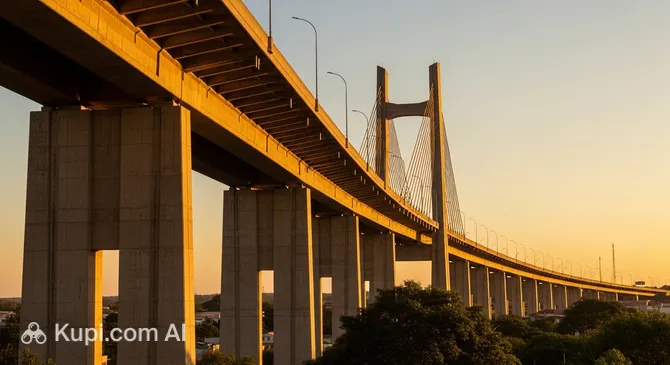
In the heart of the state of Goiás lies the Viaduto João Alves de Queiroz—an impressive engineering structure that has become an integral part of the urban landscape. This vital transport artery of the city of Goiânia doesn't just connect districts; it serves as a vivid example of modern urbanism in Brazil.
João Alves de Queiroz Viaduct. Illustration.
Source: Kupi.com AI
Traveler photos:
Located in the Setor Sudoeste district, the viaduct is a monumental construction named after a prominent public figure who made a huge contribution to the prosperity of the region. Its architectural appearance reflects the spirit of development and progress characteristic of Brazilian metropolises in the second half of the last century.
Today, this site is of interest to tourists as a vantage point offering an honest and dynamic view of the city's daily life. The Viaduto João Alves de Queiroz is not just a bridge, but a symbol of the link between eras and the constant forward motion of the capital of Goiás.
Contacts
Since the Viaduto João Alves de Queiroz is a public transportation infrastructure facility, it has no separate administration or ticket offices. It is an open urban structure accessible to all residents and visitors.
For any inquiries regarding the condition of the site or city navigation, you can contact the official services of Goiânia:
How to contact
Contact
Address
Av. T-63, 572-598 - St. Bueno, Goiânia - GO, 74230-100, Brazil
What to Do
While the site primarily serves a utilitarian function, it offers visitors interesting observation opportunities. From the height of the viaduct, a wide panorama of Goiânia's city blocks opens up, attracting urban photography enthusiasts and those who want to feel the rhythm of a Brazilian metropolis.
The location takes on a special atmosphere in the evening hours. When the city lights come on and the artificial illumination is activated, the viaduct transforms into a striking subject for photography. The play of light on the concrete pillars and the streaks of headlights from passing cars create excellent conditions for long exposure shots.
The area under the viaduct is equally interesting. Depending on the season and the day of the week, you can find local initiatives here: from small street exhibitions to fairs. A walk in the vicinity will allow you to explore local shopping centers and parks that are in close proximity to this engineering giant.
Getting There
The structure is located in the bustling southwestern part of the city, in the Setor Sudoeste district. Due to its significance to the transportation network, finding the viaduct is easy—it is clearly visible from the city's main highways.
The easiest way to get here from the center is by using a taxi or popular mobile apps in Brazil, such as Uber or 99. The ride is quick and comfortable, especially in hot weather.
For those who prefer public transport, numerous bus routes pass through the area. The nearest stops are within walking distance of the structure. If you are traveling by private car, head for the intersection of major city arteries, but keep in mind that traffic can be quite heavy during peak hours.
Nearest city: Goiania
History & Facts
The construction of the Viaduto João Alves de Queiroz was a major milestone in the modernization program of Goiânia during the second half of the 20th century. During this period, the city experienced rapid growth, and authorities required bold engineering solutions to connect the fast-developing districts.
The structure was named in honor of João Alves de Queiroz—a prominent entrepreneur and political figure whose contribution to the development of the state of Goiás is hard to overstate. His name became a symbol of creation and progress, which the viaduct embodies in concrete and steel.
Over decades of service, the construction has undergone several stages of reconstruction. Each update was aimed at adapting the bridge to the ever-increasing flow of vehicles. Today, the viaduct is seen not just as a functional road element, but as historical evidence of how a small settlement transformed into a modern metropolis in the heart of Brazil.
Time Needed
For a standard express visit to the Viaduto João Alves de Queiroz itself, 15–30 minutes is quite enough. This time is sufficient to appreciate the scale of engineering and take a few souvenir photos.
If you plan to stroll through the adjacent neighborhoods, visit local shops, or conduct a photo session from different angles, it's better to set aside 1–2 hours. For a complete introduction to this part of the city and a visit to one of the nearby parks, you might need a good half-day.
Working Hours
As the Viaduto João Alves de Queiroz is part of the public road network, it is available for visiting and transit 24 hours a day, daily. It has no weekends or holidays, so you can see it at any time that suits you.
Nevertheless, tourists are recommended to plan their visit during daylight hours for the best visibility, or in the early evening hours when city lighting highlights the structure's forms. When visiting the site after dark, it is always wise to observe reasonable safety precautions typical of any large city.
Nearby
Exploring the surroundings of the viaduct can significantly enrich your experience of visiting the capital of Goiás. The area around the bridge is known for its dynamic atmosphere, where modern architecture coexists with cozy recreation areas and entertainment centers.
Nearby, you will find many leisure spots—from picturesque parks to modern bowling centers and play areas for the whole family.