Support

Mococa Airport

About the Airport

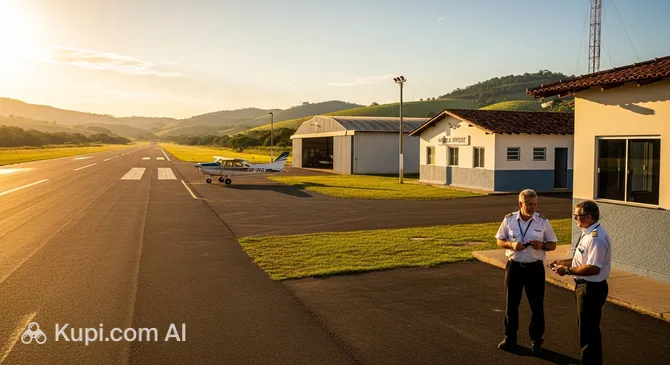
Mococa Airport. Source: Kupi.com Binoculars

Mococa Airport (Aeroporto Estadual de Mococa) is a cosy air haven hidden amongst the green hills of the State of São Paulo, serving as an ideal gateway for those who value privacy and time. Unlike bustling international hubs, an atmosphere of tranquillity and exclusivity reigns here, focused primarily on private aviation and business travel. This small airfield often becomes a point of attraction for pilot enthusiasts and travellers who prefer to explore Brazil at their own pace, bypassing the endless queues of large terminals.

AirportMococa Airport
IATAQOA
ICAOSDKK
CityMococa
TimezoneAmerica/Sao_Paulo
ScheduleOnline board

Features and advantages of the airport:

Despite its modest size, Mococa Airport plays an important role in the transport accessibility of the region, offering excellent conditions for small aircraft.

  • Ideal location: The airfield is located just a few minutes' drive from the city centre, allowing travellers to reach their destination immediately after landing.
  • Hassle-free experience: Here you will not encounter long queues for check-in or baggage claim — all processes are as fast and comfortable as possible.
  • Focus on private aviation: The airport is perfectly equipped to receive business jets and light aircraft, serving as a convenient stopover for business people and flying clubs.

Contact Information

Mococa Airport (QOA) is a small general aviation airport that does not have large commercial infrastructure. The facility is managed by the municipality (Prefeitura Municipal de Mococa), so it is recommended to use city administration contacts for official information or administrative inquiries.

  • Official airport website: www.mococa.sp.gov.br (portal of the City Hall managing the airfield)
  • Inquiry service phone: +55 (19) 3094-1600 (general phone of the municipal administration)
  • Airport address: Rua Manuel Barbosa, S/N, Distrito Industrial II, Mococa - SP, 13730-000, Brazil
  • Email: gabinete@mococa.sp.gov.br (for official inquiries to the administration)
  • Airport social media: There are no separate accounts; news is published on the Prefeitura de Mococa pages on Facebook and Instagram
  • Lost luggage information: There is no centralised "Lost & Found" service. In case of lost items, you must contact your private flight operator or the city administration.
  • Passenger support contacts: Support is provided during City Hall working hours (Monday to Friday, 09:00–17:00) through the general public appeals department.

How to Get to the Airport

Since Mococa has a small general aviation airport, transport logistics here differ significantly from major international hubs. The airfield is located just 4 kilometres from the city centre, so the journey takes minimal time. Several convenient options are available for travellers arriving by private flights or planning a departure.

Taxis and Ride-Hailing Services

The most reliable and comfortable way to get to the city or the airport is to use a taxi. The trip from the centre of Mococa to the terminal takes only 10–15 minutes. Mobile apps popular in Brazil (such as Uber or 99) operate in the region, however, in small towns, the waiting time for a car may vary. You can also order an official city taxi via your hotel reception. The estimated cost of a trip around the city is 20–30 Brazilian Reals.

Car Rental

For those who prefer freedom of movement, car rental is an excellent choice. Although international rental brand counters may be absent directly at Mococa Airport, a car can be rented in the city centre or delivered to the aircraft steps by prior arrangement with local agencies. The road to the airport runs through local streets and highway exits; traffic jams are practically non-existent here.

Public Transport

There are no specialised shuttle buses or metro lines connecting the city with the airfield. Municipal buses run around the city, but they do not enter the airport territory. The nearest stops are at a significant distance, so tourists with luggage are strongly advised to choose a car.

Parking

A parking zone is provided within the airport territory. Given the status of the airfield, parking is usually free or has a nominal cost. The spaces are located outdoors, in immediate proximity to the administration building and hangars.

Alternative Routes for Tourists

It is important to remember that Mococa Airport does not accept regular commercial flights from major airlines. Most tourists fly into major airports in the State of São Paulo and then travel to Mococa by rented car or intercity bus. The nearest major hub is Dr. Leite Lopes Airport in the city of Ribeirão Preto, located approximately 86 km away. The journey from there will take about 1–1.5 hours on a high-quality highway.

For international flights, travellers often choose Viracopos (about 170 km) or the country's main hub — São Paulo-Guarulhos International Airport (222 km), from where Mococa can be reached in 2.5–3 hours.

Terminals and Map

The infrastructure of Mococa Airport (QOA) fully corresponds to its status as a general aviation hub. Here you will not find confusing labyrinths of corridors or multi-level transitions typical of large international hubs. The air terminal complex is designed with a focus on maximum efficiency, privacy, and speed of service for private flight passengers.

Terminal Structure and Service Zones

The airport has one compact terminal, which combines an administrative block and a waiting area for crews and passengers. The building is located in immediate proximity to the apron, which reduces the travel time from the entrance to the aircraft steps to a minimum.

  • Departure and Arrival Zone: Unlike commercial airports, there is no strict separation into "airside" and "landside" zones with long corridors here. Boarding and disembarking are carried out practically "door to door".
  • Waiting Lounge: Inside the terminal, there is a small rest area where you can wait comfortably for the aircraft to be prepared.
  • Administrative Premises: Services responsible for flight planning and meteorological support are located here.

Navigation Features and Layout

Navigation at Mococa Airport is intuitively clear and does not require studying complex maps. The entire territory is compact and visually scannable. It is just a few steps from the parking to the terminal entrance. Transitions between zones are non-existent as such, since all service takes place within one small building and the adjacent apron.

Procedure Times

One of the main advantages of QOA is the absence of queues. Registration processes (if required by the flight operator) and pre-flight screening are maximally simplified and personalised here.

  • Check-in and Screening: Usually take no more than 10–15 minutes. Private aviation passengers do not need to arrive 2–3 hours before departure; it is enough to arrive shortly before the agreed start time.
  • Baggage Claim: Occurs immediately after landing and engine shutdown, often directly at the aircraft side or at the terminal entrance.

Recommendations for Travellers

Since the airport does not have electronic boards and automated notification systems, it is best to coordinate all actions directly with the pilot or the representative of your charter operator. If you are being met by car, the driver can wait for you in the parking lot right at the exit of the administrative building.

Airport History

The history of Mococa Airport (QOA) is inextricably linked with the development of the agro-industrial sector of the State of São Paulo. Unlike large hubs striving for gigantism, this air harbour has preserved its boutique status, remaining a crucial node for regional and agricultural aviation for decades.

Foundation and Agrarian Roots

The airfield was founded in the mid-20th century, when the region was experiencing an economic boom thanks to coffee plantations and livestock farming. Local entrepreneurs and farmers needed a fast way to connect with major cities and the state capital. Initially, it was a simple levelled area in a field that allowed light piston aircraft — the main "workhorses" of that time — to take off and land.

Management Stages and Infrastructure Features

An important milestone in the facility's history was its operation under the aegis of the Department of Aviation of the State of São Paulo (DAESP). During this period, the airfield was maintained in accordance with state standards. Notably, unlike many neighbouring airports, Mococa retained its authentic dirt runway. This conscious decision met the needs of the main traffic — agricultural aviation and light private vessels capable of operating on unpaved surfaces.

Transfer to Municipality and Modernisation

The newest chapter in the airport's history began with the transfer of management from the state to the local municipality. This step allowed the city to independently determine development priorities. In recent years, significant efforts have been made to comply with the modern requirements of the National Civil Aviation Agency of Brazil (ANAC):

  • Enhanced Security: New perimeter fencing (alambrado) was installed to prevent animals from entering the runway, which is critically important for flight safety in rural areas.
  • Navigation Update: The system of windsocks and marker signs was modernised, which facilitated visual orientation for pilots.

Role in Regional Life

Today, Mococa Airport continues to fulfil its historical mission. It does not chase passenger traffic records but serves as an indispensable base for aircraft treating fields and private jets of local businessmen. Furthermore, keeping the dirt runway in proper condition makes it an important point for training flights for pilots honing their skills on various surface types.

Interesting Facts

  • Lifeline: The airfield is regularly used for air ambulance services. The ability to land an aircraft in close proximity to the city has saved lives more than once when emergency patient transport was needed.
  • Strategic Asset: Despite the lack of asphalt, the runway is considered one of the most well-maintained dirt runways in the region, capable of receiving certain types of turboprop aircraft.
  • Community Centre: The airport is a popular meeting place for the local flying club, preserving the spirit of "old school" aviation romance, where pilots know each other by name.

Services and Facilities

Given the status of Mococa Airport (QOA) as a small general aviation hub, the range of services here differs significantly from the standards of large international terminals. The airfield infrastructure is designed on the principle of the "necessary minimum", ensuring the basic needs of pilots and private flight passengers, for whom priority is speed of service rather than shopping or entertainment.

Dining and Shopping

There are no familiar Duty Free zones, souvenir shops, cafes, or restaurants on the airport territory. Passengers are advised to consider this when planning their trip:

  • Dining: It is better to have a full lunch or coffee in the city of Mococa itself before leaving for the airfield. Drinking water or coffee for crews may be available in the administration building, but there is no guaranteed catering service. Catering for private flights is usually ordered in advance through the flight operator.
  • Shops: The nearest supermarkets and pharmacies are located within the city limits, just a 5–10 minute drive away.

Waiting Lounges and Connectivity

The atmosphere of the airport itself resembles an open-air VIP lounge thanks to the silence and absence of crowds.

  • Rest Zone: The administrative building has a small general waiting hall with basic furniture where you can spend time comfortably before departure. There are no separate business lounges or closed VIP rooms, as passenger traffic is minimal.
  • Wi-Fi and Device Charging: The airport usually provides internet access for pilot needs (flight planning, weather reports). Passengers can check the Wi-Fi password with administration staff. There are few sockets for charging devices; they are located in the main hall.

Financial and Medical Services

Due to the compactness of the facility, there are no stationary banking service points here.

  • Banks and Currency Exchange: There are no ATMs or exchange offices on the premises. It is recommended to arrange cash (Brazilian Reals) in advance in the centre of Mococa, where branches of major Brazilian banks are represented.
  • Medical Assistance: There is no medical post in the terminal. In case of an emergency, staff call an ambulance from the city. The nearest hospitals are a few kilometres away, ensuring the rapid arrival of medics.

Services for Special Categories of Passengers

Despite the lack of complex equipment, airport staff are always ready to provide individual assistance.

  • Passengers with Reduced Mobility: The single-storey terminal structure and lack of jet bridges simplify movement. Boarding the aircraft is carried out from the apron; if necessary, airfield staff or the crew help passengers board. There are no specialised lifts or ambulifts here.
  • Passengers with Children: Mother and child rooms or play zones are not provided. However, thanks to the private environment and the ability to drive almost up to the aircraft, travelling with children proceeds more calmly here than in major hubs.

Accommodation and Business Services

The airport does not have its own hotel or conference centre. For overnight stays or business meetings, it is necessary to go into the city.

  • Hotels: The nearest hotels and "pousadas" (guesthouses) are located in the centre of Mococa (about 4–5 km from the airfield). The city offers accommodation options in the mid-price segment with a decent level of comfort.
  • Business Meetings: Holding negotiations is possible in the lobby of the administrative building if a brief meeting is required before departure, but for full-scale conferences, it is better to use the infrastructure of city hotels.

Where to Eat

It is important to understand that Mococa Airport (QOA) is a small general aviation airfield oriented exclusively towards private and business flights. There is no passenger terminal in the usual sense, and, as a consequence, a commercial public catering zone is completely absent.

Restaurants and Cafes

You will not find restaurants, coffee shops, or food courts on the airport territory. There is no separation into "airside" and "landside" zones with shops and snack points. Infrastructure is limited to the administrative building and hangars.

Dining Options for Passengers

Given the specifics of the airport, the following alternatives are available to travellers:

  • In-flight Catering: For passengers of private jets and charter flights, the issue of meals is resolved at the flight booking stage. Ordering dishes (including hot meals, snacks, and beverages) is arranged through the flight operator and delivered to the aircraft by specialised catering services or from the best restaurants in the city.
  • Self-catering: If you are flying on a light private aircraft without a steward, it is recommended to bring food and drinks with you.
  • Basic Service: In the waiting area of the administrative building (during its opening hours), crews and passengers may be offered water or simple coffee, however, one should not count on this as a substantial snack.

Gastronomic Recommendations in the City

Since the airport is located just 4 km from the centre of Mococa, it is best to have lunch or buy food in the city before leaving for the airfield. This region of the State of São Paulo is famous for its culinary traditions, which largely intersect with the cuisine of the neighbouring state of Minas Gerais.

What is worth trying (purchasing in the city):

  • Pão de queijo (Cheese bread): Fresh hot buns made from cassava flour and cheese — an ideal option for a quick snack before a flight.
  • Local Coffee: Mococa is historically a coffee region. Be sure to drink a cup of quality espresso in one of the city bakeries (padaria).
  • Homemade Sweets: The region is known for its desserts based on milk and fruit (doce de leite, fruit compotes), which are sold in local shops.

Dietary Requirements (Vegetarian, Halal, Gluten-free)

Due to the absence of sales points at the airfield, specialised meals are available only by pre-order through your air carrier or catering company. If you are buying food in the city yourself, basic products for vegetarians and fruits can be found in local supermarkets, but specialised vegan or strictly Halal cafes might not exist in a small town.

Operating Hours

Since there are no catering outlets, one should rely on the opening times of city establishments (usually from 08:00 to 22:00) or the airport administration schedule for access to drinking water.

Travel Tips

Travelling through Mococa Airport (QOA) differs significantly from flights via major international hubs. Since general aviation is based here (private aircraft, air taxis, training flights), standard rules like "arrive three hours early" do not apply. We have prepared recommendations to help make your visit as comfortable and efficient as possible.

Optimal Arrival Time

The main advantage of private aviation is saving time. You do not need to budget hours for queues.

  • When to arrive: It is sufficient to arrive at the airport 15–20 minutes before the scheduled departure time. This time is enough to meet the pilot, load luggage, and complete necessary formalities.
  • Schedule Flexibility: If you charter the entire aircraft, the departure time can often be adjusted to suit you, however, respect for slots (if you are flying onwards to a large airport) and crew working hours is mandatory.

Check-in and Security

Procedures in Mococa take place in a relaxed but professional atmosphere. There are no check-in counters or endless security conveyor belts here.

  • Documents: Always have your original identification document (passport or ID) with you. The pilot or flight operator is obliged to check the documents of all passengers before boarding in accordance with ANAC (National Civil Aviation Agency of Brazil) rules.
  • Screening: Luggage checks and personal screening are usually conducted by the crew visually or using handheld metal detectors. The process takes mere minutes.

Choosing a Seat on the Plane

In light aviation, the concept of "seat selection" is dictated not by legroom comfort, but by flight physics.

  • Aircraft Balancing: Weight distribution is critically important for light aircraft. The pilot will assign you a seat based on centring (distribution of passenger and luggage weight). Please do not change seats without the commander's permission.
  • Best Views: Since most aircraft flying to Mococa are low-flying, practically any window seat guarantees stunning panoramas of the coffee plantations and hills of the State of São Paulo.

Luggage and Hand Luggage

Luggage restrictions here are stricter than on commercial liners due to the small volume of luggage compartments.

  • Type of Bags: It is strongly recommended to use soft bags or backpacks instead of rigid suitcases on wheels. Soft luggage is easier to fit into the limited fuselage space.
  • Weight: Strictly observe the agreed weight limit. Overloading in light aviation is impermissible.
  • Liquids and Prohibited Items: Although the "100 ml" rule may not be applied as strictly here as on commercial flights, the transport of dangerous substances (flammable liquids, gases) is categorically prohibited.

Transfers and Connections

Mococa Airport is often used as the start or end point of a route, but if you plan to transfer to a large commercial flight in another city (for example, in São Paulo or Campinas):

  • Time Buffer: Leave a significant time margin between flights (minimum 3–4 hours). Light aviation is more dependent on weather conditions, and departure from Mococa may be delayed due to fog or storms, which could lead to missing a connecting flight at a large hub.

Customs Control

Please note that Mococa Airport is a domestic airport. There are no customs and passport control points for international flights here. If you are flying from abroad on a private aircraft, your flight must first land at one of Brazil's international airports (International Port of Entry) to complete formalities, and only then fly to Mococa.

Tips for Saving Money

  • Transfer to the City: Calling a taxi from the city is cheaper than arranging a transfer through the flight operator. Since the distance is short, a trip via Uber or a local taxi will be inexpensive.
  • Dining: Bring a snack with you from the city. This will save time and money, as there is nowhere to buy food at the airport, and ordering catering on board can cost significantly more than a regular lunch in a restaurant.

Actions in Case of Flight Delay

In light aviation, delays are most often related to meteorological conditions (non-flying weather).

  • Don't Wait in the Field: If departure is postponed indefinitely, there is no point sitting in the small waiting room. The centre of Mococa is only 4 km away — it is better to return to the city, visit a local cafe, or rest at a hotel while staying in touch with the pilot.
  • Ground Alternative: If the weather does not permit flying, have a "Plan B". Major airports (Ribeirão Preto or Viracopos) can be reached by rental car in 1.5–2.5 hours.

Reached the end of the page?

That means the route is fully explored