Support

Sao Paulo-Guarulhos International Airport

About the Airport

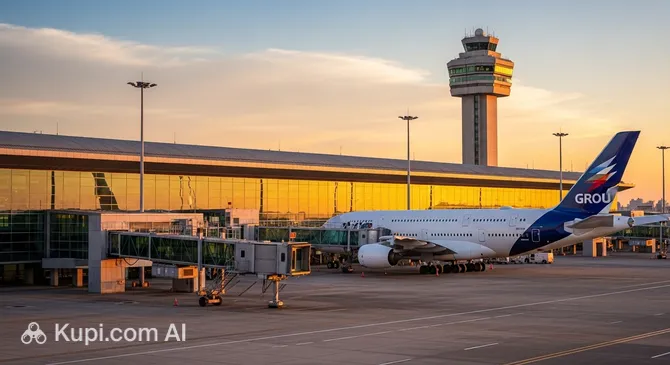
Sao Paulo-Guarulhos International Airport. Source: Kupi.com Binoculars

São Paulo/Guarulhos International Airport (IATA: GRU), officially named after Governor André Franco Montoro, serves as the primary air gateway to Brazil and stands as one of the busiest transport hubs in Latin America. Located in the city of Guarulhos, it acts as the main centre for millions of travellers discovering the beauties of São Paulo and the entirety of South America. The airport, also known by its former name Cumbica, plays a pivotal role in connecting Brazil with dozens of countries worldwide, offering flights to over 100 destinations.

IATA Code GRU
ICAO Code SBGR
City São Paulo / Guarulhos
Distance to Centre 25 km
Status International
Annual Passengers approx. 41.3 million (2023)
Popular Airlines LATAM Airlines, GOL Linhas Aéreas, Azul Brazilian Airlines
Schedule online flight board "São Paulo/Guarulhos International Airport"

Guarulhos Airport offers passengers modern infrastructure and a high level of service. It consists of three terminals: Terminal 1 mainly serves domestic flights; Terminal 2, the largest, handles both domestic and international flights; and Terminal 3 specialises in international destinations. A complimentary shuttle bus operates between the terminals, ensuring convenient movement for passengers.

Travellers are provided with a wide range of amenities: from numerous shops, including duty-free, and restaurants to suit every taste, to comfortable VIP lounges with panoramic views of the runways. Free Wi-Fi is available throughout the airport territory, along with luggage storage, currency exchange points, and a hotel. For those seeking exclusive service, the airport operates one of the world's largest VIP terminals, offering personal escort services, conference rooms, and relaxation zones.

Contact Information

If you need to contact representatives of São Paulo/Guarulhos International Airport (GRU), please use the following contact information. It is recommended to verify the data on the official website as it may change.

  • Official Website: www.gru.com.br. Here you will find the latest information on flights, services, and airport regulations.
  • Information Desk Phone: +55 (11) 2445-2945. Available for general enquiries and answers to questions.
  • Address: Rodovia Hélio Smidt, s/nº, Cumbica, Guarulhos, São Paulo, CEP 07190-100, Brasil.
  • Email: A direct email address for general questions is not published. For communication, it is recommended to use the contact form on the official website in the "Fale Conosco" (Contact Us) section.
  • Social Media: The airport maintains active pages on popular social networks where it publishes news and updates. These can be found via links on the official website.
  • Lost Luggage Information: If you have lost your luggage, you should first contact your airline's representative office. For items lost within the terminal, you can contact the airport's "Achados e Perdidos" (Lost and Found) service via a special form on the website.
  • Passenger Support Contacts: For assistance directly at the airport, approach the information desks located in the terminals. You can also contact the enquiry service by phone.

How to Get to the Airport

Getting to São Paulo/Guarulhos International Airport (GRU), the main international hub of São Paulo, is possible in several ways, each with its own advantages depending on your budget, time, and comfort requirements. The airport is located approximately 25 km from the city centre, and travel time can vary significantly due to the metropolis's notorious traffic jams.

Public Transport is the most economical method.

  • CPTM Train: Line 13-Jade (Expresso Aeroporto) connects the airport with Luz station in the city centre, from where you can transfer to the metro. This is a reliable and fast option, allowing you to avoid traffic. Trains run at regular intervals. There is also a cheaper Connect service that makes more stops.
  • Airport Bus Service (EMTU): Comfortable express buses run between the airport and key points in the city, including Paulista Avenue, Tietê Bus Terminal, and Congonhas Airport. This is a more expensive option than the train, but convenient, especially if you are travelling with heavy luggage.
  • City Buses: There are also regular city routes that go to the airport. This is the cheapest method, but it can be slow and not very convenient for tourists with suitcases.

Taxi and Transfers offer maximum comfort. Official taxis (look for Guarucoop counters in the terminal) have fixed fares, protecting you from overcharging. Ride-hailing apps like Uber and 99 are also widely available and may be slightly cheaper, though prices depend on demand and road conditions. A taxi ride to the centre will take from 45 minutes to 1.5 hours or more, depending on traffic.

Car Rental and Parking. If you plan to travel extensively around the state of São Paulo, you can rent a car directly at the airport, where all major international and local companies are represented. The airport has several parking options — from short-term to long-term, including more economical remote car parks with free shuttles to the terminals. However, it is worth noting that parking at GRU is not cheap.

Besides Guarulhos, the metropolitan region is served by other airports. The largest for domestic flights is Congonhas (CGH), located right within the city. Also noteworthy is the international airport Viracopos (VCP) in Campinas, which handles many flights, and smaller airports such as São Paulo Catarina Airport, Jundiaí, and São José dos Campos, serving primarily regional and private aviation.

Terminals and Map

São Paulo/Guarulhos International Airport (GRU), the main air hub of Brazil, consists of three main passenger terminals: Terminal 1, Terminal 2, and Terminal 3. Each has its own specialisation, so it is important to know in advance which one you need.

Terminal 1 is the most compact and mainly serves domestic flights, acting as a base for the budget airline Azul. Everything here is organised simply and clearly, and procedures generally take less time.

Terminal 2 is the largest and oldest of the terminals. It serves the vast majority of domestic flights, as well as international flights to Latin American countries. The terminal is divided into two wings (East and West), so watch the signs carefully to find your check-in counter or boarding gate.

Terminal 3 is the most modern and comfortable. It is designed exclusively for serving long-haul international flights (to Europe, North America, Asia, and the Middle East). Spacious waiting lounges, Duty Free shops, and the airport's best restaurants are located here.

Navigation in Guarulhos Airport is quite simple thanks to numerous signs in Portuguese and English. Free shuttle buses run between all terminals with an interval of about 15 minutes. Furthermore, Terminals 2 and 3 are connected by a convenient and modern pedestrian walkway, allowing movement between them without waiting for transport.

It is recommended to allocate sufficient time for check-in and security checks. For domestic flights, arrive at the airport 2-3 hours before departure, and for international flights — at least 3-4 hours. Especially during peak hours, queues for check-in, passport control, and security can be significant. Main advice: always check your terminal number on your ticket in advance and verify information on the departure boards upon arrival at the airport, as boarding gate numbers may change.

Airport History

The history of São Paulo/Guarulhos International Airport (GRU) is closely tied to the rapid growth of the São Paulo metropolis and all of Brazil. The decision to build it was made to relieve the old and overcrowded Congonhas Airport, which could no longer cope with the growing international traffic. The official opening took place on 20 January 1985. Initially, the airport, named after Governor André Franco Montoro, consisted of two passenger terminals and quickly became the country's main air gateway.

A key stage in the airport's development was its privatisation in February 2012. Management passed to the GRU Airport consortium, which launched a massive modernisation programme. This was done in anticipation of two major events for the country: the 2014 FIFA World Cup and the 2016 Olympic Games. The main result of these investments was the construction and opening in 2014 of the modern Terminal 3, which is entirely dedicated to international flights and significantly increased capacity and comfort levels for passengers.

Throughout its history, Guarulhos Airport has set numerous records. Today, it is the busiest airport in South America by passenger volume and one of the largest cargo hubs in Latin America. It serves as the main base for major Brazilian airlines such as LATAM Brasil and GOL Linhas Aéreas, connecting Brazil with dozens of countries across all continents.

Among interesting facts, it is worth noting that planning for the airport began back in the 1960s, but construction dragged on for many years. It received its unofficial and better-known name — Guarulhos — from the municipality where it is located. Despite its relative youth compared to other global giant airports, GRU has gone from a simple functional hub to a modern and award-winning aviation complex that continues to expand and improve.

Services and Amenities

São Paulo/Guarulhos International Airport (GRU) offers passengers a full range of services and amenities to make waiting for a flight as comfortable and productive as possible. Here, every traveller will find everything they need, from places to rest to business services.

For gourmets and shopping enthusiasts, the terminals feature numerous restaurants, cafes, and bars, offering both Brazilian cuisine and international favourites. From a quick snack in the food courts to an exquisite dinner — the choice is vast. Duty Free shops offer a wide assortment of perfumes, cosmetics, beverages, and souvenirs, while other retail outlets feature fashionable clothing, books, and electronics.

For those valuing enhanced comfort, VIP lounges and lounges of various airlines and alliances are available. Here you can relax in silence, use shower facilities, enjoy snacks and drinks, and work in a calm environment. Access to free Wi-Fi is provided throughout the airport, and numerous charging stations for electronic devices ensure you stay connected.

Financial matters are easily resolved on-site: bank branches, currency exchange points, and ATMs operate within the airport. In case of necessity, passengers can visit 24-hour medical points and pharmacies. For travellers with children, mother and child rooms and play areas are provided to help pass the time before departure.

The airport is fully equipped for the comfortable stay of passengers with reduced mobility: there are ramps, special lifts, equipped restrooms, and escort services. For those needing rest between flights, hotels are located directly in the transit zone and in close proximity to the terminals. Business travellers can utilise business centres and rent conference rooms for meetings.

Where to Eat

São Paulo/Guarulhos International Airport (GRU) offers passengers a wide selection of establishments for every taste and budget. You can find everything from quick snacks to full-service restaurants scattered across all terminals, with the highest concentration in Terminals 2 and 3.

Dining options are conveniently divided into two main zones: `landside` (public area before security control) and `airside` (secure area after control). In `Terminal 2`, which serves domestic and some international flights, the largest food court in the `landside` zone is located on the departure floor, featuring popular fast-food chains. In the `airside` zone of this same terminal, there are numerous cafes, bars, and restaurants. `Terminal 3`, the main international hub, offers more premium restaurants and bars, located predominantly in the `airside` zone.

A trip to Brazil is impossible to imagine without experiencing the local cuisine. Right at the airport, you can taste the famous cheese buns `pão de queijo`, which pair perfectly with a cup of strong Brazilian coffee. Also popular are bowls with `açaí` berries — a delicious and healthy snack. Some full-service restaurants may even offer national hits like `feijoada` or `churrasco` steaks.

If you are short on time, numerous coffee shops such as Starbucks or local brands, as well as fast-food outlets like McDonald's and Burger King, are excellent for a quick snack. They are present in all terminals. For a full lunch or dinner, head to the restaurants in the `airside` zones of `Terminals 2 and 3`. Here you can find establishments specialising in Italian, American, or Brazilian cuisine, where you can sit calmly while waiting for your flight.

Most establishments in the `airside` zones of international terminals operate `24/7` or until the last flight, whereas cafes in public zones may have more limited opening hours. The price range varies: from budget options in fast-food chains to higher prices in service restaurants. Regarding special dietary needs, vegetarian options (salads, sandwiches) are not difficult to find. Some cafes offer plant-based milk. However, gluten-free, vegan, or Halal meals are encountered less frequently, so it is recommended to clarify the menu or ask the staff at the establishment in advance.

Travel Tips

To ensure your journey through São Paulo/Guarulhos International Airport (GRU) goes as smoothly as possible, follow these tips. This is the largest and busiest airport in Brazil, so advance planning is the key to success.

Arrival Time and Check-in. For international flights, arrive at the airport 3-4 hours before departure, and for domestic flights — 2-3 hours. Queues for check-in and security can be long. To save time, complete online check-in and use self-service baggage drop kiosks if your airline provides such a service.

Seat Selection. For the long flights for which Brazil is known, an aisle seat will allow you to stand up and stretch freely without disturbing neighbours. If you wish to enjoy views during takeoff and landing, especially views of the endless São Paulo, choose a window seat.

Hand Luggage. Standard rules regarding liquids (up to 100 ml in transparent packaging) apply here. It is strictly prohibited to carry fresh fruit, vegetables, seeds, and other agricultural products in hand luggage or checked baggage without a special permit. Brazilian customs services monitor this very strictly.

Connecting Passengers. The airport has three terminals (T1, T2, T3), with shuttles running between them. Verify in advance from which terminal your next flight departs. If you are transferring from an international flight to a domestic one, you will need to pass passport control, collect your luggage, and re-check it for the next flight.

Customs Control. Upon entering the country, you will see two channels: green ("Nada a Declarar" — Nothing to Declare) and red ("Bens a Declarar" — Goods to Declare). If you are unsure whether your items are subject to declaration, it is better to choose the red channel to avoid fines.

Saving Time and Money. Prices for food and drinks at the airport are high. Bring an empty water bottle and fill it at drinking fountains after passing security. To get to the city, you can use more budget-friendly options than a taxi — for example, Airport Bus Service buses or the CPTM train, which connects Terminal 1 with the metro system.

In Case of Flight Delay. Monitor information on the boards and in your airline's app. Strict rules protecting air passenger rights (ANAC) apply in Brazil. For significant delays, the airline is obliged to provide food vouchers, and for very long delays — hotel accommodation. Contact an airline representative for clarification.

Reached the end of the page?

That means the route is fully explored