Support

São Paulo Aquarium

About

The São Paulo Aquarium (Aquário de São Paulo) is not just an attraction, but an entire underwater and terrestrial world located in the heart of one of South America's largest metropolises. As the largest oceanarium in Brazil, it impresses with its scale and diversity of inhabitants. Spanning approximately 15,000 square meters, the exhibits introduce visitors to amazing fauna from around the world.

It is home to more than 300 species of animals, including not only marine and freshwater inhabitants but also creatures quite unexpected for an aquarium. Get ready to meet sharks and rays, penguins, and even kangaroos. One of the most impressive areas is the polar bear enclosure, where conditions mimicking the cold Arctic climate have been created. You can also see a very rare albino alligator, giant river otters, and lemurs.
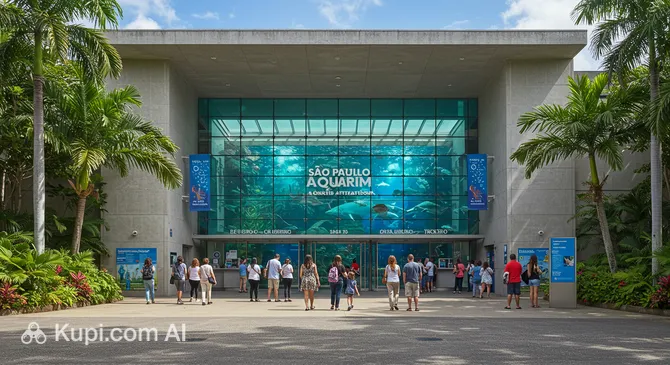
São Paulo Aquarium. Illustration.
Source: Kupi.com AI

Traveler photos:

The São Paulo Aquarium uses modern technology to create environments for the animals that are as close as possible to their natural habitats. This allows guests to observe their behavior in comfortable and educational conditions. Besides its entertainment function, the aquarium fulfills an important educational mission by teaching about the planet's biodiversity and the need for its conservation. It is a place that will be interesting for both adults and children and will provide a wealth of vivid impressions.

Contacts

To plan your visit and check details such as current opening hours, ticket prices, or special event schedules, it is recommended to contact the São Paulo Aquarium directly. Below are the official contact details.

How to contactContact
AddressR. Huet Bacelar, 407 - Vila São José, São Paulo - SP, 04275-000, Brazil
Phone number+55 11 2273-5500
Websiteaquariodesaopaulo.com.br

What to Do

A visit to the São Paulo Aquarium is a fascinating journey to different corners of the planet. You can explore themed exhibits dedicated to the fauna of the Amazon, Africa, Australia, and even cold Antarctica. Here you will find tanks with colorful tropical fish, crocodiles, fur seals, sharks, and penguins. The polar bear enclosure attracts special attention, being a unique opportunity for Latin America.

Many interactive activities are provided for visitors. You can watch the animal feeding schedule, which allows you to see them during their most active moments. Furthermore, the aquarium offers educational exhibitions and informative workshops for children, which use a playful format to teach about the importance of nature conservation. For the youngest guests, special play areas are equipped and animation programs are held, making the visit interesting for the whole family.

To dive deeper into the world of wildlife, you can join a guided tour. Professional guides provide detailed information about the characteristics of each species, their habitats, and habits. This is a great way to learn many interesting facts and make your visit not just entertaining but truly educational. Some exhibits, such as the touch tank, even allow you to touch certain marine inhabitants, providing an unforgettable experience.

Getting There

The São Paulo Aquarium is conveniently located in the Ipiranga district, relatively close to the city center, making it easily accessible for tourists. One of the most convenient ways to get here is by using the metro. You need the Green Line (Line 2), and the closest station to the aquarium is Santos-Imigrantes. From the station to the aquarium entrance, it's a pleasant walk that takes about 15–20 minutes.

In addition to the metro, the aquarium can be reached by city buses with routes passing through the Ipiranga district. If you prefer a more comfortable and faster way to travel, taxis or ride-sharing services, popular in São Paulo, are at your disposal. The ride from the city center doesn't take much time, depending on traffic conditions.

For those traveling by car, reaching the São Paulo Aquarium is also straightforward. It is located at: Rua Huet Bacelar, 407 — Ipiranga. Visitor parking is provided near the entrance, eliminating the need to search for a spot on busy streets. This is especially convenient for families with children or large groups.

Nearest city: Sao Paulo

History & Facts

Opened in 2006, the São Paulo Aquarium quickly evolved from a new city landmark into one of Brazil's most important centers for environmental education. From the beginning, its mission went beyond simple entertainment, setting an ambitious goal: to introduce residents and visitors of the metropolis to the planet's amazing biodiversity and instill a responsible attitude toward nature.

The aquarium gained true world fame thanks to its polar bear conservation program. This initiative became particularly significant after the polar bears Aurora and Piligrim were moved here from Russia as part of an international project. Their adaptation and subsequent life in specially created conditions became a subject of close attention from scientists and the public.

The culmination of this program was a historic event: in 2024, a cub named Nur was born to the pair. This was the first instance of a polar bear being born in Latin America, which was a sensation and a huge achievement for the entire continent. This fact not only strengthened the São Paulo Aquarium's reputation as a leading conservation institution but also secured its place in the history of global efforts to preserve this vulnerable species.

Time Needed

When planning a visit to the São Paulo Aquarium, you should aim for a duration of 2 to 3 hours. This time is usually enough to leisurely walk through all the main themed zones — from the Amazon rainforests to the icy expanses of Antarctica — and see the most interesting inhabitants, including sharks, penguins, and rare reptiles. The entire route is designed sequentially, ensuring you don't miss anything important.

If you are traveling with children or want to get the most out of your visit, feel free to set aside about 4 hours or even more. This will allow you to participate in interactive programs without rushing, watch the animal feeding schedules — which is always a spectacular sight — and take a break for rest and a snack at one of the on-site cafes. Thus, for a full immersion in the atmosphere of this amazing place, it is best to allocate half a day.

Working Hours

The São Paulo Aquarium is open to visitors year-round, making it a great choice for a visit at any time. As a rule, it is open daily from 9:00 AM to 5:00 PM. It is important to note that the closing time represents the last possible entry, so it is better to arrive early. The schedule may change on holidays or depending on the season, so it is highly recommended to check current information on the attraction's official website before your trip.

To guarantee entry and avoid long queues, especially on weekends, holidays, or during school breaks, it is strongly recommended to buy tickets online in advance. Online purchasing not only saves time but often requires pre-booking your visit for a specific date and time, which helps distribute the flow of visitors evenly and makes your stay more comfortable.

9:00 – 17:00

Nearby

Visiting the São Paulo Aquarium is a great start for exploring the city, but its surroundings offer just as many interesting discoveries. The Ipiranga district, where this attraction is located, and neighboring parts of São Paulo are rich in cultural and historical sites. By combining a visit to the aquarium with a stroll through nearby parks or museums, you can create a full one-day itinerary.

This approach will allow you to dive deeper into the atmosphere of this dynamic metropolis and see its different facets — from natural diversity to rich historical heritage. Below is a list of interesting places located nearby that will help make your journey through Brazil even more memorable.

NameDistance
Ipiranga Museum1 km
Ibirapuera Obelisk4.2 km
Enigma Club5.4 km
Hotel Unique5.5 km
São Paulo Museum of Art5.5 km
Catavento Museum5.6 km
Famiglia Mancini Trattoria5.7 km

Have you reached the end of the page?

So the route has been studied inside and out