Support

Esquimalt Lagoon Migratory Bird Sanctuary

About

Imagine a quiet harbor where fresh water meets salt, creating a unique ecosystem for thousands of winged travelers. The Esquimalt Lagoon Migratory Bird Sanctuary is a picturesque nature reserve located near the city of Langford. This location in Canada is famous for its shallow lagoon, separated from the Strait of Juan de Fuca only by the narrow sandy spit of the Coburg Peninsula.
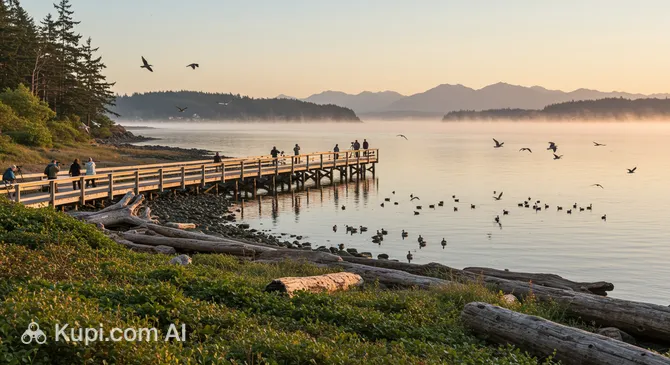
Esquimalt Lagoon Migratory Bird Sanctuary. Source: Kupi.com AI

The sanctuary covers an area of 134 hectares and is a key point on the Pacific Flyway. More than 220 bird species have been recorded here, including majestic Great Blue Herons, Bald Eagles, and numerous flocks of waterfowl. The mudflats and estuarine marshes serve as an ideal "dining room" for birds migrating from far-off Alaska to South America.

Beyond its natural significance, the lagoon is a territory with a rich cultural heritage belonging to the Esquimalt and Songhees Nations. It is not just a park, but a living museum of nature, where every turn of the path reveals views of the snow-capped Olympic Mountains and the historical towers of nearby forts.

Contacts

To clarify information about visiting the sanctuary or nature conservation rules, you can use the official communication channels.

Phone+1 800-668-6767
Websiteesquimaltlagoon.com
AddressColwood, BC, Canada

What to Do

The main draw for visitors here is, undoubtedly, birdwatching. Armed with binoculars, you can see rare bird species in their natural habitat. The lagoon looks particularly impressive between October and May, when thousands of waterfowl take a break here. Special information boards are installed along the shore to help you accurately identify exactly who is flying overhead.

For outdoor enthusiasts, the lagoon offers walks along scenic trails and the opportunity to go kayaking in waters sheltered from the wind. The beaches of the Coburg Peninsula are ideal for family picnics and thoughtful contemplation of the seascapes. If you're lucky, you might spot otters, sand dollars, or even schools of Pacific herring in the water.

Wildlife photographers will find an inexhaustible source of inspiration here, especially during the "golden hours" of sunrise and sunset. It's important to remember the sanctuary's rules: to avoid disturbing the inhabitants, dogs must be kept on a leash and visitors should stay on marked trails, preserving the fragile balance of this amazing place.

Getting There

The sanctuary is conveniently located in the suburb of Colwood, about 10 kilometers west of Victoria. If you are traveling by car, the drive from downtown Victoria via the Trans-Canada Hwy (Hwy 1) takes about 15–20 minutes. You will need to turn onto Old Island Hwy and then follow Ocean Boulevard, which leads directly to the picturesque Coburg Peninsula. Free parking is provided at the sanctuary entrance and along the beaches.

For those who prefer public transport, BC Transit buses run regularly from Victoria to Colwood. The stop is within walking distance of the lagoon, making the site accessible even without a private vehicle. The area is also very popular with cyclists thanks to well-maintained coastal paths and the absence of steep elevation changes.

History & Facts

The area around Esquimalt Lagoon has deep roots reaching back into the past of the Esquimalt, Songhees, and Beecher Bay indigenous peoples. For millennia, these lands served as an important source of sustenance: clams were gathered, fish were caught, and birds were hunted here. Archaeological finds confirm that the Coburg Peninsula was not just a place for harvesting, but also a space for the spiritual practices of the First Nations.

The European history of the site began in the mid-19th century, when a British naval base was established here in 1854. Later, during the gold rush of 1858, an influx of settlers led to the development of farming in the surrounding area. However, awareness of the lagoon's natural value came quite early: on December 12, 1931, it officially received the status of a migratory bird sanctuary to protect the Pacific coast fauna from mass hunting.

The modern era of the sanctuary's life is characterized by close cooperation between ecologists and First Nations communities. In recent decades, strict rules have been introduced, such as mandatory leashing of dogs and the creation of "total quiet" zones for birds. Today, the lagoon is a living example of how the ecosystem of salt marshes and wetlands can be restored in proximity to urban infrastructure.

Time Needed

To take a leisurely stroll along the coast and enjoy the views, 1 to 3 hours is sufficient for most visitors. This time is enough for a short birdwatching session, checking the interpretive signs, and a small walk along the Coburg Peninsula.

If you plan a full picnic on the beach, professional wildlife photography, or kayaking in the calm waters of the lagoon, you should set aside half a day for the trip. Morning and evening hours are especially valuable for those who want to see the maximum variety of birds in soft light.

Working Hours

The sanctuary doors are open to everyone 24 hours a day, 7 days a week. You can come here at dawn to catch the awakening of nature, or late in the evening for a secluded walk under the starry sky.

Year-round access allows you to observe the changing seasons and bird migration cycles at any time convenient for you, as the site has no days off or seasonal closures.

Nearby

A visit to the lagoon can easily be combined with exploring other interesting sites in the vicinity. The proximity of historical landmarks and cozy local establishments allows for a full day's itinerary, alternating fresh air walks with relaxation in atmospheric pubs or restaurants.

NameTypeDistance (km)
Building 29Attraction0.7
The Rose - neighbourhood public housePub2.1
Boston PizzaRestaurant3.4
Darcy's Pub WestshorePub3.5
Browns Socialhouse LangfordRestaurant3.7
MR MIKES SteakhouseCasualRestaurant4.5
Bucky's TaphousePub4.5
Everything WineShop4.6
City Centre GrilleRestaurant4.8
The Loghouse PubPub5.1

Reached the end of the page?

That means the route is fully explored