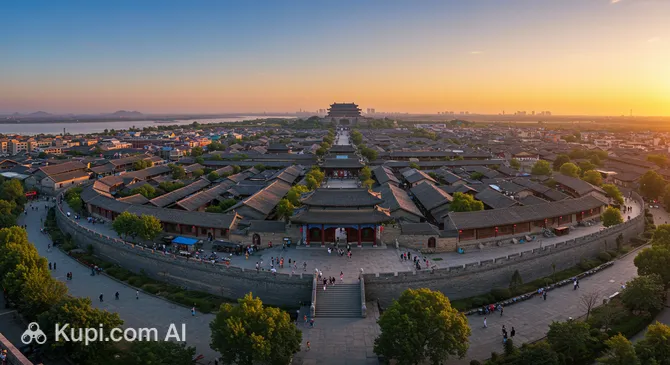
Ancient Hancheng is a treasure trove of Chinese civilization, located on the western bank of the legendary Yellow River in Shaanxi Province. With a history spanning over three millennia, the city serves as a living monument to China's imperial past. Here, provincial tranquility harmoniously blends with the grandeur of ancient architecture, creating a unique atmosphere for a thoughtful journey.
Hancheng. Illustration.
Source: Kupi.com AI
Geographically, the city occupies a strategic position within the Weinan prefecture, serving as an important industrial and cultural hub for the region. With a population of about 391,000, Hancheng remains compact enough to preserve its ancient spirit. Exploring its rich historical heritage, travelers discover not just a settlement, but the birthplace of the great Sima Qian, the "father of Chinese historiography," whose name is inextricably linked to these lands.
The main magnet for travelers is the well-preserved Ming Dynasty city walls—some of the few in the country that have reached us almost in their original form. A walk through the old city, covering nearly one square kilometer, reveals authentic residential quarters and ancient temples. We invite you to visit Hancheng to touch the roots of Eastern culture and enjoy picturesque views of the Yellow River's bends.
Weather Overview
Hancheng is dominated by a continental monsoon climate that clearly separates the seasons. Summers here are hot and quite humid—the average temperature in July is about +25.3°C, and daytime highs often exceed +30°C. Winters, on the contrary, are dry and frosty: in January, the thermometer drops to an average of -1.1°C, and due to strong winds, the cold can feel more piercing.
If you are planning a trip, aim for the spring (April–May) and autumn (September–October) months. During this period, the city's climate is most pleasant for long walks through historical sites: the air temperature fluctuates within comfortable limits from +15°C to +24°C, and rainfall is low.
It is worth considering that most of the annual precipitation falls in July and August, which can be accompanied by brief but heavy downpours. Winter months in Hancheng are practically devoid of precipitation, which makes the sky clear, but requires warm windproof clothing for exploring the city walls and the banks of the Yellow River.
Average monthly temperature
Average monthly precipitation
Interesting Facts
Cradle of History: Hancheng is the birthplace of Sima Qian (145–86 BC), the great historian of the Han Dynasty, whose work "Shiji" laid the foundations of Chinese historiography.
Ancient Bastions: The city has preserved authentic Ming Dynasty city walls built in the 14th century, which is a great rarity in modern China.
Etymology of the Name: The name "Hancheng" literally translates to "City of Han," directly referencing the era of the imperial dynasty of the same name.
Natural Gateway: The city is considered the starting point for visiting the Huanglong Cave—an amazing natural site with a complex system of stalactites and stalagmites.
Architectural Continuity: The first earth walls of the future city were erected in 1164, long before the large-scale construction of the Ming and Qing eras.
How to Get There
Despite its status as a provincial center, Hancheng enjoys good transport links with key cities in Shaanxi Province. Most tourists arrive via the region's major transport hubs, using the developed railway network and modern highways. For detailed route planning, we recommend checking the available transport links.
The nearest airports to the city are in Weinan and Xi'an (the distance to the latter is about 200 km). Most international travelers fly into Xi'an, from where Hancheng can be reached by high-speed train in 1.5–2 hours. This is the most comfortable and fastest way to start exploring the ancient city.
Railway transport plays a key role in the region's logistics. Hancheng Station serves both regular passenger trains and high-speed trains connecting the city with Weinan and other hubs in the province. Bus services are also well-developed: buses from Weinan (a distance of about 50 km) depart regularly, and the travel time is usually about an hour and a half, provided there are no traffic jams near the Yellow River.
Station
Passenger traffic
Distance
Yuncheng North railway station
4
64 km
Linfen West railway station
4
115 km
Yan'an Railway Station
3
148 km
Shangluo North Railway Station
2
184 km
Xi'an North railway station
10
184 km
Main Attractions
The main attractions of Hancheng are deeply historical in nature. The jewel of the city is the Ancient City of Hancheng, founded as early as 195 BC. Walking through its winding streets, you can feel the breath of time, especially near the massive Ming Dynasty city walls that reliably guard the peace of the old quarters.
A special place in any tourist's itinerary is Sima Qian's Tomb and Ancestral Temple. This memorial complex is dedicated to the great historian and impresses with its solemn architecture and panoramic views of the Yellow River. A visit to this site allows for a better understanding of ancient China's intellectual legacy and the magnitude of the author of "Shiji."
Equally interesting is Dangjia Village—a unique architectural ensemble that has preserved its traditional layout and residential houses from the Ming and Qing dynasties. Also worth noting is the Temple of the City God, built in 1571, which is considered one of the most richly decorated religious sites in the region. For fans of ancient fortifications, Hancheng offers the chance to view the ruins of the Great Wall of the State of Wei, adding another chapter to the history book of this amazing place.
Local Cuisine
The culinary traditions of Hancheng are closely linked to the gastronomy of Shaanxi Province, where wheat products and aromatic spices take center stage. While here, be sure to try the famous biangbiang noodles—thick, hand-made noodles served with hot oil, garlic, and vegetables. Another local favorite is baozi with various fillings, which locals often buy for breakfast.
The proximity to the Yellow River and the region's historical ties have left an imprint on meat dishes: mutton is masterfully prepared here. Try the rich lamb soups or fried flatbreads with spicy minced meat. The general character of the local cuisine can be described as hearty, moderately spicy, and very homey. Among drinks, various types of green tea and local fruit infusions are popular.
The dining culture in the city is mainly represented by small family restaurants and lively street stalls at the entrances to the ancient city. It is in such authentic establishments that you can experience the true taste of the region. Street food in Hancheng is not just a snack, but an opportunity to see the process of preparing traditional treats right before your eyes, which adds a special flavor to the meal.
Travel Tips
A trip to Hancheng will be an unforgettable experience if you consider a few practical points characteristic of this ancient corner of China in advance. We have prepared several tips to help you feel confident.
Clothing and Footwear: Choose the most comfortable shoes for walking on the uneven stones of the old city and climbing the fortress walls. The weather here is ideal in spring and autumn, but you should bring a windbreaker.
Transport: Install the Didi app for calling taxis and Alipay for paying on buses. Public transport can be crowded during peak hours, so plan your trips for the middle of the day.
Finance: Cash is hardly used in China, so link an international card to Alipay or WeChat Pay. A small supply of yuan will only be useful in the most remote shops.
Health: During the winter period, smog is possible due to industrial activity. If you have allergies, bring protective masks and monitor the air quality index.
Communication: English is not widely spoken in the province. Be sure to download an offline translator and save the hotel address in Chinese (characters).
Etiquette: When visiting temples, keep quiet and do not take photos of worshippers without permission. A polite "Ni hao" at the beginning of a conversation always earns the sympathy of the locals.
What to Avoid: Do not plan walks in the industrial areas on the outskirts of the city in the evening—there is little of interest for a tourist there, and it may be uncomfortable due to truck traffic.
Specific Tip: Try to get to the city walls during the sunset hour—this is the best time to view the panorama of the Yellow River and get the most striking photos.
May your acquaintance with the birthplace of Sima Qian be filled only with pleasant discoveries and harmony with history!
Entertainment & Nightlife
Entertainment in Hancheng is calm and contemplative, reflecting its status as an ancient cultural center. You won't find noisy nightclubs or neon bars common in megacities here. Instead, the city offers the magic of evening walks: after sunset, the ancient city walls are illuminated with soft lights, creating a backdrop for unforgettable photo sessions and romantic relaxation.
Daytime leisure is focused on exploring history and natural beauty. Tourists often spend time in traditional tea houses, where they can not only sample local varieties of the drink but also observe the slow-paced life of the townspeople. For those seeking more active experiences, excursions along the banks of the Yellow River or visits to local festivals dedicated to historical events and legends of the region are available.
If you crave a vibrant nightlife with concerts and bar-hopping, experienced travelers suggest heading to Weinan or Xi'an for an evening, both of which are conveniently connected to the city by rail. In Hancheng itself, it is best to enjoy the silence of the riverside parks and the peaceful atmosphere of the temple complexes, which take on a special charm at twilight.
Parks & Museums
Immersion in the cultural life of Hancheng is impossible without visiting its main museums. The Hancheng Museum, located in a beautifully preserved Confucian temple, takes center stage. It houses unique artifacts detailing the city's development from antiquity to the present day. No less significant is the Sima Qian Hall, which functions as a memorial museum where the life and work of the great historiographer are revealed through manuscripts and installations.
The city's natural areas are closely linked to the landscapes of the Yellow River. Parks located along the shoreline offer guests quiet walking routes with views of the majestic waters of the Yellow River. Although there is less large-scale landscape art here than in the provincial capital, the modest green zones of Hancheng are charming in their naturalness and silence.
The city's greenery has a distinct provincial character: small squares at the foot of ancient walls and green terraces on the hills serve as favorite relaxation spots for locals. For tourists, these locations are ideal for taking a break between visits to historical sites and having a small picnic while admiring the panorama of the old city and the river landscapes.
Getting Around
The public transport system in Hancheng is geared toward the needs of a compact city and consists mainly of bus routes and taxis. Municipal buses cover all key areas, including the historical center and new residential quarters. Service intervals are 10–20 minutes, making them a convenient means of transport for budget tourists.
The city does not have a metro, so taxis remain the most popular alternative to buses. To call a car, it is best to use the Didi app—the Chinese equivalent of popular international services. Taxis here are relatively cheap, but during peak hours or heavy rain, waiting times can increase to 15 minutes due to traffic at the city entrances.
For exploring the old quarters of Hancheng, transport is practically unnecessary: it is best to get around on foot or rent a bicycle through special apps. A walking tour will allow you to peek into the narrowest alleys of the ancient city, which are inaccessible to cars. When planning trips to the outskirts or industrial zones, it is recommended to check bus schedules in advance, as transport runs less frequently on these routes.
Accommodation
Accommodation options in Hancheng can satisfy the needs of a wide variety of travelers. The bulk of tourist housing is concentrated in the ancient city area and along the central thoroughfares. Here you can find both modern mid-range hotels with the usual level of service and cozy guest houses that allow you to dive deeper into the atmosphere of old China.
For those who value local flavor, small family-run hotels located directly inside or near the Ming Dynasty city walls are an ideal choice. Staying in such places offers the chance to enjoy historical views right from your room window. For business trips and short visits, comfortable chain hotels are available in the new city center, where the infrastructure is more modern.
When planning a visit, keep in mind that during national holidays and festivals dedicated to Sima Qian, the demand for housing increases sharply, so it is better to book rooms in advance. The price range in the city remains very affordable compared to megacities, making Hancheng an excellent destination for a budget-friendly but impression-rich vacation.
Nearby Cities
Hancheng serves as an excellent starting point for exploring the eastern part of Shaanxi Province and the neighboring Shanxi Province, offering travelers interesting routes for short trips. Just 28 kilometers away is the city of Hejin, which can be visited to get acquainted with the industrial and cultural landscape of the neighboring region.
For those ready to travel a little further, an excellent destination is Yuncheng (about 72 km away), known for its Salt Lake and rich history. Also worth visiting is Yongji, located 68 kilometers away, where many monuments of ancient architecture are concentrated. These cities can be reached by suburban buses or trains, making day trips easy and pleasant.
The region around Hancheng is rich in hidden gems, from the scenic banks of the Yellow River to small temple complexes lost among the hills. We recommend not limiting yourself only to the city walls, but dedicating time to exploring the surroundings to fully appreciate the diversity and hospitality of this part of China.
Shopping & Souvenirs
Shopping in Hancheng is primarily about searching for unique items with historical context. The main shopping opportunities are concentrated in the markets and small shops at the gates of the Ancient City. Here, the atmosphere of traditional Chinese trade prevails, where the process of choosing goods turns into a small adventure.
As souvenirs from Hancheng, people most often bring back replicas of ancient artifacts, calligraphy, and books dedicated to Sima Qian. The city is also famous for its local crafts: textiles with traditional embroidery and ceramic products. Fans of gastronomic gifts can purchase excellent local tea and spices typical of the Shaanxi region here.
Modern shopping centers in the city are quite modest and are located mainly in the new center, not far from the main square. Most shops are open from morning until late evening, and payment is most often made through mobile applications (Alipay, WeChat Pay), although cash Yuan is still welcomed in the souvenir shops of the old city. If you are looking for something special, check out the weekend markets where you can meet local artisans and collectors of rarities.