Situated on the fertile Guanzhong Plain, Weinan is a major cultural and historical hub of China. With a population of over 5.3 million, the city spans the confluence of the Wei and Yellow Rivers, a location that has made it a strategic economic center between the ancient capitals of Xi'an and Luoyang for centuries.
Weinan. Illustration.
Source: Kupi.com AI
The city's modern face harmoniously blends dynamic development with a deep historical heritage reaching back to antiquity. While Weinan officially gained prefecture-level city status in 1995, its lands remember events from thousands of years ago as one of the cradles of Chinese civilization.
For tourists, the city is primarily attractive due to its proximity to the sacred Mount Huashan and unique archaeological sites. The atmosphere of Weinan is imbued with the tranquility of provincial China, where traditional farmlands—famous for their apples and pomegranates—sit alongside modern residential districts. Visiting this region offers a rare opportunity to witness the authentic rhythm of life in Central China.
Weather Overview
The climate in Weinan is distinctly continental with four clear seasons. Winters here are usually cold and dry; in January, the average temperature is around +1.3°C, and at night it often drops to -3.5°C. Precipitation is sparse during this time, so the weather is favorable for quiet city walks, provided you have warm clothing.
Summers in the city are hot and humid, with peak temperatures in July and August when the air warms up to +32°C. This period also sees the most rainfall, often in the form of short but intense downpours. If you want to study the city's climate in detail before your trip, keep in mind that spring (April-May) and autumn (September-October) are considered the most comfortable seasons for a visit.
Spring months offer mild warmth: in April, the average temperature stays around +17°C, and nature begins to bloom. Autumn in Weinan is dry and sunny, with pleasant temperatures around +15...+21°C, making it ideal for long excursions to historical monuments and walks in the foothills.
Average monthly temperature
Average monthly precipitation
Interesting Facts
Geographical Paradox: The city's name literally translates to "south of the Wei River," yet due to changes in the landscape and city growth, most of it is now located north of the river.
Ancient Roots: Remains of the "Dali Man" were found in the Weinan area, proving that humans inhabited these lands as far back as the Paleolithic era.
Imperial Rest: During the prosperous Tang Dynasty, this region was considered so prestigious that ten emperors of this great dynasty were buried here.
Memory of the Elements: In 1556, Weinan was at the epicenter of one of the deadliest earthquakes in human history, which fundamentally changed the landscape and history of Shaanxi Province.
Cradle of Statehood: The first administrative settlements appeared here as early as the 7th century BC, when the State of Qin was founded on these lands.
How to Get There
Thanks to its location on the main transport artery between Xi'an and the eastern provinces, reaching Weinan is quite easy. The city is a major hub of the railway network, served by high-speed trains connecting Beijing, Shanghai, and neighboring Xi'an. You can explore the routes and ways to arrive in detail to plan your trip effectively.
The city does not have its own major airport, so most tourists use Xi'an Xianyang International Airport (XIY). It is the region's largest air hub, receiving flights from all over the world. From the airport, Weinan can be reached by high-speed train, intercity bus, or taxi; the journey takes about an hour and a half to two hours.
Rail transport is the most convenient way to travel. Weinan North Railway Station serves high-speed trains, making the trip to Xi'an in just 15–20 minutes. This makes the city an excellent base for day trips throughout Shaanxi Province.
Station
Passenger traffic
Distance
Xi'an North railway station
10
55 km
Xi'an railway station
10
56 km
Shangluo North Railway Station
2
81 km
Yuncheng North railway station
4
150 km
Ankang Railway Station
3
203 km
Main Attractions
Weinan and its surroundings are a true treasure trove for history buffs and fans of breathtaking landscapes. One of the most famous natural landmarks is the majestic Mount Huashan. It is renowned not only for its sheer cliffs and cloud-shrouded peaks but also for the legendary "Plank Walk in the Sky"—a narrow wooden path over an abyss that draws thrill-seekers from all over the world.
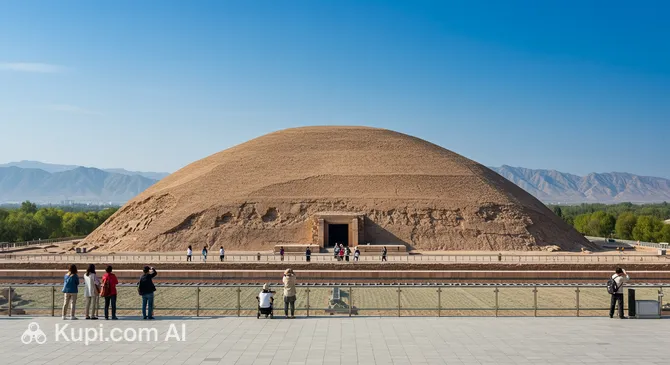
In the immediate vicinity of the city lies a UNESCO World Heritage site — the Mausoleum of the First Qin Emperor. This grandiose structure captures the imagination with its scale and historical significance, serving as a key point on any itinerary through Shaanxi Province.
Mausoleum of the First Qin Emperor. Illustration.
Source: Kupi.com AI
Traveller photos:
Beyond ancient monuments, the city offers a chance to explore the region's "revolutionary history." For instance, it is worth visiting the former home of Wang Taiji, one of the founders of the Red Army. The exhibition dedicated to revolutionary events allows for a deeper understanding of the country's modern development and local values.
Local Cuisine
The cuisine of Weinan is a vivid reflection of Shaanxi Province's gastronomic traditions, where wheat-based dishes, aromatic spices, and hearty soups take center stage. Be sure to try Roujiamo—the Chinese equivalent of a burger with succulent minced pork in a crispy flatbread—as well as the famous "Biang Biang" noodles, known for their unusual width and generous amount of spicy sauce.
The region is historically known as a land of orchards, so the local cuisine is rich in fresh fruit. Weinan's apples and pomegranates are considered some of the best in the country; they are often served as dessert or used for fresh juices. For drinks, look out for local rice wine and various types of green tea grown on the slopes of the nearby mountains.
For the best culinary adventures, head to the night markets or small family restaurants where the locals eat. If you find yourself near iconic sites like the Mausoleum of the First Qin Emperor, you will find many establishments offering traditional sets for tourists, but for an authentic taste, it's better to head deeper into the residential blocks of the Linwei district.
Travel Tips
Preparing for your trip to Weinan will help you fully enjoy the beauty and history of this region of China. These practical tips will help make your journey comfortable and safe.
Clothing and Equipment: Choose clothing according to the season. For city walks, casual style is fine, but if you plan to climb Huashan, sturdy trekking boots and layered clothing are essential—it can be windy and cold at the peaks even in summer.
Transport: High-speed trains are the fastest way to move between cities. For city travel, install the DiDi app (English version available) to avoid issues with explaining the route to taxi drivers.
Finances:Alipay or WeChat Pay are used almost everywhere in China. Link your international card to one of these apps in advance. Cash is accepted, but finding change can be difficult.
Health: Pharmacies are common, but medicine names will be in Chinese. Bring a basic first-aid kit. Tap water is not recommended for drinking—buy bottled water instead.
Communication: Install an offline translator and download the Chinese data pack. English is not widely spoken here, so a card with your hotel address in Chinese will be extremely useful.
Etiquette: Greet people with a slight nod. Tipping is not customary in restaurants—it might even confuse the staff. Be polite and patient in crowded places.
What to Avoid: Do not engage in discussions on political topics and respect the rules of conduct in temples and at memorial sites.
Planning Tip: Try to visit Mount Huashan on weekdays to avoid the massive queues for the cable cars that are common on weekends.
May your journey to Weinan be a bright discovery, filled with amazing views and a touch of centuries-old history!
Entertainment & Nightlife
Weinan's entertainment scene offers tourists a classic array of pleasures found in a large Chinese metropolis. Evening life is centered in the central districts, where neon signs of modern shopping centers and restaurants light up after sunset. Locals enjoy spending time in karaoke bars (KTV) and cozy cafes where you can try traditional tea or modern desserts.
For those seeking cultural leisure, there are theaters and cinemas showcasing both national productions and global new releases. Outdoor enthusiasts should consider evening strolls in city parks, where you can often see group dancing or qigong exercises, creating a unique glimpse into everyday local life.
If you are looking for real adventure, the proximity to Mount Huashan allows you to plan not just daytime climbs, but also to watch the sunrise from one of its peaks. Tours to iconic sites like the Emperor Qinshihuang's Terracotta Army Museum are also available in the region, making for a very full daytime program.
Parks & Museums
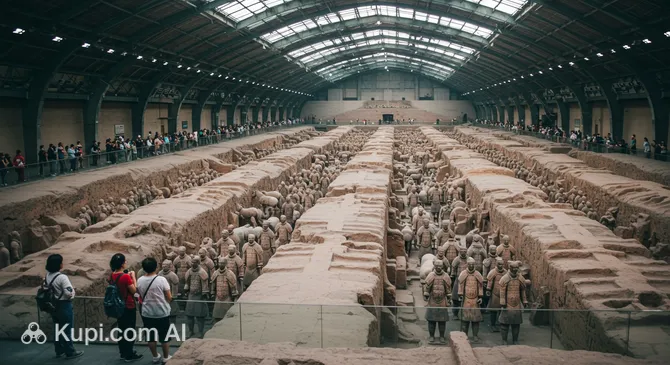
The region's primary pride in the museum sphere is the Emperor Qinshihuang's Terracotta Army Museum, located on the district's border. This grandiose complex allows you to see thousands of unique statues of warriors and horses created over two thousand years ago. The scale of the excavations and the detailing of each figure make this museum a must-visit for every tourist.
Museum of Qin Terracotta Warriors and Horses. Illustration.
Source: Kupi.com AI
Traveller photos:
In the very center of the city, the Weinan Museum is worth a visit. Its exhibits detail the region's history from prehistoric times to the present. Special attention is given to archaeological finds from the Zhou, Qin, and Tang dynasties, as well as the traditional crafts for which the Wei River valley was famous. The museum is a great place to span a thousand years of the region's history in a couple of hours.
Among the green zones, parks dedicated to revolutionary history and the natural landscapes along the embankments stand out. It is recommended to visit the memorial sites associated with Wang Taiji, which are harmoniously integrated into the urban environment. While information about parks in open sources may be limited, locals can always point the way to well-maintained squares where you can relax from the city noise among shady alleys.
Getting Around
Weinan's public transport system is focused on ease of movement within the large city district. Buses are the main form of transport, covering almost all city areas and suburbs. Routes are designed to connect residential quarters with railway stations and key shopping zones. Fares are usually paid in cash (exact change is needed) or via QR codes through payment systems.
For tourists, taxis and ride-hailing services (such as DiDi) remain the most comfortable way to get around. Taxis in Weinan are relatively inexpensive compared to Beijing or Shanghai. This is a convenient option for trips to attractions located on the outskirts. Note that drivers rarely speak English, so prepare the destination name in Chinese beforehand or show it on a map.
Thanks to the developed high-speed rail network, Weinan is effectively integrated into the transport system of neighboring Xi'an. This allows the city to be used as a base for travel, moving quickly between the cultural sites of Shaanxi Province. Bike rentals are also gaining popularity in the central parts of the city, offering an eco-friendly way to explore local streets and parks.
Accommodation
Weinan offers a wide range of accommodation options to suit both budget travelers and those seeking comfort. Most modern hotels are concentrated in the Linwei district—the business heart of the city, where international hotel chains and large Chinese business hotels are located. Here you will find developed infrastructure, including proximity to shopping centers, restaurants, and transport links.
If your main goal is to visit Mount Huashan, consider staying at its base in the city of Huayin. There you will find many guesthouses, traditional inns, and specialized hotels for climbers. Booking accommodation in this area will allow you to start your ascent early in the morning, avoiding the crowds.
For those planning a cultural program, staying near major museums like the Emperor Qinshihuang's Terracotta Army Museum is a convenient option. During peak seasons (May holidays and the "Golden Week" in October), accommodation prices can rise significantly, so it is recommended to book rooms 3-4 weeks in advance. On average, a quality room in a four-star hotel is moderately priced compared to megacities like Shanghai.
Nearby Cities
Weinan serves as an excellent starting point for exploring the rich historical heritage of Shaanxi Province, as it is located in the heart of ancient China. Just an hour's drive away is the legendary Xi'an—a city with a three-thousand-year history where you can see the ancient city wall, the Giant Wild Goose Pagoda, and immerse yourself in the atmosphere of the Muslim Quarter.
For nature lovers and hikers, a trip to Huayin, located at the foot of the sacred Mount Huashan, is a must. This destination is perfect for a day trip, allowing you to enjoy breathtaking views and return to your hotel by evening. Also worth noting is the small city of Sanyuan, known for its preserved traditional architecture and cozy atmosphere.
Exploring the surroundings of Weinan will allow you to see the contrast between futuristic metropolises and quiet county towns that have preserved the spirit of old China. Good transport links make such excursions easy and pleasant.
Shopping & Souvenirs
Shopping in Weinan is primarily an opportunity to purchase unique agricultural products and traditional Chinese goods. The city is famous for its status as the "fruit capital," so the best gifts from here are dried apples, pomegranates, or exquisite sets of local sweets. Local markets also offer high-quality silk and porcelain items typical of the central provinces.
The main shopping areas are concentrated in the Linwei district, where modern shopping centers offer products from well-known brands. Here you can find electronics, clothing, and cosmetics. For a more colorful experience, head to the street markets, which bustle in the morning with trade in handicrafts, decor items, and tea.
When visiting tourist areas, such as those near the Mausoleum of the First Qin Emperor, you will encounter many souvenir shops. It is worth looking for miniature replicas of the terracotta warriors and calligraphy. Shops generally operate from 9:00 AM to 9:00 PM, and payment is most often made via popular mobile apps (Alipay, WeChat Pay), although large shopping centers also accept bank cards.