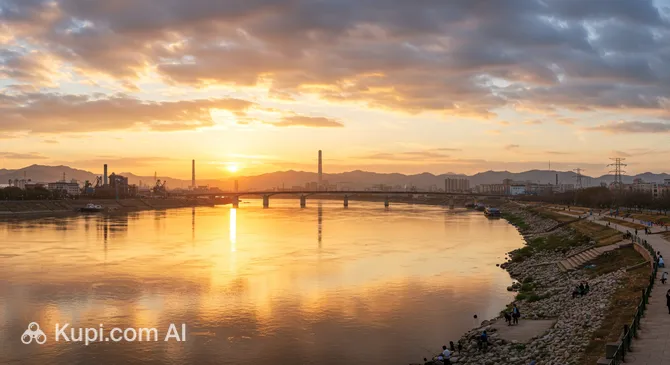
Situated in the picturesque basin of the legendary Yellow River, Hejin is an important industrial and administrative center of Shanxi Province in eastern China. It is a place where the modern rhythm of a provincial hub intertwines with the ancient landscapes of the river valley. With a population of about 395,000, the city plays a significant role in the region's economy, offering travelers an authentic look at life in modern China off the beaten path.
Hejin. Illustration.
Source: Kupi.com AI
The city's geographic location in the Yellow River valley has largely determined its development and rich history. Hejin serves as an important trade hub connecting the surrounding agricultural and industrial areas. Although the city is not a mass tourist destination, it attracts visitors with its sincerity and the opportunity to see the real, unvarnished China with its developed infrastructure, bustling markets, and hospitable residents.
The main natural treasure of the surroundings is the Dragon Gate area—a place where the Yellow River is squeezed between majestic cliffs, creating stunning views. A visit to this city is an invitation to explore the heart of the Middle Kingdom, enjoy the tranquility of the riverbanks, and discover the unique cultural heritage of Shanxi Province.
Weather Overview
The city of Hejin is located in a continental climate zone, characterized by a clear change of seasons. Winters here are usually cold and dry: in January, the average temperature stays around -1°C, but it can drop to -6°C at night. Summer, on the contrary, can be hot and humid—in July and August, the thermometer often reaches +30°C, and most of the annual precipitation falls during this period.
Spring and autumn are considered the most favorable seasons to visit the city, as mild and comfortable temperatures are established at this time. If you are planning a trip, keep in mind that the weather can be changeable during transitional seasons. More detailed information and the current forecast can be found on the page describing the weather in Hejin.
Special attention should be paid to precipitation in the summer months, when showers can be brief but very intense. In winter, snow falls rarely, and clear but frosty weather prevails. Due to its location in the Yellow River valley, air humidity can change depending on the season, which should be considered when choosing a wardrobe for the trip.
Average monthly temperature
Average monthly precipitation
Interesting Facts
The name of the city Hejin literally translates as "between rivers," emphasizing its unique location in the Yellow River valley.
The city is located in close proximity to the legendary Dragon Gate area—a natural phenomenon on the Yellow River considered one of the most impressive stretches of its course.
Despite its industrial status, Hejin is an important cultural hub closely linked to the history of the Tang Dynasty and the exploits of General Xue Rengui.
The city ranks 12th in population in Shanxi Province, while remaining a quiet and cozy place compared to Chinese megacities.
The Yellow River here is not only a natural feature but also a major cultural symbol that shapes the identity and economic way of life of local residents.
How to Get There
The transport accessibility of Hejin is ensured by a developed network of roads and railways in Shanxi Province. Although the city itself does not have its own airport, travelers usually use air travel through the nearest major transport hubs. Detailed information about routes can be found on the specialized page how to get to Hejin.
The main air gateway for the region is the international airport of Taiyuan, located approximately 2-3 hours away. From there, the city can be reached by express buses or a rented car. The airport in Yuncheng is also in demand, as it is located significantly closer and accepts flights from many cities in China.
Railway services connect Hejin with key cities in the province. Regular trains provide a reliable and budget-friendly way for tourists to travel. Taxis are always available at the stations, ready to take you anywhere in the city.
Station
Passenger traffic
Distance
Yuncheng North railway station
4
60 km
Linfen West railway station
4
88 km
Yan'an Railway Station
3
154 km
Luoyang Longmen railway station
7
194 km
Shangluo North Railway Station
2
204 km
Bus service is one of the most popular ways to travel between cities in the region. Comfortable buses depart from neighboring provinces, and travel time varies depending on the distance of the departure point. For those who prefer freedom of movement, modern highways are available, providing quick access to the city by private transport.
Main Attractions
Although Hejin is better known as an industrial center, it can surprise curious tourists with its natural and cultural sites. Undoubtedly, the main pearl of the region is the picturesque Dragon Gate on the Yellow River (Dragon Gate on Yellow River). This majestic site is famous for its unique rock formations and the powerful current of the river, creating dramatic landscapes that have inspired Chinese poets and artists for centuries.
In the city itself and its immediate surroundings, significant historical monuments have been preserved, among which the Jiulong Temple (Jiulong Temple), or the Nine Dragons Temple, stands out. This place is steeped in an atmosphere of tranquility and traditional architecture reflecting the spiritual heritage of ancestors. Another interesting location is the historical site of Xue Rengui Cold Kiln (Xue Rengui Cold Kiln), associated with local legends about the famous general of the Tang Dynasty.
For those who prefer urban strolls, the central squares and business districts of Hejin become the center of attraction. Here you can observe the daily life of citizens, visit modern shopping centers, or simply relax in one of the local squares. The city is ideal for those seeking solitude and wanting to explore "undiscovered" China away from the crowds of tourists.
Local Cuisine
A culinary journey to Hejin is an introduction to the hearty and aromatic traditions of northern China. Local cuisine is based on wheat, so it is worth trying an endless variety of noodles. Be sure to order Dao Xiao Mian—the famous noodles that chefs masterfully cut into thin strips directly into boiling broth. These dishes are often served with thick sauces based on the vinegar for which Shanxi Province is so famous.
Meat dishes hold a place of honor in the local diet, especially lamb and beef. Traditional stews and aromatic kebabs prepared with cumin and hot peppers are immensely popular at local street stalls. The dining culture in Hejin is very democratic: from bustling night markets with an incredible selection of snacks to cozy family restaurants where portions are always generous and the atmosphere is homey and warm.
As for drinks, it is customary here to accompany a meal with hot tea, which helps in digesting calorie-rich dishes. Fans of stronger drinks can try local beer or traditional Chinese baijiu. The city's gastronomic scene delights with affordable prices and the opportunity to try real "home-cooked" food without unnecessary frills but with the authentic taste of the Shanxi region.
Travel Tips
A trip to Hejin will give you a unique experience of getting to know the real China, and these practical tips will help make your journey as comfortable and enjoyable as possible.
Clothing and Seasonality: The climate in the region is continental, so dress in layers. Winters here are dry and cold, while summer can be hot. Be sure to bring comfortable closed shoes for walking along the banks of the Yellow River.
Language Barrier: English is not widely spoken in the city. It is recommended to download an offline translator in advance and have cards with the hotel address and main points in Chinese.
Transport and Navigation: For getting around, it is most convenient to use a taxi or the Didi app. For navigation, Baidu Maps or Amap are best, as international maps may be inaccurate.
Finance: The main currency is the Chinese Yuan. While mobile payments (Alipay, WeChat) dominate, always carry cash for small shops and markets. International cards are only accepted in very large hotels.
Connectivity: For stable internet, it is worth purchasing a local SIM card (China Unicom or China Mobile) at official communication stores by presenting your passport.
Local Etiquette: A greeting with a nod of the head or a slight bow is welcomed. Try to avoid loud conversations in public places and always ask for permission before taking photos of local residents.
What to Avoid: Do not drink raw tap water—use only bottled water. It is also best to avoid discussing sensitive political topics to prevent misunderstandings.
Health: During the winter period, air quality may decrease due to the region's industrial nature, so people with sensitive respiration should carry a protective mask.
May your acquaintance with this hospitable city bring only bright emotions and pleasant discoveries!
Entertainment & Nightlife
Leisure in Hejin reflects the preferences of residents of a modern Chinese city. Main evening activities are concentrated around large shopping centers and restaurants that stay open until late. Karaoke bars (KTV) are popular here—a favorite place for meeting friends and colleagues, where you can spend time in an informal setting and get acquainted with modern Chinese pop culture.
For those who prefer quieter walks, the central squares are perfect, as they transform into venues for social dancing and active recreation for citizens at dusk. The atmosphere here is friendly and relaxed, allowing tourists to feel like part of the local community. On holidays, seasonal festivals and fairs may be held in the city, offering colorful spectacles and traditional entertainment.
Fans of more intense nightlife and large-scale concert venues are recommended to take a trip to neighboring major centers such as Yuncheng or Taiyuan. Nevertheless, Hejin offers enough opportunities to comfortably end the day in one of the many cozy cafes or restaurants serving local cuisine and refreshing drinks.
Parks & Museums
The natural landscape around Hejin is largely determined by its proximity to the Yellow River. The city's main walking areas are concentrated along its banks, where picturesque observation decks and relaxation spots are set up. It is here that you can feel the power of the great river and enjoy tranquility away from city noise, watching the water flow in the area of the famous Dragon Gate.
Although there are no major world-class museums in the city itself, you can find small cultural centers dedicated to local history and the development of the region's industry. These exhibitions tell the story of how Hejin transformed from a small settlement into an important industrial hub and what role the Yellow River played in this. It is also worth paying attention to local temples, which are open-air museums in their own right, preserving traditions of carving and architecture.
For a deeper immersion into the art and history of the province, tourists are recommended to visit museums in neighboring Yuncheng or the capital, Taiyuan. Nevertheless, Hejin itself offers a unique opportunity to see authentic monuments, such as ancient pagodas and memorial structures scattered throughout the city blocks, which best convey the spirit of this part of China.
Getting Around
The public transport system in Hejin is represented by an extensive network of bus routes connecting residential areas, shopping centers, and industrial zones. Buses are the most budget-friendly way to get around the city, though it's worth noting they can be crowded during peak hours. Schedules and signs are mostly in Chinese, so it will be useful for tourists to have a map with stop names in characters.
The most comfortable and fastest way for guests to travel is by taxi. Both traditional taxi services and the popular mobile app Didi operate in Hejin. The cost of a trip within the city is low, and cars are easy to find at specially designated stands near stations and shopping centers. This eliminates the need to navigate bus routes and saves time.
Alternative public transport for short trips includes electric scooters and bicycles, which are popular among locals. However, it's important to remember that infrastructure for them is not uniformly developed everywhere, so caution on the roads is essential. Overall, the city's transport system allows tourists to move between key points relatively easily if the route is planned in advance and peak traffic periods in the morning and evening are avoided.
Accommodation
The hotel infrastructure in Hejin is primarily oriented toward the business segment and travelers who value practicality and comfort. The bulk of the offers consist of mid-range hotels and modern budget guesthouses that offer clean rooms and a necessary set of services for a very reasonable price. This is an excellent choice for those who want to save on accommodation without sacrificing quality of service.
Most convenient accommodation options are concentrated in the central district of the city, in close proximity to shopping centers and main transport arteries. This location makes it easy to reach restaurants and attractions, as well as to quickly head out of town for sightseeing. In Hejin, you can also find apartments suitable for longer stays.
Housing prices in Hejin are significantly lower than in the major tourist centers of China, making it attractive for budget travelers. It is recommended to book hotels in advance, especially if your trip coincides with national holidays when the demand for rooms may increase due to business activity and local travel.
Nearby Cities
The city of Hejin is an excellent starting point for exploring the cultural and natural riches of Shanxi Province. Just 28 kilometers away is the historical city of Hancheng, which is famous for its preserved ancient architecture and is considered one of the best places to study the traditional Chinese way of life.
Just an hour's drive away is the large administrative center of Yuncheng, offering a wide range of entertainment and attractions, including the famous Salt Lake. It is also worth paying attention to Xiezhou, where one of the largest and oldest temples of Guan Yu in China is located, and the cozy city of Yongji with its picturesque mountain landscapes.
For those ready for longer trips, the region offers visits to Wenxi and other small settlements, each of which holds its own unique legends. Exploring the surroundings will allow you to deeper understand the history of the Yellow River and the diversity of the cultural landscape of central China.
Shopping & Souvenirs
Shopping in Hejin is a combination of modern comfort and traditional oriental flair. Main shopping centers are concentrated in the heart of the city, offering buyers a wide selection of clothing, electronics, and daily goods. Both well-known Chinese brands and international labels are represented here. Shopping complexes are equipped with modern relaxation areas and food courts, making the shopping process convenient for the whole family.
Those looking for a more authentic experience should head to the local markets and bazaars. These are noisy and vibrant places where you can find literally everything: from fresh produce and spices to textiles and folk crafts. It is customary to haggle at the markets of Hejin—this is not only a way to lower the price but also an important part of the local communication culture. Here you can find unique ceramic souvenirs or traditional Chinese jewelry.
Famous local vinegar from Shanxi, considered one of the best in China, is often brought as a gift from the city, as well as paper cuttings and calligraphy. Shops usually operate from morning until late evening without days off. For payments in large centers, it is convenient to use mobile payment systems like Alipay or WeChat Pay, but it is always useful to have some cash Yuan on hand for small markets.