Support

Adama

About

Adama, also widely known as Nazret, is one of Ethiopia's most dynamically developing centers. Located about 90 kilometers southeast of the capital, this city serves as a crucial transport and industrial hub for the Oromia region. Thanks to its strategic position on the edge of the Great Rift Valley, Adama combines the atmosphere of a modern business center with traditional Ethiopian hospitality.

Geographically, the city sits at an altitude of approximately 1,600–2,000 meters above sea level, providing it with a pleasant climate, although its proximity to the rift fault sometimes brings dusty winds. With a population exceeding 430,000 people, Adama is the country's second-largest city, attracting students to its famous universities and workers to modern manufacturing facilities.
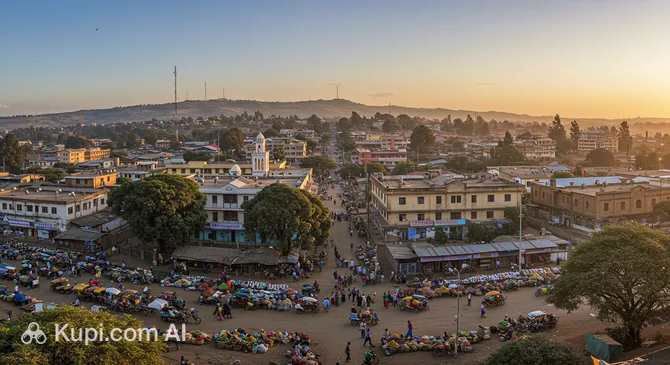
Adama. Illustration.
Source: Kupi.com AI

While Adama is not considered a classic tourist destination with an abundance of historical monuments, it captivates visitors with its energy. It is worth paying attention to the modern campus of the University of Science and Technology and the bustling central markets. To learn more about how this industrial giant was formed, you can explore Adama's history, which is inextricably linked to the development of the railway and transport routes to the sea.

For the traveler, Adama is primarily a convenient base for exploring the central part of the country and an excellent example of how modern Ethiopia is moving into the future. We invite you to feel the rhythm of this city, where traditional coffee ceremonies coexist with large-scale green energy projects.

Weather Overview

The climate of Adama is classified as tropical savanna, which makes the weather here predictable and generally comfortable for visiting. The average annual temperature stays around +22 °C. January and December are the coolest months, when night temperatures can drop to +11 °C, and during the day, the air warms up to a pleasant +25 °C. The hottest period is considered to be from March to May, when daytime maximums often reach +30 °C.

Precipitation in the city is distributed unevenly. In Adama, there are two rainy seasons: the small one (March–May) and the main one (June–September), when heavy downpours are possible. July and August are the wettest months. The rest of the year is dry and sunny, which is ideal for walking. Detailed weather in Adama by month will help you choose the ideal time for your trip, considering the humidity levels and the winds typical of the rift valley.

Average monthly temperature

Average monthly precipitation

Interesting Facts

  • Adama became the first city in Ethiopia to establish an official sister-city relationship with a city in the USA—in 2014, Aurora, Colorado, became its partner.

  • The local football club "Adama City", founded in 1993, is a source of great pride for the residents and regularly competes in the country's top division.

  • The city is a key hub for Ethiopia's "green" energy, actively utilizing wind and solar potential in its industrial zones.

  • The name Nazret was given to the city in honor of biblical Nazareth by Emperor Haile Selassie, but today the original Oromo name Adama is the official one.

  • Thanks to its developed infrastructure and proximity to the Awash River, Adama is considered one of the most stable cities in the region regarding water supply.

How to Get There

Adama's transport accessibility is among the best in the country thanks to its location at the intersection of key routes. The main flow of travelers arrives here from the capital. You can find details about routes and prices in the special section on how to get to Adama. A trip by car or bus on the modern Express Highway No. 6 takes between one and a half and two hours, though it is worth allowing extra time for potential traffic jams when leaving Addis Ababa.

For those who prefer air travel, the capital's airport remains the closest international hub. However, 30 kilometers from the city lies Mojo Airport (IATA: MJX), which is periodically used for domestic purposes. Most tourists fly into Addis Ababa and then use ground transport to transfer to Adama.

AirportPassenger trafficDistance
Addis Ababa Bole International Airport12.1 mln71 km
Goba35 000178 km
Awassa70 000182 km
Jimma Airport180 000285 km
Combolcha100 000290 km

Railway communication is another excellent option. The city is an important stop on the new electrified Addis Ababa – Djibouti line. Modern trains allow you to reach the capital comfortably in about two hours. The railway station in Adama is conveniently located for transit passengers, and tickets can be purchased directly at the station's ticket offices.

Main Attractions

Since Adama is primarily an industrial and educational center, it is difficult to find ancient temples or royal palaces here. However, the city offers tourists interesting sites of modern infrastructure. One of the main points of attraction is the Science and Technology University Stadium (ASTU Stadium). This is not just a sports arena, but also a venue for large-scale city celebrations and football matches for the local "Adama City" club, where you can experience the true passion of Ethiopian fans.

For those who want to see the daily life of the city, the central markets are a must-visit. These are colorful spaces where real life buzzes among the stalls selling fabrics, pungent spices, and teff grain. A walk through the market allows you not only to purchase authentic goods but also to observe the multi-ethnic composition of the city's population, where Oromo, Amhara, and Gurage cultures blend together.

Fans of panoramic views should head to the outskirts of the city facing the Great Rift Valley. From here, breathtaking landscapes of African savannas and volcanic scenery, characteristic of this part of Ethiopia, unfold. This is an excellent place to realize the scale of the geological processes that formed the region's terrain.

Local Cuisine

The culinary landscape of Adama is a vibrant embodiment of Ethiopian traditions with a light emphasis on the Oromo culture. The foundation of any meal here is injera—a large sour flatbread made from teff flour, which replaces both the plate and the cutlery. Be sure to try various wots (thick stews), especially those made from beef or lentils. The influence of the Oromia region is evident in the frequent use of lamb and sorghum dishes.

For those who love spicy sensations and unusual flavors, kitfo is ideal—finely chopped raw beef marinated in spices and warmed niter kibbeh (clarified butter). If you prefer vegetarian food, order bayenetu—an assortment of vegetable stews usually served on fasting days (Wednesdays and Fridays).

Coffee in Adama is not just a drink, but a sacred ritual. Observing a coffee ceremony, accompanied by the scent of frankincense and the roasting of beans, will be one of the warmest memories of the city. It is also worth trying the local honey ale—tej, and the spiced tea macchiato. It is best to eat in establishments near the markets or in the university district, where the food is always fresh and affordable.

Travel Tips

Visiting Adama will give you a unique experience of getting to know an "unvarnished" but very lively Ethiopia. To ensure your trip is comfortable and safe, we have prepared a few practical recommendations.

  1. Clothing and items: Choose light clothing made from natural fabrics, as it can be hot during the day. Be sure to bring closed shoes—streets can be dusty. Don't forget sunglasses and a hat. Important: when visiting religious sites, shoulders and knees should be covered.
  2. Transport: Inside the city, it is most convenient to get around by tuk-tuks (bajajs). For trips to other cities, use only official buses or the train, avoiding travel on highways at night due to poor road lighting.
  3. Finances: The primary currency is the Ethiopian Birr (ETB). Cards are accepted very rarely, so always carry cash with you. It is best to exchange money in banks or official exchange points in hotels.
  4. Health and safety: Drink only bottled water and avoid ice in drinks. In crowded places, especially at markets, watch your pockets and bags. Basic medications can be found in pharmacies, but it is better to bring specific drugs with you.
  5. Communication: The main languages are Oromo and Amharic. English is spoken in the university and large hotels. Learn a couple of greeting phrases—this always earns sympathy from locals. An Ethio Telecom SIM card can be bought in specialized offices.
  6. Local etiquette: Ethiopians greatly value a polite greeting. A handshake is common, often accompanied by a slight bow. Always ask permission before taking photos of people.
  7. What to avoid: Do not discuss politics or sensitive social topics. Also, try not to display wads of cash or expensive equipment on busy streets to avoid attracting unnecessary attention.
  8. Additional tip: Be sure to attend a local coffee ceremony—it is not just a tasting, but a key to understanding the Ethiopian soul and the best way to get to know the townspeople.

Be open to the new, and Adama will surely reward you with its hospitality and the bright colors of African life!

Entertainment & Nightlife

The nightlife in Adama differs significantly from the scale of the capital. The city lives at a calmer pace, and the main evening entertainment is concentrated in the university area and along the major transport arteries. Here you can find cozy cafes and bars where students and expats gather in the evenings. The general public prefers spending time watching football matches or engaging in leisurely conversations.

If you are looking for classic nightclubs with dance floors, keep in mind that there are few in the city, and many locals prefer to travel to Addis Ababa for serious night-time entertainment. Nevertheless, venues where you can listen to modern Ethiopian music or visit traditional bars serving the honey drink tej are popular in Adama. The atmosphere in such places is usually friendly and casual, and there is practically no dress code.

Daytime entertainment in the city is related to sports and walking. Local youth actively visit gyms and small cinemas. For a more relaxed break, coffee houses are excellent, where the ritual of making coffee turns into a real performance. Safety in the central districts during the evening is at an acceptable level, but it is recommended to use taxis or tuk-tuks to move between venues after sunset.

Parks & Museums

Adama is an industrial city, and there are currently few large-scale park zones. The main green islands are concentrated on the grounds of educational institutions. The university campus is considered one of the most pleasant places for walking: order is maintained here, and trees and shrubs are planted, creating a pleasant contrast to the dusty city streets.

In the city itself, you can find small squares along the main roads and near administrative buildings, but they serve more as places for a short rest in the shade than as full-fledged parks for long walks. Due to the arid savanna climate, maintaining greenery requires great effort, so residents value every corner of living nature within the city limits.

As for museums, they are practically non-existent in Adama. For cultural enlightenment and historical artifacts, travelers usually head to Addis Ababa. Nevertheless, the very appearance of the city with its factories and developing infrastructure can be viewed as a kind of open-air museum demonstrating the country's modern economic history.

Getting Around

The backbone of the public transport system in Adama is minibuses, which locals call "hiaces." They run on fixed routes and connect the city center with the outskirts and the university. The cost of a trip is extremely affordable, ranging from 5 to 20 Birr. One must be prepared for minibuses to be overcrowded during peak hours (morning and evening), and traffic on main roads slows down due to the large number of trucks.

For short-distance trips within neighborhoods, three-wheeled tuk-tuks (bajajs) and motorcycle taxis are ideal. This is a fast and maneuverable way of moving around that allows you to bypass traffic jams. It is better to agree on the price for a tuk-tuk trip in advance, as they do not have meters. In the central part of the city, many distances are quite manageable on foot if you are not deterred by road dust.

Electronic ticket systems or unified travel passes do not yet exist in Adama—payment is made in cash to the conductor or driver. Tourists are advised to always have small bills with them. Despite some chaos, the city's transport network works quite efficiently, allowing you to reach any necessary point without using specialized mobile applications.

Accommodation

The accommodation market in Adama is primarily focused on business travelers, students, and those passing through the city. You won't find massive five-star resorts here, but you will easily find solid mid-range hotels and budget guesthouses. Most quality accommodation options are concentrated along the main highway and in the areas adjacent to the university.

For a short-term stay, tourists are better off choosing hotels in the center or near transport hubs—this will save time on moving around the city. The price range here is significantly lower than in the capital, making Adama an attractive place for budget-conscious travelers. Small private hotels offering a basic set of services and a traditional Ethiopian breakfast are popular.

If you plan to visit during major holidays or sports events, it is worth booking accommodation in advance. At other times, finding a free room in local hotels is not difficult. Payment is most often made in cash in the local currency (Birr), as international cards are not accepted in all establishments.

Nearby Cities

Thanks to its location, Adama serves as an excellent starting point for exploring central Ethiopia. The city's surroundings offer both industrial landscapes and the calm atmosphere of provincial towns, each with its own character.

Just 16 kilometers away is the city of Mojo, known as an important logistics center. If you are looking for a place to relax by the water, head to Debre Zeyt (Bishoftu), famous for its picturesque crater lakes and resorts. Also of interest for a short trip are small settlements such as Dera or Alem Tena, where you can see the traditional way of life in rural Ethiopia.

CityPopulationDistance
Mojo49 52116 km
Dera16 73123 km
Debre Zeyit99 92836 km
Alem Tena13 52942 km
Huruta16 92243 km

Exploring the nearby areas will allow you to better understand the diversity of this region. Whether it is a short trip to a neighboring industrial hub or an excursion to the lakes, Adama's surroundings will certainly complement your impression of the country with new experiences.

Shopping & Souvenirs

Shopping in Adama is primarily about visiting traditional markets, which are the heart of the city's trade. The most interesting for a tourist will be the central market, where you can find literally everything: from fresh tropical fruits to high-quality Ethiopian textiles. There are no usual Western-style shopping malls with brand boutiques here, but local artisan shops are presented in abundance.

Main shopping activities are concentrated on the central streets connecting the market with the university district. Here you can purchase everyday goods and clothing. If you are looking for something special, pay attention to cotton products with traditional Oromo patterns—this is one of the most authentic souvenirs you can bring from this region.

Of course, it is impossible to leave Adama without Ethiopian coffee. It is sold in beans at the markets, often directly in sacks, and the aroma is simply incredible. Accessories for coffee ceremonies and woven items are also popular. Most shops operate from morning until sunset, and payment is accepted exclusively in cash, so it is worth taking care of exchanging money in advance.

Reached the end of the page?

That means the route is fully explored