Support

Tour Tanguy

About

Perched on a picturesque rocky hill at the very mouth of the Penfeld River stands the legendary Tanguy Tower — one of the primary symbols of what Brest was many centuries ago. This medieval structure, approximately 25 meters high, immediately catches the eye with its circular shape and conical roof, creating a striking contrast with the modern port facilities for which France is famous.
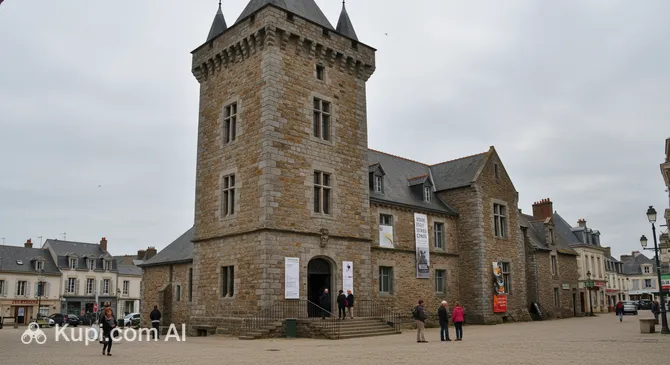
Tanguy Tower
Tanguy Tower. Иллюстрация. Источник: Kupi.com AI

Since 1962, the tower has housed the Museum of Old Brest (Musée du Vieux Brest). This place is considered a true treasure trove of the city's memory, housing unique collections of maps, engravings, and archival photographs. The museum's main pride is the stunning dioramas by artist Jim Sévellec, which reconstruct the appearance of city quarters, markets, and quays before the mid-20th century with incredible accuracy.

A visit to the tower allows tourists to embark on a kind of journey through time. Located directly opposite Brest Castle on Pierre Péron Square, it serves as an ideal starting point for exploring the region's history. Today, it is a popular cultural space that deservedly receives high praise from travelers for its authenticity and educational value.

Contacts

For the convenience of visitors, we have gathered up-to-date information to help you easily find this historic site in the city. Below are the official details, including the address and contact phone number for the museum administration.

How to contactContact
AddressSq. Pierre Péron, 29200 Brest, France
Phone+33 2 98 00 80 80
Websitebrest.fr

What to Do

A visit to the museum in the Tanguy Tower is very well-organized: the exhibition is spread across several floors, offering guests a sequential immersion into the past. On the ground floor, you can study ancient city plans, examine a collection of 34 coats of arms of Brest corporations, and see rare postcards capturing the daily life of locals in past centuries.

Ascending to the first and second floors, visitors encounter the main exhibits — realistic dioramas. Here you can witness the arrival of Siamese ambassadors in the 17th century, the visit of Emperor Napoleon III, and even the appearance of the famous Imperial Bridge. The craftsmanship of the models allows for the examination of every figure and architectural detail, creating a sense of being present in quarters that have long since vanished.

Beyond the historical section, it is definitely worth taking time to enjoy the views. The tower windows offer a magnificent panorama of the Penfeld River and the rugged walls of Brest Castle. The museum is free to visit, making it a must-see for anyone who wants to see the "soul" of the city and take memorable photos in a historical setting.

Getting There

Finding this historic building is easy, as it is located in one of the city's most picturesque spots on Square Pierre Péron. The tower rises on the right bank of the Penfeld River, right at the foot of the famous Recouvrance Bridge. If you are in the city center or at the train station, the walk will take about 10–15 minutes, allowing you to enjoy views of the old port along the way.

For those who prefer public transport, Tram Line A is an excellent choice — get off at the Port de Commerce stop and walk for about five minutes. You can also use buses that go to the Château or directly to Square Pierre Péron. If you are traveling by taxi, just give the driver the address or the name of the tower; the trip from central districts will be quick and comfortable.

Drivers should look for parking zones near the square or in the arsenal area. An ideal route would be to combine a visit to the tower with a tour of the castle: by crossing the Recouvrance Bridge, you will get the best panoramic view for photos, where the Tanguy Tower appears in all its glory against the river landscape.

Ближайший город: Brest

History & Facts

This majestic structure, also known as the Bastille de Quilbignon, appeared on the rocky bank of the Penfeld River as early as the 14th century. Originally, it served as a vital element of the defensive system and was positioned directly opposite the castle to ensure control over the river mouth. During various periods of its long life, the tower fulfilled different administrative functions and served as a venue for official meetings of the Lords of Châtel.

In the 19th century, the appearance of the building underwent remarkable changes. In 1862, the architect Bariller, who purchased the building, decided to give it an unusual look by adding a Chinese-style roof with an ornate pavilion. In those years, the tower was used as a private residence, which added a special architectural charm and made it a prominent landmark for all passing vessels.

The monument was returned to its modern historical appearance in the second half of the 20th century. In 1971, specialists carried out a large-scale restoration, restoring the medieval silhouette with its characteristic conical roof and crenelated cornice. Since 1962, the museum has been officially open here, aiming to preserve the memory of what the city looked like in previous eras.

Time Needed

To fully soak in the atmosphere of the ancient city and study all the details of the exhibition without rushing, the average visitor will need about 1–2 hours. The museum spans three floors, and each is filled with small details that invite careful observation.

The bulk of the time is traditionally spent examining the highly detailed dioramas. These miniature reconstructions are so precise that history buffs can spend dozens of minutes in front of them, identifying familiar features of city streets. If you also plan to take photos from the observation point and walk through the adjacent square, it is better to budget a bit more time.

Working Hours

The museum doors are open to visitors in the afternoon, making it easy to combine a visit with a pleasant walk along the embankment or a post-lunch tour of the neighboring castle. Please note that the site operates on a set schedule from Tuesday to Sunday, with Monday being the day off.

Official working hours: From Tuesday to Sunday, the tower is open from 2:00 PM to 6:00 PM. The museum is closed on Mondays. It is recommended to arrive no later than 30–40 minutes before closing to have enough time to see all the exhibitions on the three floors.

DayWorking hours
ПонедельникЗакрыто
Вторник2:00 – 18:00
Среда2:00 – 18:00
Четверг2:00 – 18:00
Пятница2:00 – 18:00
Суббота2:00 – 18:00
Воскресенье2:00 – 18:00

Nearby

A walk around the surroundings of this historic district allows for a deeper immersion into the atmosphere of the port city. Exploring the attractions within walking distance will significantly enrich your experience and help form a complete picture of this region's past and present.

NameDistance
Recouvrance Bridge0.1 km
Greenwich Café0.3 km
Explorers' Garden0.3 km
National Maritime Museum0.4 km
Brest Cable Car0.4 km
Brest Museum of Fine Arts0.5 km
La PAM0.6 km

Reached the end of the page?

That means the route is fully explored