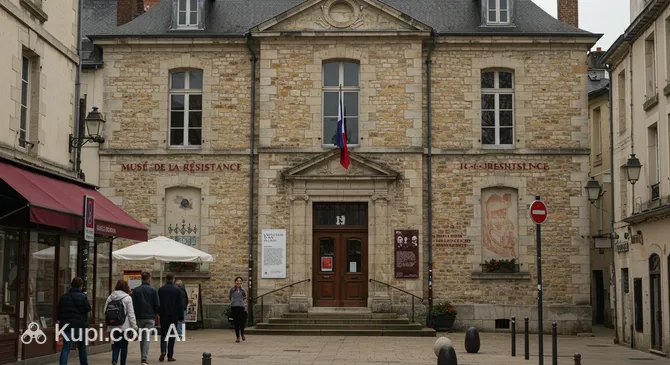
In the heart of the historic Cité district of Limoges lies the Museum of the Resistance (Musée de la Résistance)—an important cultural space dedicated to one of the most dramatic chapters in European history. Housed in the majestic building of the former 17th-century Sisters of Providence convent, this institution serves as a living reminder of the values of solidarity and civic courage shown during World War II.
Resistance Museum. Illustration.
Source: Kupi.com AI
Traveler photos:
The museum's exhibition is carefully designed and covers a wide range of topics, from life under occupation to the heroism of local underground participants in the Haute-Vienne department. Visitors to France highly appreciate this site for its deep educational approach and visually appealing design, as evidenced by high ratings and positive tourist reviews.
The museum serves as an important educational center where the chronology of events from those years is reconstructed through photographs, authentic documents, and personal belongings. This site will be of interest not only to history buffs but to anyone who wants to better understand the cultural code and spirit of resistance inherent to the people of the Limousin region.
Contacts
To contact the Museum of the Resistance administration or clarify visiting details, you can use the official contact information. Please note that it is best to book group tours in advance via the online form or by phone.
A visit to the museum begins with an immersion into the past through the permanent exhibition located on two floors. Here you can see unique archival films, original letters, diaries, and even samples of military equipment that vividly illustrate the activities of the Resistance in Limousin. For those who do not speak French, it is highly recommended to take an audio guide (costing about 2 euros)—it explains the historical context of each exhibit in detail.
Special attention should be paid to the basement area, where temporary themed exhibitions are regularly held. These may be dedicated to various aspects of the era—from wartime costumes to contemporary art reflecting on the events of those years. Interaction with interactive displays and viewing rare photographs makes the visit educational for visitors of all ages.
Many guests note that the museum space is very comfortably organized: the friendly staff is always ready to point the way, and the flow of the tour is intuitive. At the end of the visit, you can stop by a small specialized section to once again reflect on the role of local residents in defending republican values and enjoy the silence of the ancient convent building.
Getting There
The museum is located at 7 Rue Neuve Saint-Étienne, in the heart of the historic Cité district of Limoges. Reaching it on foot from the central attractions is easy, as clear signs leading to the museum complex are installed throughout the city.
For those arriving by train, the walk from the famous Limoges-Bénédictins station takes less than 10 minutes. If you prefer public transport, use the city buses that stop in the immediate vicinity of the Cité district. The museum is also convenient for cyclists following the La Vélidéale (V93) route, which passes just 700 meters away.
Drivers can leave their cars in one of the central parking lots in Limoges located nearby. For your GPS, use the coordinates 45.8303031, 1.2656261 to quickly find the best route to the former convent where the exhibition is housed.
Nearest city: Limoges
History & Facts
The building housing the exhibition today has a rich history: it is a former convent of the Sisters of Providence, built back in the 17th century. In the 18th century, its appearance was modified under the guidance of the famous architect Joseph Brousseau, giving the museum a special atmosphere of ancient seclusion that contrasts with the gravity of the themes presented here.
During World War II, Limoges and the Limousin region became key centers of the Resistance in France. Local residents actively defended republican values by creating an extensive network of underground activities. The museum was established specifically to preserve the memory of this struggle and the people who sacrificed themselves for freedom.
The exhibition places a special emphasis on the values of citizenship and solidarity. It doesn't just list dates but tells the story of the everyday courage of ordinary people. Authentic archival materials, including personal letters and diaries, allow visitors to feel the spirit of the era and the scale of the contribution made by the residents of Haute-Vienne to the common cause of victory.
Time Needed
For a standard introduction to the main exhibition of the Museum of the Resistance, most visitors need 1 to 2 hours. This is enough time to leisurely walk through the two floors and view the key artifacts and documents.
However, if you plan to study the archival materials in detail, listen to the full audio guide, or visit the temporary exhibitions in the basement, you should allow about 3 hours for your visit. The depth of information presented often encourages guests to stay at the displays longer than they initially planned.
Working Hours
The museum is open to visitors year-round, except for Tuesdays, when the institution is closed. On weekdays (Monday, Wednesday, Thursday, Friday), the doors are open from 9:00 AM to 12:30 PM and, after a lunch break, from 1:30 PM to 5:00 PM.
On weekends—Saturday and Sunday—the museum is open only in the afternoon, from 1:00 PM to 5:00 PM. As the schedule may change slightly on public holidays, it is recommended to check the current timetable on the museum's official website or at the city's tourist office before your visit.
Day
Working hours
Monday
09:00–12:30, 13:30–17:00
Tuesday
Закрыто
Wednesday
09:00–12:30, 13:30–17:00
Thursday
09:00–12:30, 13:30–17:00
Friday
09:00–12:30, 13:30–17:00
Saturday
13:00–17:00
Sunday
13:00–17:00
Nearby
Exploring the surroundings of the Museum of the Resistance will allow you to delve deeper into the atmosphere of the historic center of Limoges. The site's location in the Cité district provides easy access to the city's main architectural and cultural monuments, which are just a few minutes' walk away.
A stroll through the picturesque streets will lead you to medieval bridges and ancient squares where every stone breathes history. Below is a list of the most interesting places to visit before or after your museum visit: