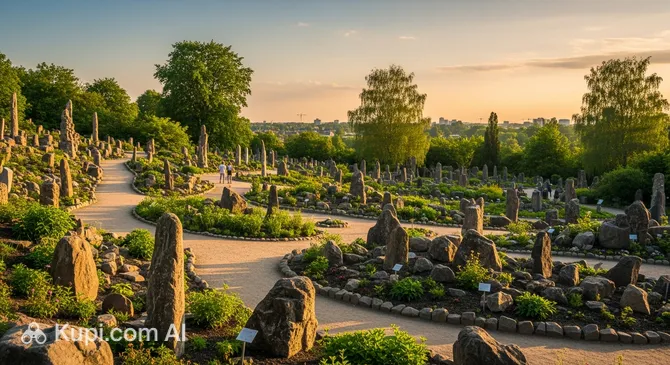
Imagine a place where time is frozen in stone, revealing pages of planetary history spanning 300 million years. The Geological Garden of Bochum is a unique open-air park in the city of Bochum, Germany, recognized as an official natural monument. Located on the site of a former quarry, it covers an area of about 2 hectares and serves as a vivid textbook on the geology of the Ruhr region.
Traveler photos:
Here, you can witness a rare phenomenon—exposed layers of the Earth's crust from different periods: from the Carboniferous to the Cretaceous and Quaternary. Visitors can literally touch ancient coal seams and examine traces of an ancient sea turned into solid sandstone. It is not just a park for walking, but a true open-air museum where geological processes are presented in their original form.
Of particular value are the giant gneiss and red granite boulders displayed in the northern part of the garden, brought here by glaciers from Scandinavia. Complementing the prehistoric atmosphere are "living fossils"—ginkgo trees and majestic giant sequoias, which recall the flora of those distant eras when Europe's coal reserves were formed.