Support

Kloster Bentlage

About

Located on the picturesque banks of the Ems River, Bentlage Monastery (Kloster Bentlage) is one of the most significant cultural and architectural treasures that Rheine takes pride in. It is not just an ancient structure, but a living witness to history that has successfully transformed from an austere monastic cloister into a dynamic center for contemporary art and culture.
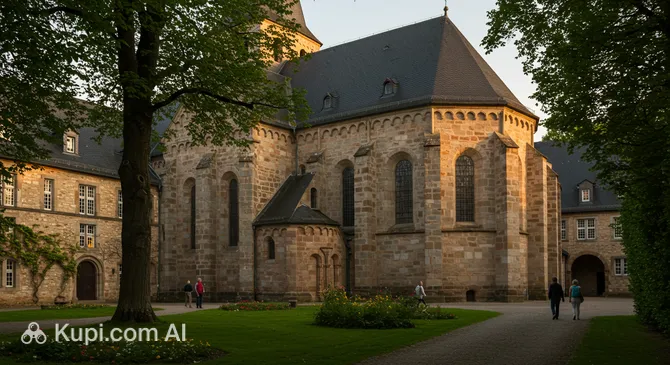
Bentlage Monastery
Bentlage Monastery. Иллюстрация. Источник: Kupi.com AI

Founded in 1437 by monks of the Order of the Holy Cross, the complex is a magnificent example of medieval Gothic architecture. Today, this attraction, carefully preserved by Germany, attracts travelers with its unique atmosphere of tranquility and the harmonious blend of ancient masonry with modern museum exhibitions.

Visitors appreciate Bentlage for the opportunity to see well-preserved architectural elements and learn about the daily life of the Crosier monks. Its status as an architectural monument highlights its historical value, making the monastery a must-visit for anyone interested in the past of the Münsterland region.

Contacts

For further details before your visit or to organize a group tour, you can use the official communication channels. The information below will help you quickly find your way and contact the administration of this unique cultural center.

Below are detailed contact details, including the exact address and a link to maps for planning a convenient route.

How to contactContact
AddressBentlager Weg 130, 48432 Rheine, Germany
Phone+49 5971 918468
Websitewww.kloster-bentlage.de

What to Do

A visit to the monastery complex offers guests a rich program. The main point of interest is the preserved wing of the medieval four-story building, where you can study the craftsmanship of past builders in detail. The reconstructed floor plan of the church, which was dismantled in the 19th century, makes a special impression—it allows you to visualize the grandeur of the former temple.

Today, the monastery's halls have been transformed into exhibition spaces where works of contemporary art are regularly displayed. The contrast between the centuries-old walls and avant-garde works creates a unique aesthetic environment. For those who want to dive deeper into the history, there are exhibitions dedicated to the development of monastic life and the daily routine of the medieval order.

An equally pleasant part of the visit is a walk through the surrounding grounds. Here, you can trace the historical layout of the complex and enjoy the silence by the river. This place is ideal for cultural encounters and slow contemplation, combining the functions of an open-air museum and a modern art space.

Getting There

This landmark is conveniently located in the northern part of the city, on the picturesque banks of the Ems River. Thanks to its proximity to residential areas, getting to the former monastery is easy, whether by private car or public transport.

If you prefer buses, look for routes passing through the city's northern quarters. A taxi ride from the central station or the city center takes very little time, making it an excellent option for those who value comfort and want to save their energy for exploring the monastery complex.

For drivers, parking is available nearby. Navigation users can simply enter the address: Bentlager Weg 130. The road to the monastery passes through green areas, making the drive a pleasant start to your excursion.

Ближайший город: Rheine

History & Facts

The history of this site began on April 24, 1437, when Pope Eugene IV signed a charter for its establishment in Bologna. The first residents were monks of the Order of the Holy Cross (Crosiers), who arrived from Cologne and Wuppertal. Along with the land, they were granted salt mining and fishing rights in the Ems River, ensuring the monastery's economic stability.

The golden age of the cloister occurred at the end of the 15th century. During this time, large-scale construction of the four-story Gothic complex began, and the number of monks exceeded 50. The monastery became a major landowner, managing over 20 estates and farmsteads, which underscored its significant influence in the Münsterland region.

The history of the complex was not always peaceful: in 1647, during the Thirty Years' War, Swedish troops burned the buildings. However, the monks showed resilience, and by 1662, the monastery was completely restored. Later, in the 18th century, extensive restoration work was carried out, giving the interiors and exterior new artistic features.

A new chapter in its chronicles opened in 1803 following the process of secularization. The monastery changed its status to become the residence of Duke Joseph Arnold and subsequently passed into the possession of the Belgian noble house of Looz-Corswarem. The new owners converted the ancient cells and halls into a noble castle, while preserving the grandeur of the medieval architecture.

Time Needed

To explore every corner of this historic complex without rushing, tourists are recommended to set aside 2 to 3 hours. This is sufficient time to admire the Gothic facades, stroll through the courtyards, and appreciate the landscape layout of the grounds.

If temporary art exhibitions are taking place on the day of your visit, or if you plan to stop by the local cultural center, it is worth allowing a bit more time—about half a day. The monastery's atmosphere invites contemplation, so rushing here would be out of place.

Working Hours

When planning your visit, keep in mind that the monastery is open to the public from Tuesday to Sunday. The main operating hours on weekdays and Saturdays are from 2:00 PM to 6:00 PM. On Sundays, the doors open earlier, inviting guests from 10:00 AM until the evening.

Please note that Monday is the official day off. We recommend arriving a couple of hours before closing to have enough time to explore all the exhibitions at a relaxed pace.

DayWorking hours
ПонедельникЗакрыто
Вторник2:00 – 18:00
Среда2:00 – 18:00
Четверг2:00 – 18:00
Пятница2:00 – 18:00
Суббота2:00 – 18:00
Воскресенье10:00 – 18:00

Nearby

A visit to the monastery can be perfectly combined with exploring other interesting locations in the area. The district is rich in both historical monuments and unusual architectural sites that help you better feel the atmosphere of this part of Westphalia.

The surroundings offer a variety of experiences, from ancient megalithic structures to industrial heritage and cozy historic villas. Here is a list of sites located within a radius of several kilometers:

NameDistance
Saline Gottesgabe0.7 km
NaturZoo Rheine0.7 km
Adams1.7 km
Farmacia Bar2.6 km
Hotel Freye2.7 km
Emsforum2.7 km
Landhotel Hopster2.8 km

Reached the end of the page?

That means the route is fully explored