Support

Dom St. Peter

About

In the heart of the ancient city of Worms majestically stands one of the most brilliant monuments of medieval architecture — St. Peter's Cathedral. This monumental Romanesque basilica, built on the city's highest point, is rightfully considered one of Germany's "imperial cathedrals," alongside the temples in Speyer and Mainz.

The cathedral impresses with its elegance and the harmony of its Late Romanesque style. Erected in the 12th century on the site of ancient Celtic and Roman settlements, it became a symbol of the region's prosperity. Its red sandstone walls and richly decorated apses preserve the memory of the great emperors and bishops who shaped the fate of Europe in the Middle Ages.

Today, it is not only an active church and a minor papal basilica but also a vital cultural landmark, attracting history and architecture enthusiasts from all over the world. Its four towers and powerful domes create a unique silhouette that dominates the landscape of the Rhine Valley.
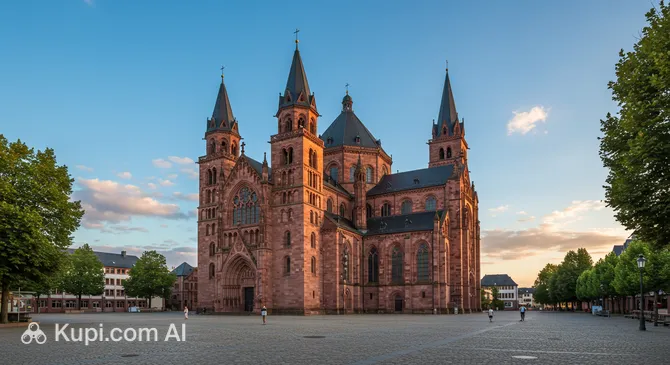
Worms Cathedral
Worms Cathedral. Иллюстрация. Источник: Kupi.com AI

Contacts

To plan your visit to the cathedral or check service times, you can use the official contact details.

How to contactContact
AddressDomplatz, 67547 Worms, Germany
Phone+49 6241 596160
Websitewww.wormser-dom.de

What to Do

Inside the church, every visitor's attention is invariably drawn to the magnificent Baroque high altar, designed by the famous Balthasar Neumann. This composition of gilded wood and colored marble is considered one of the most impressive elements of the interior. It is also worth taking the time to examine the numerous medieval tombstones and memorial plaques that tell the stories of the city's prominent figures.

Be sure to descend into the crypt, where the remains of Emperor Conrad II's relatives are interred. The atmosphere of this place allows you to literally touch a thousand years of history. The South Portal of the cathedral, decorated with the exquisite Gothic sculpture "The Coronation of the Virgin," provides an excellent backdrop for photos and a subject for studying the fine craftsmanship of 14th-century masters.

Before entering or after your tour of the cathedral, look for the bronze scale model on the square. It showcases the cathedral in its full medieval glory, including chapels that have not survived to the present day. There is also a souvenir kiosk on the grounds where you can purchase commemorative postcards and books about the history of this remarkable place.

Getting There

The cathedral is very easy to find — it is located at Domplatz in the heart of the historic center. If you are traveling by public transport, it is most convenient to head towards Worms Hauptbahnhof (the central station). A walk from the station to the cathedral takes about 15–20 minutes through scenic streets.

The city has excellent rail connections with major hubs. You can quickly reach it by direct train from Frankfurt (the journey takes about an hour), as well as from Mainz or Ludwigshafen. For those who prefer traveling by car, follow the A61 motorway; you can leave your vehicle at one of the parking lots at the foot of the hill where the cathedral stands.

Within the city itself, it is also convenient to get around by taxi or on foot, as most iconic sites are concentrated in the central area, which is very walkable.

Ближайший город: Worms

History & Facts

The history of this majestic structure began in the early 11th century, but the appearance that delights tourists today was acquired between 1130 and 1181. It was then that the old basilica was demolished and the current Late Romanesque church was built. The west choir and elegant vaults were completed slightly later, in the 13th century.

Over the centuries, the cathedral has been not only a religious center but also a symbol of power. Until 1802, Worms served as the residence of Prince-Bishops, whose palace, the Bischofshof, was located right next door. The cathedral has repeatedly witnessed important imperial events and survived several major destructions, after which it was carefully restored, particularly in the early 20th century.

In 1925, Pope Pius XI granted the church the honorary status of a minor basilica. A point of particular pride is that the building was preserved and reinforced despite soil challenges: in the 1930s, extensive work was carried out to stabilize the foundation of the western part of the cathedral to safeguard this monument for future generations.

Time Needed

To fully appreciate the scale of the architecture, examine the details of the Baroque altar, and descend into the quiet crypt, we recommend setting aside approximately 1.5–2 hours for your visit. This time is sufficient for viewing both the exterior decor and visiting the souvenir kiosk.

If you plan to join a guided tour or wish to study the detailed informational scale model of the cathedral located on the square, your stay may be longer. The cathedral encourages quiet contemplation, so it is best not to rush through your visit.

Working Hours

As Worms Cathedral is an active Catholic church, visiting hours for tourists may change depending on religious services, weddings, or festive concerts.

We strongly advise visitors to check the official cathedral website before their visit to ensure the doors will be open for sightseeing on your chosen day. Remember that during Mass, sightseeing inside the cathedral is usually restricted to avoid disturbing the worshippers.

Nearby

Exploring the surroundings of the cathedral will allow you to fully experience the spirit of ancient Worms. A short walk through the historic center will reveal fragments of old fortifications and interesting architectural monuments from different eras.

NameDistance
Vannini Italian Ice Cream0.1 km
Luther Monument0.2 km
Rialto Night Club Worms0.4 km
Kaiser Passage0.4 km
ParkCafé0.5 km
Wormser Einkaufspark0.5 km
Hotel Boos Museum0.7 km

Reached the end of the page?

That means the route is fully explored