Support

Venetian Walls of Heraklion

About

The Venetian Walls of Heraklion are an outstanding monument of Renaissance fortification architecture, majestically framing the historical center of the city of Heraklion on the island of Crete, Greece. These ancient fortifications are not just walls, but a true testament to the rich history and engineering art of the past, attracting travelers with their monumentality.
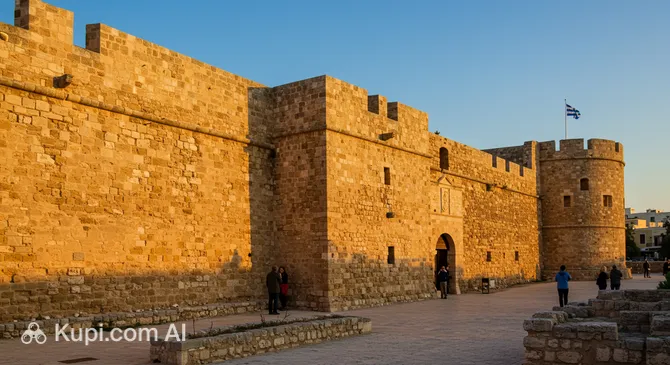
Venetian Walls of Heraklion. Illustration.
Source: Kupi.com AI

Traveler photos:

Representing a massive defensive structure, the walls extend for more than 4.5 kilometers. Their power is highlighted by imposing bastions, well-preserved gates, and a once-formidable deep moat. Built to protect the city from external threats, they are considered some of the most impressive and well-preserved fortifications in the eastern Mediterranean, making them a key historical site.

To this day, the Venetian Walls largely define the appearance of old Heraklion and are one of its main attractions. A walk along these historical fortifications allows you not only to touch the past and imagine city life in former times but also to enjoy magnificent panoramic views. This place is definitely worth a visit to feel the spirit of history and admire the scale of the ancient structures.

Contacts

The Venetian Walls of Heraklion are an impressive historical structure surrounding the old part of the city of Heraklion. As this is an extensive historical site, there may not be a specific contact number or a single address for all sections of the walls.

For detailed information about access to various bastions, gates, possible tours, or cultural events held on the territory of the walls, we recommend contacting local tourist information centers upon arrival in Heraklion or visiting the city's official tourism websites.

How to contactContact
AddressNik. Plastira 25, Iraklio 712 01, Greece
Websitewww.explorecrete.com

What to Do

A walk along the Venetian Walls of Heraklion is a real journey through time. Visitors can leisurely walk along the massive fortifications, exploring well-preserved bastions and impressive gates. Special attention should be paid to St. George's Gate, once the city's main land entrance, and powerful bastions such as the Vitouri Bastion. From the top of the walls, breathtaking panoramic views of modern Heraklion and the seaport open up, allowing you to appreciate the strategic significance of these fortifications.

In addition to historical exploration, the territory of the Venetian Walls often serves as a venue for various cultural events, exhibitions, and educational tours. During your walk, you can also find monuments erected along the walls, such as the statue of the famous political figure of Greece, Eleftherios Venizelos. This place allows you not only to learn about the defensive power of the ancient city but also to feel its living history, immersing yourself in the atmosphere of medieval Heraklion.

Getting There

Getting to the Venetian Walls of Heraklion is quite simple, as they are located in the heart of Heraklion. If you are already in the central part of the city, the most convenient way is a stroll on foot. The walls encircle the old town, and their various sections, including the famous gates and bastions, are in close proximity to major streets, squares, and tourist routes.

For those arriving in Heraklion by car, the city center or the old port will serve as a landmark. The Venetian walls are clearly visible and can serve as an excellent navigation point. Parking spaces can usually be found near the walls, though they may be busy during peak season. If you prefer public transport, many city bus routes pass near different sections of the walls. Look for stops located near the central gates, such as the Pantokrator Gate (Chanioporta) or the Jesus Gate (Kenouria Porta).

Taxis are also a convenient option, especially if you want to quickly reach a specific part of the walls from a more distant area of Heraklion or from the airport/port. Simply tell the driver a well-known landmark, such as the Martinengo Bastion or one of the main gates, and you will be easily taken to the start of your exploration of this impressive fortification.

Nearest city: Heraklion

History & Facts

The Venetian Walls of Heraklion are an impressive fortification whose history dates back to the middle of the 15th century. Their construction began in 1462 under the direction of the prominent engineer of his time, Michele Sanmicheli. The erection of these powerful fortifications took about a hundred years and was completed around 1560. The walls were a complex defense system that included four main gates, seven imposing bastions, and a wide moat surrounding the city.

Interestingly, before the appearance of the Venetian fortifications, Heraklion (then Candia) already had defensive structures built by previous civilizations—the Byzantines and the Arabs. However, it was the Venetians, recognizing the growing Ottoman threat, who undertook the grand project of creating the most modern and powerful fortifications of that period. These walls were designed taking into account the latest military engineering achievements to ensure reliable protection for the prosperous port city.

The historical significance of the Venetian Walls was particularly evident during the famous Cretan War. The walls withstood one of the longest sieges in history—the 24-year siege of Heraklion by Ottoman forces in the 17th century. This heroic defense was a testament not only to the strength of the fortifications themselves but also to the courage of the city's defenders. Today, these walls are silent witnesses to the turbulent history of Heraklion and an important part of its cultural heritage.

Time Needed

To fully appreciate the Venetian Walls of Heraklion, it is recommended to set aside 1.5 to 3 hours. This time is usually enough to leisurely walk along the best-preserved and most interesting sections of this impressive fortification, climb the bastions, which offer beautiful views of the city and the sea, and take memorable photos.

If your time is limited, an hour and a half is enough to see the key points and get a general idea of the scale and history of the walls. However, if you want to dive deeper into the atmosphere of the past, explore various bastions such as Martinengo, where the tomb of Nikos Kazantzakis is located, and enjoy the panoramas without rushing, it is better to plan for about three hours. This will allow you to walk a significant part of the wall's perimeter and truly feel their grandeur.

Working Hours

The Venetian Walls of Heraklion are an open city attraction, so access to them for walking is possible 24 hours a day, year-round. You can enjoy their views and grandeur at any time convenient for you, strolling along them or on top of them.

However, it should be noted that certain sites located on the territory of the walls or inside the bastions, such as museums or exhibition spaces, may have their own opening hours and require a ticket. We recommend checking the opening hours of such places and whether prior booking is necessary directly on-site or on their official websites before visiting.

Open 24 hours

Nearby

Visiting any landmark is just the starting point of an exciting journey. Exploring the surroundings allows you to dive deeper into the atmosphere of a place, discover hidden gems, and get a more complete picture of the culture and history of the region.

After seeing the Venetian Walls of Heraklion, don't rush to end your walk. Nearby are other interesting sites that will complement your impressions of Heraklion and allow you to better get to know this amazing city in Greece. A short stroll through the neighboring streets can lead to new discoveries and pleasant surprises.

NameDistance
Kuzina Casual Food0.5 km
Talos Plaza0.5 km
Natural History Museum of Crete0.6 km
Thirathen Museum of Musical Instruments0.6 km
Cathedral of Saint Minas0.7 km
Historical Museum of Crete0.8 km
Morosini Fountain0.9 km

Have you reached the end of the page?

So the route has been studied inside and out