Support

Amber fort downhill area

About

Towering over the picturesque hills, the Lower Amber Fort is a majestic gateway to one of the most famous palace complexes in Jaipur. This site is more than just an ancient fortification; it is a true architectural masterpiece and a UNESCO World Heritage site. The formidable ochre walls of the fortress hide the exquisite luxury characteristic of royal residences in Rajasthan, India.

Founded in 1592 by Raja Man Singh I, the fort is a unique example of a harmonious blend of Rajput and Mughal styles. The use of red sandstone and pure white marble gives the structures a monumental yet elegant appearance. The lower part of the complex serves as the starting point for exploring the history of the powerful Kachwaha dynasty.
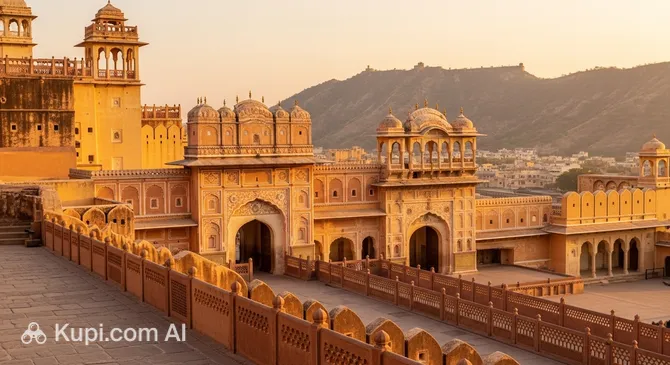
Amber Fort Lower Area
Amber Fort Lower Area. Иллюстрация. Источник: Kupi.com AI

Strolling through this area, tourists can appreciate the scale of medieval engineering and see how rugged military might meets fine decorative art. Amber Fort is considered a must-see for anyone wanting to experience the rich cultural heritage of Indian Maharajas.

Contacts

To check the latest information before your visit, you can use the official contact details. Although the fort is a popular tourist site, it is always helpful to have direct contact information for the administration at hand.

How to contactContact
AddressДевизингпура, Амер, Джайпур, Раджастан 302001, Индия
Phone+91 141 253 0293
Websitewww.tourism.rajasthan.gov.in

What to Do

Exploring this grand complex promises many discoveries. One of the first highlights is the Ganesh Pol gate, richly decorated with mosaics and paintings, through which Maharajas once entered their private quarters. No less impressive is the Diwan-i-Aam — the Hall of Public Audience, where slender rows of columns create a sense of infinite space.

The real jewel of the walk is the Shesh Mahal, or Mirror Palace. Its walls and ceilings are inlaid with thousands of tiny mirrors that reflect even the slightest light, creating the effect of a shimmering starry sky. Nearby is Sukh Niwas (Hall of Pleasure), which once featured a unique natural air-conditioning system using running water.

Be sure to visit the Zenana — the women's quarters of the palace, where carved windows offer breathtaking panoramic views of Maota Lake. It is also worth strolling through the geometrically precise gardens, designed according to the Chahar Bagh principle, which offer coolness and peace amidst the massive stone walls.

Getting There

This majestic architectural ensemble is located in the Amer district, about 11 kilometers north of the city center. Thanks to its popularity, the way to the fort is well-known to every local resident and driver.

The most comfortable way to get here is by using taxi services or mobile ride-hailing apps. Colorful auto-rickshaws also cruise throughout the city, making them an excellent choice for those who want to experience the local flavor. If you prefer public transport, city buses regularly run from the center toward Amer.

For travelers with their own or rented transport, parking is available at the foot of the hill. From there, you can walk up to the main gate while enjoying the views, or use local transport services that will take you right to the entrance.

Ближайший город: Jaipur

History & Facts

The history of this site began long before the palace took its familiar form. As early as 967, a small fortification of the Meena tribe, known as Kadimi Mahal, stood on the Cheel ka Teela (Hill of Eagles). However, its true flowering began in 1592, when Raja Man Singh I of the Kachwaha dynasty decided to build a grand fortress here as a symbol of his power and influence.

Man Singh I was not only a talented ruler but also a trusted general of the Mughal Emperor Akbar. It was thanks to these close ties with the Mughal court that the fusion of Hindu and Islamic traditions became so prominent in the fort's architecture. Construction continued for decades, transforming the stern fortress into an exquisite residence.

Mirza Raja Jai Singh I made a significant contribution to the complex's expansion in the 17th century. Under his rule, luxurious halls and the famous gardens, modeled after Mughal parks, were added. The fort remained the primary residence of the Maharajas until 1727, when the capital was moved to the new city, but even after that, it did not lose its sacred significance for Rajasthan's history.

Time Needed

For a leisurely tour of the main halls and courtyards and to enjoy the panoramas, an average visitor will need about 2–3 hours. The complex territory is quite vast, and each transition between levels reveals new interesting details.

If you are an architecture enthusiast planning to study the fine carvings and mosaics in detail and photograph every corner, it is better to set aside 3–4 hours for your visit. This will allow you to enjoy the atmosphere without rushing and perhaps wait for the perfect lighting for photos in the mirror halls.

Working Hours

The fortress doors are open to guests daily from 07:00 to 21:00. This extended schedule allows you to choose the most comfortable time for a visit: either early morning to avoid the heat, or evening hours when the fort walls are beautifully illuminated.

Given that the schedule may change due to festive events, it is recommended to check the official Rajasthan tourism website or ask for information from the administrators on-site before your trip.

07:00–21:00

Nearby

After immersing yourself in the history of the ancient fortress, you can diversify your trip by visiting modern entertainment centers. The surrounding area offers many options for active recreation, especially if you are traveling with family.

NameDistance
Amber Palace0.3 km
Sheesh Mahal, Amber Fort0.3 km
Jaigarh Fort1.1 km
Nahargarh Biological Park3.3 km
Jal Mahal3.9 km
Pratap Celebrity Wax Museum5.4 km
Ele Experience Farm6.4 km

Reached the end of the page?

That means the route is fully explored