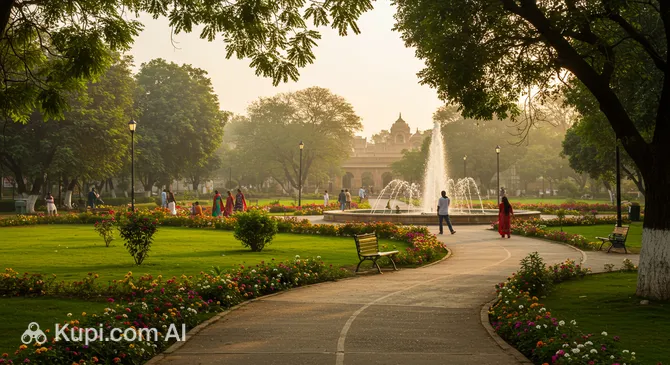
Phool Bagh Park, located in the city of Kanpur, is inextricably linked to the city's rich and multi-layered history. While the exact founding date of the park itself may not be clearly documented, its existence and development reflect key stages in Kanpur's growth. The city, originally known as Kohna, was founded in 1207 by Raja Kanti Deo of Prayag. For centuries, it remained a relatively small settlement serving as a suburb of the larger Kannauj, and it was in this historical context that the foundations for future urban spaces, including green zones, were laid.
A significant turn in the history of Kanpur, and consequently in the fate of its lands, occurred in the 18th century. Between 1773 and 1801, when the region was part of Awadh, European entrepreneurs began to settle actively in Kanpur. This led to the city's growth and a change in its appearance. In 1801, under a treaty with the Nawab of Awadh, Saadat Ali Khan, Kanpur came under the control of the British East India Company. This period marked the beginning of a new era in the city's development, which undoubtedly influenced the planning of public spaces like Phool Bagh.
One of the most dramatic and significant events that left a deep mark on Kanpur's history occurred in the mid-19th century. The city was at the center of momentous historical events in 1857, which inevitably reflected on all aspects of urban life, including the development and preservation of parks and gardens. Phool Bagh, as a witness to those times, carries the memory of the city's complex past, its challenges, and its subsequent revival. The park has likely seen periods of neglect as well as stages of improvement, each adding a new page to its story.
Today, Phool Bagh Park is not just a green area for city dwellers to relax, but a living reminder of the historical path taken by Kanpur. From its modest beginnings as part of an ancient settlement to its transformation into an important industrial and historical center, every stage has left its mark. Walking along its paths, one can imagine how the city has changed over the centuries and how the park has witnessed these changes, weaving itself into the broader tapestry of India's history.