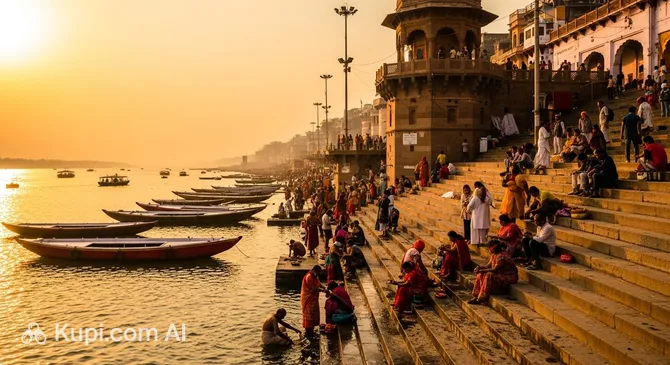
Ganga Ghat stretches along the banks of the great river—a majestic complex of stone steps that has become a symbol of the spiritual life of the city of Patna. This is a place where ancient traditions meet everyday life, representing a unique cultural space that India has carefully preserved for many centuries.
Ganga Ghat. Illustration.
Source: Kupi.com AI
Traveler photos:
Ghats are special stone structures designed for easy access to the water. In historical Pataliputra, these steps serve not only practical needs but also act as a stage for sacred Hindu rites and ritual ablutions. The Ganges is revered here as the main waterway and spiritual mother, granting purification to every believer.
For the tourist, Ganga Ghat is primarily an opportunity to see living history and the deep faith of the local population. The site is an important architectural and religious monument reflecting the centuries-old continuity of Indian culture and its inseparable bond with the forces of nature.
Contacts
Since Ganga Ghat is an open-air public space, it does not have an official reception desk or a single phone number. For any questions regarding organized tours or information, it is recommended to contact the city's tourist information center.
How to contact
Contact
Address
near pmch hospital, Dujra Diara, Patna, Bihar 800004, India
What to Do
The main impression Ganga Ghat offers is the chance to witness ancient religious traditions. Visitors can observe pilgrims performing ritual ablutions, meditating on the steps, or conducting pujas. For photography enthusiasts, this place is an inexhaustible source of colorful scenes reflecting the authentic spirit of the country.
One of the day's highlights is the Aarti ceremony—the evening worship of the river. At dusk, the shore is lit by the glow of many lamps, and the air is filled with the sounds of mantras and bells. This spectacle carries incredible energy and allows you to feel the deep mystical atmosphere that brings many to Bihar.
Beyond spiritual practices, it's pleasant just to watch the flow of life. You can see locals washing clothes, socializing, or relaxing by the water. A walk along the bank allows you to enjoy panoramic views of the Ganges River, which seems endless and majestic here.
Getting There
Reaching the banks of the sacred river in Patna is easy, as Ganga Ghat is located in the central part of the city. The most popular and accessible ways to get around are auto-rickshaws and taxis, which can be hailed anywhere in the city. The PMCH hospital serves as a landmark for drivers, as there is a convenient path to the water nearby.
For travelers coming from afar, Patna serves as a major transport hub. The city's railway station receives trains from Delhi, Kolkata, and Mumbai, while the Jay Prakash Narayan International Airport provides connections to the country's main aviation hubs. From the station or airport, you can reach the ghats by taxi in about 20–30 minutes, depending on traffic conditions.
Nearest city: Patna
History & Facts
The history of this place dates back to ancient times when Patna was known as Pataliputra—the capital of the powerful Mauryan Empire. It was the seat of power for King Ashoka, and the banks of the Ganges served as a vital transport and spiritual hub for ancient Indian civilization. For centuries, the ghats have witnessed the rise and fall of dynasties, while the traditions of river worship remained unchanged.
The architecture of the ghats demonstrates remarkable continuity. These stone structures were built to accommodate the river's seasonal floods, and their stepped form became a classic element of Indian architecture. It is believed that the construction techniques used in their building have been perfected over two millennia, ensuring the strength and durability of the steps against the river's current.
In a later period, during the 18th and 19th centuries, the Ganges Valley became a key region for the activities of the East India Company. British influence affected the administrative life of the city, yet the spiritual significance of the ghats for the local population only grew. With independence in 1947, Ganga Ghat firmly established its status as a major cultural and religious center of Bihar state.
Time Needed
For a regular visit, including a walk along the river and observing daily rituals, visitors are recommended to allocate 1–2 hours. This is enough time to leisurely explore the stone steps, take atmospheric photos, and feel the tranquility emanating from the sacred waters.
If you plan to visit Ganga Ghat during the evening Aarti ceremony or during major religious festivals, it is worth setting aside up to 3–4 hours. At these times, large crowds gather, and it is advisable to arrive early to find a good vantage point to watch the vibrant spiritual performance.
Working Hours
You can visit Ganga Ghat at any time of day, as it is an open public site with no strict operating hours. However, to see the most interesting moments, it is best to plan your visit at sunrise (roughly 5:00 to 8:00 AM) or sunset.
It is in the early morning hours that you will witness the mass ritual ablutions, while the evening (5:00 PM to 7:00 PM) is the best time to attend the Aarti ceremony. Since the ghat does not have an official website, it is recommended to check the start time of the evening rituals with local guides or at your hotel, as it may vary slightly depending on the season.
Nearby
Exploring the waterfront is just one part of the cultural experience that the capital of Bihar has to offer. A walk through the surrounding areas will allow you to see both historical monuments and modern recreational spots, completing the overall picture of life in the Ganges Valley.