Support

Erbil Citadel

About

In the very heart of the city of Erbil in Iraq rises the majestic Erbil Citadel—a unique historical monument and a UNESCO World Heritage site. It is not just a fortress, but an ancient fortified settlement situated on an artificial mound (tell) about 30 meters high. The citadel dominates the cityscape and serves as one of the most striking symbols of the region's rich cultural heritage.
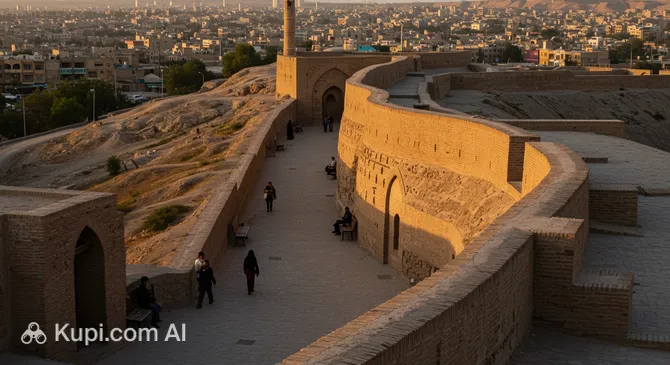
Erbil Citadel. Illustration.
Source: Kupi.com AI

Traveller photos:

The main feature of the Citadel is its incredible history. It is one of the oldest continuously inhabited places on the planet. Archaeological finds confirm that people were living here as early as the 5th millennium BC. Over thousands of years, many civilizations—from the Assyrians and Babylonians to the Ottomans—have left their mark on the cultural layers of this mound. Thus, a true treasure trove of history is hidden beneath the modern buildings.

The current appearance of the citadel took shape during the late Ottoman period, which is reflected in its fan-shaped layout. The outer perimeter of the fortress is formed by a continuous wall of residential building facades dating back to the 19th century, creating the impression of an impregnable stronghold. The total area of this historical complex exceeds 100,000 square meters. Today, the Erbil Citadel is not only an archaeological site but a place that captures the imagination of everyone who visits, offering a glimpse deep into the centuries.

Contacts

Erbil Citadel is a massive historical complex located in the very heart of Erbil. Given that it is primarily an open-air archaeological and historical site, it does not have a single centralized tourist contact service in the conventional sense. For up-to-date information regarding opening hours, accessible areas, and upcoming events, it is recommended to visit the official website of the High Commission for Erbil Citadel Revitalization or check for details at local tourist information centers upon arrival in the city.

How to contactContact
AddressQalat, Erbil, Erbil Governorate, 44001, Iraq
Websitewww.hawlergov.org

What to Do

Visiting the Erbil Citadel is a true immersion into history. The main activity here is a leisurely stroll through its ancient, narrow streets, where every stone seems to hold its own secrets. You can admire the unique architecture of traditional houses, whose facades merge into a single fortress wall, and feel the unique atmosphere of one of the oldest continuously inhabited places on the planet. From the citadel walls, picturesque panoramic views of modern Erbil open up, allowing you to see the contrast between antiquity and the present day.

Inside the citadel, you will have the opportunity to visit several interesting museums that help provide a deeper understanding of the site's rich past. Of particular note are the Kurdish Textile Museum and various archaeological exhibitions detailing the thousand-year history of the fortress and the entire region. Additionally, the complex often hosts cultural events, exhibitions, and festivals that introduce guests to the local traditions, crafts, and arts of Iraq.

For a more comprehensive and meaningful introduction to this unique UNESCO World Heritage site, it is recommended to take a guided tour. A professional guide will not only show you the most significant corners of the citadel but will also share fascinating legends and facts that are impossible to discover on your own. In the morning, numerous cafes open at the foot of the citadel where you can try a traditional Kurdish breakfast and have some tea while watching the ancient city wake up.

Getting There

Reaching the Erbil Citadel is incredibly easy, as it is located in the very center of Erbil. Its central position makes it highly accessible from any part of the city. You can easily take a taxi, which will quickly drop you off at the foot of the historical mound. Additionally, many urban public transport routes pass through the central square next to the citadel, offering a convenient and budget-friendly alternative.

If you are arriving in Erbil by plane, the journey to this landmark is also short. Erbil International Airport is located just 7 kilometers from the city center. A taxi ride from the airport to the citadel typically takes no more than 15–20 minutes, depending on traffic conditions.

The citadel itself can be accessed through one of three main gates. The southern entrance is the most popular and convenient for visitors, leading directly to the main tourist routes and attractions within the fortress.

Nearest city: Erbil

History & Facts

The history of the Erbil Citadel is a living chronicle spanning millennia, with roots reaching deep into antiquity. It is one of the oldest continuously inhabited fortified settlements on the planet, established at least five thousand years ago. Over the centuries, great civilizations have succeeded one another on this mound, including the Sumerians, Akkadians, and Assyrians. Historical sources closely link this site to ancient Arbela—an important political and religious center of the powerful Assyrian Empire, where the goddess Ishtar was worshipped. Each cultural layer of this hill preserves traces of bygone eras, making the citadel a priceless treasure for all of humanity.

The citadel in Erbil experienced a particular flourishing in the 12th and 13th centuries under the rule of Turkic dynasties. In the 12th century, it became the center of an independent emirate under the Atabeg Zein el-Din Ali Kuchuk. However, it reached its greatest power and cultural peak during the reign of Emir Muzaffar al-Din Gökböri (1190–1232), who was the brother-in-law of the famous Sultan Saladin. During this period, the city turned into a prosperous center of trade and culture, attracting scholars, poets, and craftsmen from across the Middle East.

The name of Emir Gökböri is associated with one of the most remarkable facts in the history of the citadel and the Islamic world. In 1207, here in Iraq, the birthday of the Prophet Muhammad (Mawlid) was officially celebrated with great splendor for the first time in history. This event highlights Erbil's high status and religious significance during that era. Furthermore, the reign of Muzaffar al-Din left behind a significant architectural legacy, including the famous Muzaffariya Minaret, also known as the "Broken Minaret," which has partially survived to this day as a silent witness to the citadel's former grandeur.

Time Needed

To fully explore the Erbil Citadel, it is recommended to set aside 2 to 4 hours. This time is generally enough to leisurely stroll through the ancient streets, examine the main architectural ensembles, and visit the key museums located on the grounds. During this period, you can get a good overview of this unique UNESCO World Heritage site and take memorable photos from the panoramic viewpoints.

If you plan a deeper dive into the history and culture of the site, you should allow for more time. For instance, participating in a guided tour can add another hour or an hour and a half to your visit but will significantly enrich your experience with interesting facts and legends. Also, if there are cultural events, temporary exhibitions, or festivals taking place in the citadel during your visit, exploring them may take additional time. In this case, you can easily dedicate half a day to visiting the citadel in Erbil to enjoy its unique atmosphere without rushing.

Working Hours

Erbil Citadel is an extensive open-air historical complex, so access to its main grounds is open 24/7 throughout the year, allowing visitors to walk freely through its ancient streets at any convenient time. Entry to the citadel itself is free, and no advance booking is required for a stroll through the complex.

However, it is worth noting that museums, exhibitions, and souvenir shops located within the citadel, such as the Kurdish Textile Museum, follow their own schedules. They are typically open to visitors during the day, for example, from 9:00 AM to 5:00 PM or 6:00 PM, but hours may vary depending on the season. As restoration work is ongoing on the grounds, some areas may be temporarily closed to the public. Before your visit, it is recommended to check the latest information on the opening hours of specific sites through the official tourism resources of Erbil.

9:00 – 19:00

Nearby

A visit to the Erbil Citadel is undoubtedly the highlight of any trip to the city. However, to form a complete and multifaceted impression of Erbil, it is worth exploring its surroundings. A stroll through the nearby neighborhoods will show you how ancient history lives in harmony with modern life and will reveal many other interesting spots, from green parks to cultural centers.

Exploring the attractions within walking distance of the citadel will enrich your journey. You will be able to better understand the rhythm and atmosphere of the capital of Iraqi Kurdistan, seeing not only its majestic past but also its vibrant present. Below is a list of interesting sites located very close by.

NameDistance
Kurdish Textile Museum0.1 km
Minara Park1 km
Shanadar Park1.2 km
Jalil Khayat Mosque1.4 km
UK Pizza & More1.7 km
Sami Abdulrahman Park2.2 km
Gulan Mall2.8 km

Reached the bottom of the page?

Looks like you know this route inside out