Support

Cattedrale di Santa Maria Assunta

About

In the heart of the historic center of Oristano on the island of Sardinia, the majestic Santa Maria Assunta Cathedral stands tall. This significant architectural monument, a beautiful example of Italian Baroque, serves as a spiritual symbol of the region and draws attention with its elegant appearance.
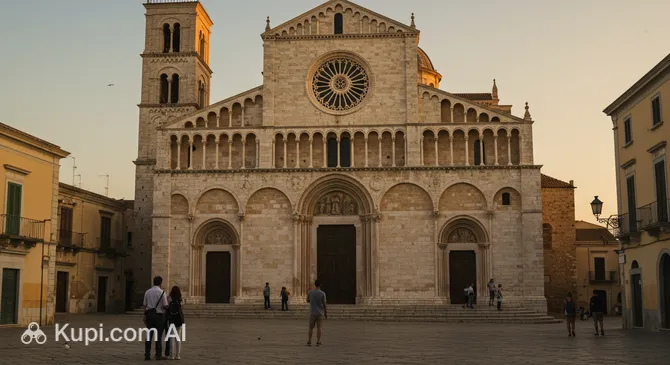
Cathedral of Santa Maria Assunta
Cathedral of Santa Maria Assunta. Иллюстрация. Источник: Kupi.com AI

The cathedral building, located on the picturesque Piazza Duomo, is easily recognized by its unique polygonal bell tower, which crowns the city skyline. In the architecture of this site in Italy, elements of Classicism and ancient Gothic traditions blend harmoniously, creating a unique ensemble that reflects the change of eras.

The interior is impressive for its nobility: decorated with red and white marble, and featuring a Latin cross floor plan with a spacious central nave that creates a sense of solemnity. Special attention is drawn to the octagonal drum at the intersection of the transept, supporting a high dome where soft natural light filters through the lantern.

Contacts

For those planning a visit to the Santa Maria Assunta Cathedral, it is helpful to know its exact location. The church is situated in the very heart of the historical district and serves as the city's main spiritual landmark.

How to contactContact
AddressPiazza Duomo, 09170 Oristano OR, Italy

What to Do

Visiting the Santa Maria Assunta Cathedral is, above all, an opportunity to experience art and tranquility. Inside the church, pay attention to the unique floors created in the famous Cosmatesque style—a mosaic technique characteristic of medieval Italian masters. As you observe the architectural details, you will notice how harmoniously elements from different centuries blend in the decoration of the side chapels.

History and religious art enthusiasts should definitely visit the nearby Diocesan Museum. It houses a rich collection of artifacts and valuable ritual objects that help visitors better understand the cultural heritage of Oristano. Since the cathedral remains an active spiritual center, you can often find moments of peaceful silence here, away from the busy tourist paths.

For lovers of aesthetics, the cathedral offers many photographic angles: from the play of light under the octagonal dome to the strict lines of the Baroque facade. This site is ideal for those who want to leisurely study the evolution of Italian style, moving from austere Romanesque architecture to lush Baroque.

Getting There

Finding the city's main shrine is easy, as it is located in the heart of Oristano on Piazza Duomo. If you are already in the historical part of the city, a walk along the picturesque Via Vittorio Emanuele II will lead you directly to the cathedral's distinctive round bell tower, which is visible from afar.

For those arriving from other areas or nearby cities, such as Alghero, it is most convenient to use a bus or a rental car to reach the central station or parking areas near the old town. From Oristano's main transport hubs, the cathedral is within comfortable walking distance.

If you prefer comfort, you can always use a taxi by giving the driver the address Piazza Duomo. GPS coordinates: 39.9027361° N and 8.5903454° E.

Ближайший город: Oristano

History & Facts

The history of this majestic building dates back to the deep past: the Santa Maria Assunta Cathedral was built on the foundations of a Late Antique and Byzantine settlement. It is believed that in 1070, Ruler Orzocco I de Lacon-Zori moved the capital of the Giudicato of Arborea to Oristano, and as early as 1131, documents mention "ecclesia sanctae Mariae de Orestano" as the region's primary cathedral.

The original Romanesque structure was built between the late 11th and early 12th centuries. Later, in the first third of the 13th century under the rule of Judge Marianus II, the church underwent changes: Master Placentius created a unique wooden roof and bronze ornaments for the doors, dated 1228. By the mid-14th century, the cathedral added a transept with four Gothic chapels, expanding its space.

The cathedral's current Baroque appearance is the result of a large-scale reconstruction in the 18th century. Due to the poor condition of the old walls, it was decided in 1729 to demolish part of the Romanesque and Gothic structures. Architects Salvatore Garrucciu and Giovanni Battista Arieti implemented a project for a single-nave church while preserving some elements of the ancient transept, and the renovated cathedral was solemnly reconsecrated in 1745.

Time Needed

For a basic introduction to the interiors and architecture of the Santa Maria Assunta Cathedral, 30–45 minutes is usually sufficient. This time allows you to see the main nave, the dome, and the preserved historical chapels.

If you decide to complement your visit with the neighboring Diocesan Museum, you should plan for another 30–60 minutes. The total duration of a cultural program in this area will be about 1.5 hours, making the cathedral an ideal site for a leisurely morning or afternoon visit.

Working Hours

The Santa Maria Assunta Cathedral is open to visitors daily, though the operating schedule varies slightly depending on the day of the week. When planning your visit, pay attention to the opening and closing times:

On weekdays, the cathedral usually opens at 9:00 (on Fridays slightly later at 10:00, and on Tuesdays earlier at 8:30) and stays open until 17:30. On Saturdays, the church doors are open until 18:00, which is convenient for evening walks through the city. On Sundays, visiting is possible from 9:00 to 17:30.

DayWorking hours
Понедельник9:00 – 17:30
Вторник8:30 – 17:30
Среда9:00 – 17:30
Четверг9:00 – 17:30
Пятница10:00 – 17:30
Суббота9:00 – 18:00
Воскресенье9:00 – 17:30

Nearby

A walk around the cathedral reveals the charm of Oristano's ancient streets. Exploring the immediate surroundings allows for a deeper feel of the city's atmosphere, where every stone breathes history and cozy squares invite a leisurely rest.

Numerous interesting locations are concentrated near the main church—from historical towers and palaces to modern, cozy cafes where you can have a snack after sightseeing.

NameDistance
Eleonora d'Arborea Square0.2 km
Ta Matete Restaurant0.2 km
Il Gatto Con Gli Stivali Craft Beer Bar0.3 km
Santa Marghe Pizzeria0.3 km
Piazza Roma0.4 km
Tower of Mariano II0.4 km
Frida Bar Restaurant0.6 km

Reached the end of the page?

That means the route is fully explored