Support

Orvieto

About

Orvieto is a true gem of Umbria, a city that seems to float atop an impressive tufa plateau, rising above picturesque green valleys and vineyards. Thanks to its unique location, it feels detached from the hustle and bustle of the modern world, offering visitors breathtaking views and a unique medieval atmosphere preserved in its narrow streets and ancient buildings.

Located approximately 100 kilometers north of Rome, Orvieto is often a desired stop for travelers journeying between the capital of Italy and Florence. With a population of just over 20,000, the city is intimate yet possesses a rich history and significant cultural weight in the region. It holds traces of the Etruscans, Romans, and medieval Popes, making it one of Umbria's most important historical centers.
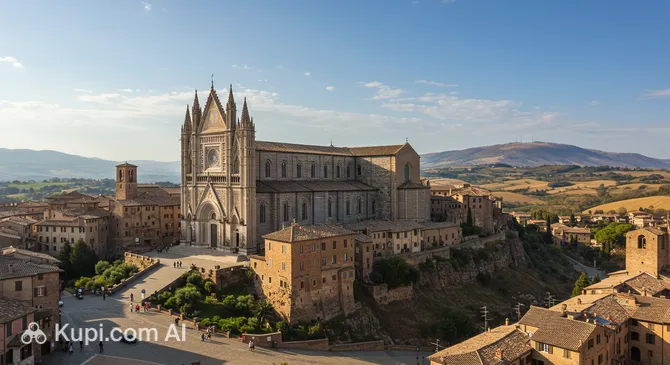
Orvieto. Illustration.
Source: Kupi.com AI

Orvieto attracts tourists not only with its impressive setting on a tufa cliff but also with its unique landmarks. One of the main highlights is the magnificent Cathedral (Duomo), a masterpiece of Gothic architecture with a stunning facade decorated with mosaics and sculptures. No less interesting is the mysterious St. Patrick's Well (Pozzo di San Patrizio), a 16th-century engineering marvel featuring two independent spiral staircases. Additionally, the city itself, with its underground passages left by the Etruscans and its medieval layout, is a living museum.

A visit to Orvieto is an opportunity to immerse yourself in an authentic Italian atmosphere, enjoy a leisurely pace of life, magnificent views, and a rich cultural heritage. This city, where every stone breathes history, will surely leave a lasting impression and a desire to return.

You can find more interesting facts on the history of Orvieto page.
Weather Overview

The weather in Orvieto is characterized by warm summers and cool winters. During the summer months, especially July and August, the average temperature stays around 25°C, with maximums potentially rising above 30°C. In winter, during January and December, the average temperature is about 6-7°C, with minimum values around 2-4°C. Precipitation is distributed throughout the year, but the rainiest months can be spring and autumn; for instance, November can have up to 15 days of precipitation, although the total amount remains moderate. Expect a warm summer with occasional rain and cool, wetter winters. To get a more detailed idea of the weather conditions, you can study the Orvieto climate.

Average monthly temperature

Average monthly precipitation

Interesting Facts

In addition to its world-famous landmarks, Orvieto hides many surprising stories and lesser-known details that make it even more attractive to curious travelers. This city, soaring atop a tufa cliff, guards secrets that date back to deep antiquity.

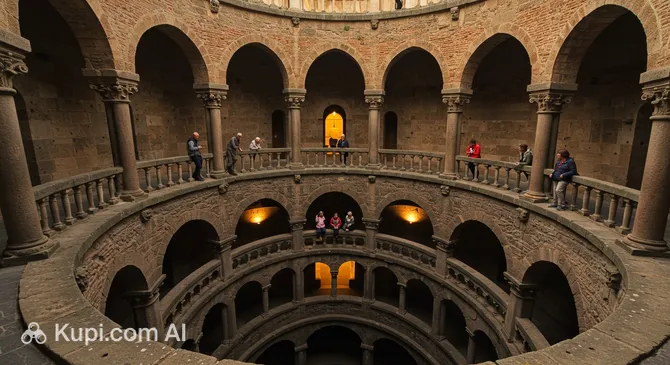
St. Patrick's Well. Illustration.
Source: Kupi.com AI

Traveler photos:

  • A City Beneath the City: Orvieto was founded by the Etruscans as early as the 7th–3rd centuries BC. Beneath the modern streets lies an entire labyrinth of underground passages, caves, and wells dug into the tufa. These subterranean spaces, including Orvieto Underground, served as refuges and wine cellars, and provided access to water during sieges.

  • An Engineering Marvel for the Papal Court: The famous St. Patrick's Well was built in the 16th century by order of Pope Clement VII, who feared a siege. It is 62 meters deep, and its unique design with two independent spiral staircases allowed mules to descend for water on one side and ascend on the other without crossing paths.

  • Inspiration for Michelangelo: It is believed that Luca Signorelli's impressive frescoes on the theme of the Apocalypse in the Orvieto Cathedral significantly influenced Michelangelo when he created his famous "Last Judgment" in the Sistine Chapel in the Vatican.

  • Papal Refuge and Distinguished Guests: In the Middle Ages, Orvieto repeatedly served as a residence and refuge for the Popes. The city's palaces and fortresses still bear traces of this period. Among the famous figures who visited the city were Dante Alighieri and the painter Raphael.

How to Get There

Reaching Orvieto, a picturesque city in the heart of Italy, is possible in several ways. The most popular options include flying into one of the nearest international airports followed by a transfer, or traveling by train, which is particularly convenient as Orvieto has its own railway station on a major line.

While Orvieto does not have its own airport, the city is easily accessible from several major international and regional Italian airports. The most convenient options for international travelers are the airports in Rome. Leonardo da Vinci–Fiumicino Airport (FCO), located in Rome, is the largest in the country and is about 103 km from Orvieto. A trip by car or taxi from there takes about 2 hours and 50 minutes. The other Roman airport, Ciampino–G.B. Pastine International Airport (CIA), which primarily serves budget airlines, is approximately 110 km away, or about a 3-hour drive. The closest airport to Orvieto is San Francesco d'Assisi Airport (PEG) in Perugia, about 53 km away (around 1 hour and 40 minutes by car), which serves some European destinations and can be convenient for regional flights.

For clarity, here is a summary of the main airports:

AirportPassenger trafficDistance
Sant Egidio Airport532 47453 km
Leonardo da Vinci-Fiumicino Airport40.5 mln103 km
Ciampino–G. B. Pastine International Airport3.9 mln110 km
Firenze-Peretola Airport3.5 mln142 km
Ancona Falconara Airport600 065143 km

Orvieto has excellent rail connections thanks to its station located on the important Rome–Florence line. This makes the train one of the most convenient and popular ways to reach the city. Many travelers arrive through major rail hubs in neighboring cities, from which direct trains run regularly to Orvieto.

For example, from Rome's main station, Roma Termini Station (XRJ), which is one of the largest in Europe and located about 96.5 km from Orvieto, trains to Orvieto depart very frequently, and the journey itself takes about 1 – 1.5 hours. Another major transport hub is Firenze Santa Maria Novella Station (ZMS) in Florence, located about 136.8 km from Orvieto. From here, it is also easy to reach Orvieto by train in about 2 – 2.5 hours. Traveling by train is not only convenient but also allows you to enjoy the scenic landscapes of Umbria and Tuscany.

For your convenience, below is information on some major railway stations from which you can reach Orvieto:

StationPassenger trafficDistance
Tiburtina Railway Station51 mln96 km
Roma Termini Station150 mln97 km
Ostiense Railway Station5.8 mln99 km
Firenze Campo di Marte Railway Station1.8 mln136 km
Firenze Santa Maria Novella Station59 mln137 km

Additionally, Orvieto can be reached by car. The city is located near the A1 motorway (Autostrada del Sole), the main artery connecting the north and south of Italy, making a car trip quite comfortable as well.

Main Attractions

Orvieto, majestically perched on a tufa plateau in the heart of Italy, is home to treasures of history and architecture. This ancient city, founded by the Etruscans, offers tourists a unique blend of cultural heritage and breathtaking views. Here are just a few of the top attractions that make Orvieto a must-visit on any traveler's Umbrian itinerary.

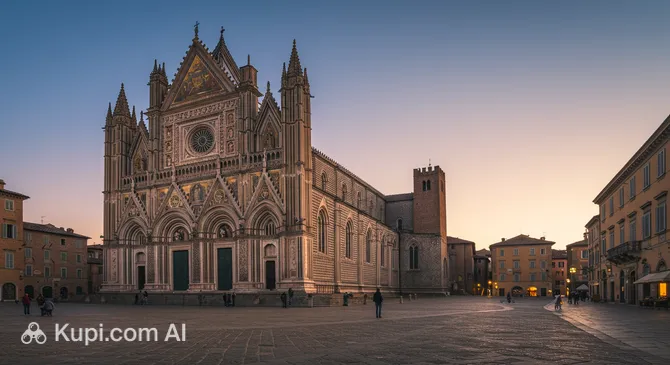
The city's landmark is undoubtedly the Orvieto Cathedral (Duomo). This masterpiece of Italian Gothic architecture captivates the imagination with its magnificent facade, adorned with vibrant mosaics, delicate bas-reliefs, and sculptures. Inside the cathedral are the priceless frescoes by Luca Signorelli in the San Brizio Chapel, depicting the Last Judgment, considered one of the greatest achievements of the Italian Renaissance. A visit to the Duomo leaves an indelible impression thanks to its monumentality and artistic richness.

Orvieto Cathedral. Illustration.
Source: Kupi.com AI

Traveler photos:

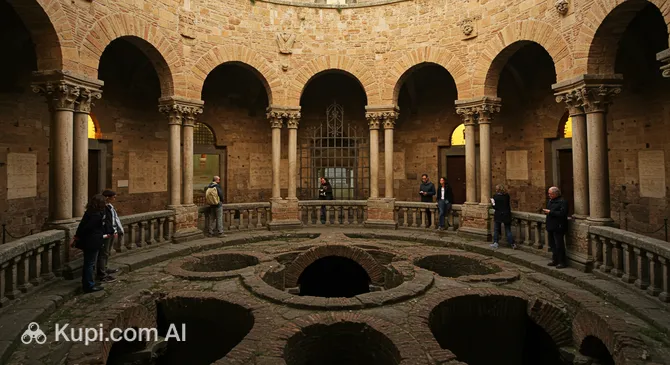
Another iconic landmark in Orvieto is St. Patrick's Well (Pozzo di San Patrizio). This impressive 16th-century engineering feat was built by order of Pope Clement VII to provide the city with water during potential sieges. The well's uniqueness lies in its double spiral staircase: one for descending and the other for ascending, allowing people and pack-laden donkeys to move without crossing paths. Descending 53 meters down one of the 248 steps is a true adventure, showcasing the scale and genius of medieval engineering.

St. Patrick's Well. Illustration.
Source: Kupi.com AI

Traveler photos:

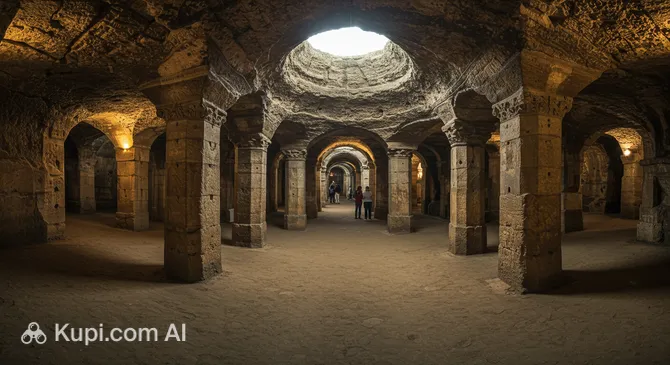
Beneath the streets of Orvieto lies another world—Orvieto Underground. This is an extensive network of over 1,200 tunnels, caves, wells, and pigeon coops dug into the tufa rock over millennia, starting from Etruscan times. Tours of these underground spaces reveal the secrets of ancient city life, showing how residents used the subterranean area for everything from storing wine and oil to seeking shelter. It is a fascinating journey into the depths of the city's history.

Orvieto Underground. Illustration.
Source: Kupi.com AI

Traveler photos:

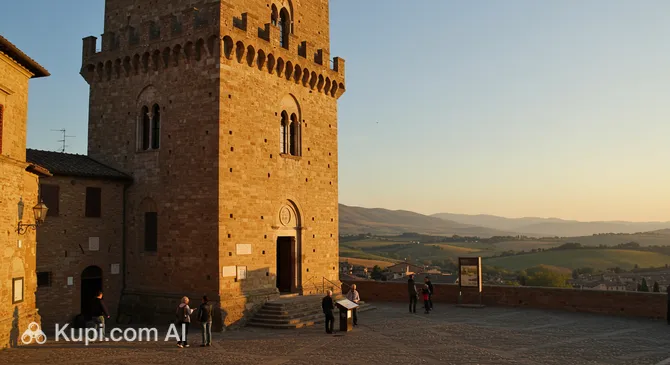
To enjoy a panoramic view of Orvieto and the surrounding picturesque valleys of Umbria, it is worth climbing the Torre del Moro. This medieval tower, rising 47 meters in the very center of the city, once served as a symbol of power and a lookout point. Today, its observation deck offers one of the best views over the tiled roofs of the old town, the majestic Duomo, and the endless green expanses, making it an ideal spot for photography and contemplating the region's beauty.

Torre del Moro. Illustration.
Source: Kupi.com AI

Traveler photos:

Beyond these iconic sites, Orvieto offers other interesting corners, such as Pozzo della Cava—another ancient well with a complex of caves—or the Palazzo del Capitano del Popolo, which testifies to the city's rich civic history. Every street and every stone in Orvieto breathes history, inviting you to make new discoveries.

Local Cuisine

The gastronomy of Orvieto is a true immersion into the heart of Umbrian cuisine—simple yet incredibly rich in flavor. Locals highly value the freshness of seasonal products and centuries-old culinary traditions passed down through generations. Be sure to try umbrichelli—a thick homemade pasta often served with a rich meat ragù, mushroom sauce, or aromatic truffles, another treasure of the region. Game meat and the famous Pecorino sheep's cheese also frequently appear on the menu.

The city's hallmark is undoubtedly the white wine Orvieto Classico DOC. This is one of Italy's most famous wines, with a production history dating back to Etruscan times. Its fresh, slightly fruity taste perfectly complements fish dishes, white meat, local cheeses, and light appetizers. In the city's numerous enotecas, you can not only taste various types of this wine but also sample homemade liqueurs and, of course, excellent locally produced olive oil.

The dining culture in Orvieto is diverse and offers options for every taste. Traditional meals take place in cozy trattorias and restaurants where you can enjoy authentic dishes. For example, stop by the restaurant Al Pozzo Etrusco to appreciate the local cuisine. For a quicker bite, look to street food: porchetta—juicy, aromatic pork roasted with herbs—is particularly popular, as are fresh focaccia and various savory pies. The city markets also delight with an abundance of fresh vegetables, fruits, local sausages, cheeses, and fragrant bread.

Al Pozzo Etrusco. Illustration.
Source: Kupi.com AI

Traveler photos:

Gastronomic impressions of Orvieto linger in the memory for a long time. The city attracts gourmets not only with its everyday dishes but also with vibrant culinary events. In the spring and autumn, festivals dedicated to wine, truffles, or olive oil are often held here, turning the streets of Orvieto into a true celebration of taste and aroma, where you can get to know Umbria's culinary heritage more deeply.

Travel Tips

Welcome to Orvieto, the gem of Umbria! To ensure your trip to this amazing city atop a tufa cliff goes smoothly and leaves only the pleasant impressions, we have prepared some practical tips.

  1. What to take with you: The climate in Orvieto is temperate, but the weather can be changeable. In summer, bring light clothing, sunscreen, a hat, and sunglasses. In spring and autumn, layered clothing and a light jacket are useful. In winter, bring warmer clothes. A key element of your wardrobe is comfortable shoes, as Orvieto's historic center is best explored on foot across cobblestones and hilly streets. Don't forget an adapter for electrical appliances (Type L). When visiting the Duomo and other churches, shoulders and knees should be covered.
  2. Getting around the city: Orvieto's historic center is quite compact, and the best way to see it is on foot. To reach the city from the railway station (Orvieto Scalo), use the scenic funicular, which will take you directly to the edge of the historic center. Local buses also run, connecting different parts of the city. Renting a car is impractical for moving within Orvieto itself due to narrow streets and limited traffic zones (ZTL), but it can be useful if you plan to explore the Umbrian countryside.
  3. Financial matters: The official currency is the Euro (EUR). You can exchange money at banks or post offices, but it is often more favorable to withdraw cash from ATMs (Bancomat), which are widespread. Credit and debit cards (Visa, Mastercard) are accepted in most hotels, restaurants, and shops. American Express may not be accepted everywhere. It is recommended to notify your bank of your trip. Tipping in Italy is not strictly mandatory but is always welcomed for good service (usually 5-10% of the restaurant bill or rounding up the amount). Note that a "coperto" (service/cover charge) is often included in the bill.
  4. Health and safety: Orvieto is a very safe city. Nevertheless, follow standard precautions: keep an eye on your belongings in crowded places. Pharmacies (Farmacia) are easy to find by the green cross; their hours vary, and information about duty pharmacies can be found on their doors or online. For medical assistance, tourists are recommended to have travel insurance. In emergencies, call 112.
  5. Communication: The official language is Italian. In tourist areas (hotels, restaurants, souvenir shops), staff often speak English, but knowing a few basic Italian phrases will be very helpful and appreciated by locals: "Buongiorno" (Good day), "Grazie" (Thank you), "Per favore" (Please), "Mi scusi" (Excuse me). Mobile SIM cards can be purchased at cellular stores. Wi-Fi is available in most hotels, cafes, and some public areas.
  6. Local etiquette: Italians are friendly and outgoing. It is customary to greet people: "Buongiorno" (before lunch) or "Buonasera" (after lunch/evening). "Ciao" is a more informal greeting. When entering a shop or cafe, it is polite to say hello. In churches and museums, maintain silence and show respect for sacred objects and exhibits.
  7. What not to do: Try not to be too loud, especially in churches and residential areas in the evening. Keep in mind that many shops may close for "riposo" (siesta)—a midday break, usually from 1:00 PM to 4:00 PM or 5:00 PM. You should not sit at a table in a cafe or restaurant if you only ordered a drink at the bar—prices may differ.
  8. Orvieto specifics: Be sure to book tickets in advance to visit the San Brizio Chapel in the Duomo, especially during high season. Explore Orvieto Underground—a fascinating network of tunnels and caves beneath the city. And, of course, don't miss the chance to try the famous local white wine, Orvieto Classico. If you are traveling by car, use the parking lots outside the historic center, such as near the funicular station.

We hope these tips help you plan an unforgettable trip to Orvieto. Enjoy its unique atmosphere, stunning views, and rich history!

Entertainment & Nightlife

Orvieto, with its rich history and medieval charm, offers guests a cozy and atmospheric nightlife that focuses more on relaxed leisure than loud parties until dawn. Evenings here are a time for leisurely strolls through the illuminated streets of the historical center, tasting local wines, and enjoying pleasant conversation in a friendly setting.

Primary evening activity is concentrated in the historic city center. Here, amidst ancient buildings, you will find numerous bars, enotecas, and restaurants that hospitably open their doors after sunset. The atmosphere in most establishments is quite casual and conducive to conversation. The crowd is a mix of locals and tourists. There is usually no specific dress code; a comfortable and neat style is appreciated. Most bars are open until midnight or 1:00 AM, especially on weekends.

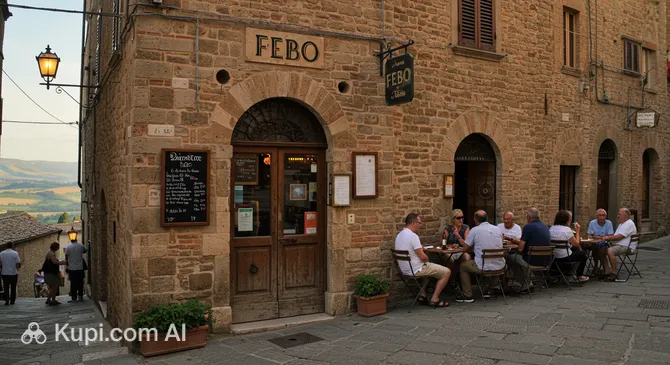
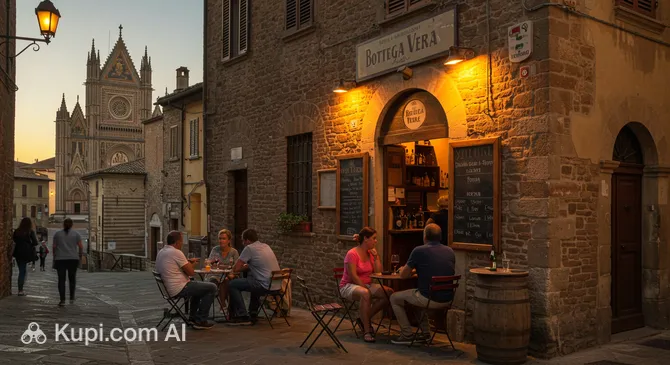
Among the venues where you can spend a pleasant evening, FEBO is a popular spot for an aperitif or a glass of wine in a cozy setting. Another interesting option is Bottega Vèra, where you can enjoy local drinks and snacks. In these bars, you can often meet both young people and older adults enjoying their evening.

FEBO. Illustration.
Source: Kupi.com AI

Traveler photos:

Practical tips for evening outings:

  • The best time to visit bars is after 7:00 PM - 8:00 PM, when aperitif time begins, and until midnight.
  • Average drink prices are quite moderate, typical for small Italian cities.
  • Orvieto's historic center is compact, and most venues are easily reachable on foot. At night, public transport runs infrequently, so if your accommodation is far away, consider a taxi in advance or walk back if it is safe to do so.
  • Orvieto is considered a very safe city. However, as elsewhere, it is best to stick to well-lit streets at night and be mindful of your belongings. You can call a taxi through your hotel reception or ask for one at a restaurant or bar.

While Orvieto is not famous for loud nightclubs, its evening life charms with its authenticity and the opportunity to quietly enjoy the atmosphere of an ancient city. There are no large concert venues or night markets in the traditional sense; the emphasis is on quality rest and social interaction.

Bottega Vèra. Illustration.
Source: Kupi.com AI

Traveler photos:

During the day, Orvieto offers a rich cultural program. You can visit the famous Orvieto Cathedral, explore the mysterious Orvieto Underground, or descend into the amazing St. Patrick's Well. The city's museums and numerous historical monuments will keep any curious traveler engaged. There are no amusement parks within Orvieto itself, but its picturesque surroundings and the city itself are wonderful places for walks and discovery.

Parks & Museums

Orvieto, majestically rising on a tufa cliff, offers its guests not only an immersion into a rich, centuries-old history but also the opportunity to enjoy scenic panoramas and cozy corners for relaxation. The city is famous for its unique underground structures and magnificent cathedral, but those who love outdoor walks will also find plenty to enjoy.

While Orvieto does not abound with vast parks in the traditional sense, its location provides unforgettable views. One such place is the Public Gardens (Giardini Comunali), located near the Albornoz Fortress (Rocca Albornoz). From here, a breathtaking panorama of the valley and the surrounding Umbrian landscape unfolds. It is a wonderful place for a peaceful stroll and a photo session. The fortress itself, partially converted into a public park, is also an interesting site to explore.

Orvieto Cathedral. Illustration.
Source: Kupi.com AI

Traveler photos:

Orvieto's cultural heritage is staggering. The crown jewel of the city is undoubtedly the Orvieto Cathedral (Duomo). This masterpiece of Gothic architecture is famous for its incredible facade, decorated with mosaics and sculptures, as well as the frescoes by Luca Signorelli in the San Brizio Chapel. The Cathedral Museum (Museo dell'Opera del Duomo) is often located near the cathedral, housing valuable relics and artworks related to its history.

Orvieto Underground. Illustration.
Source: Kupi.com AI

Traveler photos:

One of Orvieto's most intriguing features is its subterranean world. An excursion to Orvieto Underground will reveal a labyrinth of tunnels, caves, pigeon coops, and wells dug over the centuries, starting from Etruscan times. This is a unique opportunity to peek into the city's daily life across different eras. No less impressive is St. Patrick's Well (Pozzo di San Patrizio)—a brilliant 16th-century engineering feat with two spiral staircases, built to provide the city with water during sieges. Descending into this well is a true adventure.

St. Patrick's Well. Illustration.
Source: Kupi.com AI

Traveler photos:

Another iconic underground structure is Pozzo della Cava. This complex includes not only a well but also a series of caves with archaeological finds that tell the story of the city's Etruscan, medieval, and Renaissance past. Other significant architectural monuments include the Palazzo del Capitano del Popolo, once the residence of the Captain of the People and now a congress center, and the Torre del Moro, a medieval tower from whose summit a magnificent view of the entire city and its surroundings opens up.

For a more authentic experience, turn off the main tourist routes and wander through Orvieto's quiet side streets, where you can find charming courtyards and workshops of local artisans, especially those working with the famous Orvieto ceramics. It is also worth visiting small enotecas to taste local wines, including the famous Orvieto Classico white wine.

Getting Around

Getting around Orvieto is quite easy given its compact size, especially in the historical part of the city located atop the tufa cliff. The public transport system is based on a unique combination of a funicular and buses, perfectly suited for overcoming the steep climb to the center.

The main "artery" for tourists arriving by train is the Orvieto Funicular. It connects the railway station located at the foot of the hill (Orvieto Scalo) with the historic center at the top (Piazza Cahen). The funicular ride is a small adventure in itself and takes only a few minutes. From the upper funicular station (Piazza Cahen), local minibuses (Lines A, B, and C) depart, weaving through the narrow streets of the historic center and taking passengers to major landmarks like the Duomo. Modes of transport such as subways, trams, or trolleybuses do not exist in Orvieto due to the terrain and the city's size.

The payment system in Orvieto is quite simple. Tickets for the funicular and buses are usually uniform or integrated. You can purchase them at the funicular ticket office, at tobacco shops (Tabaccheria, marked with a "T"), or at newsstands. The cost of a single trip is generally low, approximately 1-2 euros. There are also tickets valid for a certain period (e.g., 90 minutes) or day passes if you plan to travel a lot. It is extremely important to remember to validate your ticket before or immediately after boarding the vehicle—special validators are installed in buses and at funicular stations for this purpose. An unvalidated ticket is considered invalid and may result in a fine.

Buses and the funicular operate according to a schedule that can be found at stops or the funicular station. Usually, service begins early in the morning and ends in the evening, but it is not 24-hour. During the tourist season, intervals between trips may be shorter. The historic center of Orvieto itself is best explored on foot—its size allows you to visit all the main sights at a leisurely pace, enjoying the atmosphere of the medieval city.

As an alternative to public transport, taxis are always available, with stands usually located at the station and in major squares. This is a more expensive but more comfortable way to travel, especially if you have a lot of luggage. Car-sharing services or large-scale bike rentals are less common in Orvieto due to the city's specific layout.

Accommodation

When planning a trip to Orvieto, you will find a variety of accommodation options to suit different preferences and budgets. The city offers a wide range: from cozy guest houses (B&Bs) and apartments, ideal for those seeking home comforts, to elegant boutique hotels housed in historic buildings. Mid-range hotels offering a good balance of price and quality are also available.

Most tourists prefer to stay in the historic center of Orvieto. This is not surprising, as the main attractions are concentrated here, such as the magnificent Orvieto Cathedral, the mysterious St. Patrick's Well, and the impressive Torre del Moro. Staying in this part of town makes it easy to explore its narrow streets and enjoy the ancient atmosphere with everything you need within walking distance. Some accommodation options may offer breathtaking views of the surrounding Umbrian landscape.

The price range for accommodation in Orvieto varies: you can find both budget options and more luxurious offers. Generally, prices are higher during the peak tourist season (spring and autumn, as well as summer months) and during local festivals. Therefore, it is recommended to book your accommodation in advance, especially if your trip coincides with popular dates. You can use popular online platforms or contact your chosen hotel or apartment directly for search and booking.

Nearby Cities

For those looking to explore the surroundings, Orvieto serves as an excellent starting point for day trips to several interesting nearby locations:

CityPopulationDistance
Montefiascone13 49821 km
Todi16 60625 km
Marsciano18 70128 km
Amelia11 82831 km
Viterbo67 79833 km

These nearby destinations offer a glimpse into the diverse culture and landscapes of the Umbria region and neighboring areas of Italy. Each trip promises new discoveries, whether it be historical centers, artistic treasures, or simply the charm of the Italian countryside.

Shopping & Souvenirs

Shopping in Orvieto is an immersion into the world of authentic Italian crafts, local delicacies, and unique finds. The city is famous for its pottery traditions, winemaking, and olive oil production, making it a wonderful place to buy special souvenirs and gifts. Instead of large shopping malls, you will find charming small shops, craft workshops, and family-run boutiques here.

The main shopping area in Orvieto is the central street Corso Cavour and its adjacent side streets, such as Via del Duomo. Strolling along them, you will discover many clothing boutiques, jewelry stores, bookstores, and specialty shops offering famous Orvieto ceramics, local wines, and gastronomic delights.

You won't find large modern shopping centers in Orvieto. The charm of shopping here lies precisely in finding unique goods in the small independent shops and workshops scattered throughout the historic center of this hilltop city.

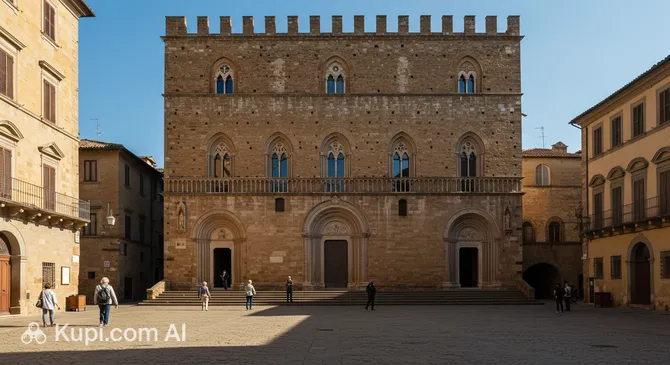
An integral part of Orvieto's retail life is its local markets. The main city market is located at Piazza del Popolo, where the Palazzo del Capitano del Popolo is also situated. On Thursdays and Saturdays, a lively trade unfolds here: you can buy fresh local produce, cheeses, and sausages, as well as clothing, home goods, and sometimes antiques or handmade items. It is a great place to feel the local atmosphere and purchase something truly authentic.

Palace of the Captain of the People. Illustration.
Source: Kupi.com AI

Traveler photos:

Souvenirs worth bringing from Orvieto include:

  • Ceramics: Orvieto has centuries-old traditions in the art of pottery. Pieces are often decorated with medieval motifs, animal imagery, and characteristic geometric patterns. You will find many shops selling hand-painted plates, vases, and decorative items.
  • Orvieto Classico Wine: This famous white wine is a must for connoisseurs and makes an excellent gift. Many enotecas (wine shops) offer tastings and a wide selection.
  • Olive Oil and Truffles: Umbria, the region where Orvieto is located, is famous for high-quality olive oil and truffles. Look for locally produced oils and truffle-based products.
  • Handmade Goods: It is also worth looking for leather goods, lace, and wood carvings created by local artisans.

Shops in Orvieto are typically open from around 9:00 AM - 10:00 AM to 1:00 PM, followed by a lunch break ("pausa pranzo") until about 4:00 PM. They then reopen and work until 7:00 PM - 8:00 PM. Many shops, especially smaller ones, may be closed on Sundays or operate on a reduced schedule. Credit cards are accepted in most places, especially in tourist shops, but it is always useful to have some cash for small purchases or at the market.

For tourists who are not residents of the European Union, there is a possibility of a VAT refund (called IVA in Italy) on purchases exceeding a certain limit. Look for "Tax Free Shopping" signs in shop windows. You will need to fill out a special form at the time of purchase and have it stamped by customs when leaving the EU.

Reached the end of the page?

That means the route is fully explored