Support

Salina

About

Salina is a true gem of the Aeolian Archipelago, often referred to as the "Green Island" due to its lush vegetation and fertile soils. Unlike its more rugged volcanic neighbors, this picturesque corner of Italy offers travelers a sense of deep peace and harmony with nature. It is the second-largest island in the archipelago, where life flows at a measured pace, dictated by the sound of the sea and the rustle of leaves.
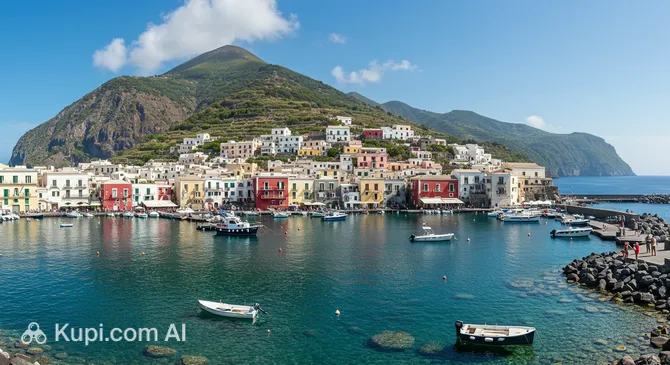
Salina. Illustration.
Source: Kupi.com AI

The island's recognizable silhouette is formed by two extinct volcanoes—Monte Fossa delle Felci and Monte dei Porri. It was because of them that the ancient Greeks called this place "Didyme," meaning "Twins." The centuries-old history of Salina is also reflected in its modern name, which derives from the ancient salt lakes in the Lingua district, where salt was once harvested. Today, just over 4,000 people live here permanently, creating a cozy, almost family-like atmosphere in the local villages.

Salina is famous not only for its landscapes but also for its culinary treasures. The island is considered the capital of capers and the home of the sweet Malvasia wine. Travelers are also drawn to Pollara Bay—an incredibly beautiful spot that gained worldwide fame as the filming location for the movie "The Postman" (Il Postino). Strolls along the Santa Marina waterfront or a climb to the mountain peaks will treat you to unforgettable panoramas of the Tyrrhenian Sea.

If you dream of a holiday away from the noisy crowds, want to enjoy authentic cuisine, and immerse yourself in the atmosphere of true Mediterranean comfort, be sure to include Salina in your itinerary.
Weather Overview

The climate on Salina is typically Mediterranean, mild and pleasant for holidays most of the year. Summer here is sunny and warm: in July and August, the average temperature stays around 26–27°C, and precipitation is practically non-existent—only 1–3 rainy days per season. This is the ideal time for those who want to enjoy the sea and beaches.

The shoulder seasons are excellent for active tourism and hiking. In May, the air warms up to a comfortable 18.5°C, while September offers a "velvet season" with average readings around 24°C. However, keep in mind that the probability of precipitation increases in autumn: by November, the number of rainy days rises to 13. You can find a detailed forecast for your desired dates by checking the weather in Salina on our website.

Winters on the island are never harsh. Even in the coldest months, January and February, the temperature rarely drops below 12–13°C. Expect a hot, dry summer and a mild winter with occasional rain, which provides the island with its famous lush greenery.

Interesting Facts

Помимо основных достопримечательностей, Салина хранит множество увлекательных секретов и особенностей, которые выделяют её среди соседей по архипелагу. Вот несколько любопытных фактов, которые помогут взглянуть на этот остров по-новому:
  • Administrative Independence. Salina is the only island in the Aeolian Archipelago that is not governed by the main municipality in Lipari. The locals have always been known for their proud nature, so the island's territory is divided into three completely autonomous communes: Santa Marina, Malfa, and Leni. This administrative division has been in place for over a hundred years.

  • The Secret of the "Green Island." Salina owes its famous lush vegetation not only to rain but also to a unique geological gift. It is the only island in the archipelago that possesses its own natural freshwater springs. The presence of these springs allowed for the development of agriculture on a scale that is impossible on the neighboring volcanic islands.

  • A Sanctuary in a Crater. The spiritual heart of the island is considered to be the Madonna del Terzito sanctuary, located in the Valdichiesa valley, right in the saddle between the two extinct volcanoes. Legend has it that the site for the temple was pointed out by a hermit in the 17th century: he heard the ringing of a bell coming from underground and, upon digging, discovered an ancient icon of the Virgin Mary.

How to Get There

Salina is an island, so a direct route here is impossible: the journey always involves a sea crossing. Usually, tourists fly to Sicily or Naples and then transfer to a ferry or hydrofoil. To plan the perfect route, we recommend exploring all the ways to get to the city and choosing the most convenient option for you.

Since the island itself has no airstrip, travelers use the airports of neighboring Sicily or mainland Italy. One of the most popular options is Catania–Fontanarossa Airport (IATA: CTA). It is located in the city of Catania, approximately 124 km from Salina (by direct line and sea). This is a major international hub with significant passenger traffic. A taxi or bus journey to the port of Milazzo, where ferries to the island depart, takes about 200–210 minutes.

Another convenient option is Falcone–Borsellino Airport (IATA: PMO), located in Palermo. The distance to Salina is about 158 km. During the summer season, direct boats run from the port of Palermo to the Aeolian Islands, which is very convenient. The overland part of the journey by car takes approximately 260 minutes.

You can also consider Tito Minniti Airport (IATA: REG) in Reggio di Calabria. It is the closest—90 km away, at the very "toe" of the Italian boot. This is a small airport, but it's convenient for reaching the port of Messina. Travel time by car to the crossing is about 155 minutes.

For convenience, here is a summary of the main airports:

AirportPassenger trafficDistance
Tito Menniti Airport400 00090 km
Catania-Fontanarossa Airport12.3 mln124 km
Lamezia Terme International Airport2.7 mln128 km
Falcone-Borsellino Airport8.9 mln158 km
Comiso Airport260 642176 km

If you prefer rail transport, the journey will also be a combination. There is no railway station on Salina itself, but you can reach major stations on the mainland or Sicily. An essential transport hub is Napoli Centrale station in Naples. It is approximately 258 km from the island. This is a very large station from which it is easy to reach the port of Naples to board an overnight ferry to Salina.

Another option is Reggio di Calabria Centrale station in the city of Reggio di Calabria, located 87 km from Salina. From here, you can quickly reach the port and cross to Sicily or directly to the islands if seasonal service is available.

Below is a table with the closest and most significant railway stations:

StationPassenger trafficDistance
Reggio di Calabria Centrale Station87 km
Lamezia Terme Centrale Railway Station1 mln130 km
Salerno Railway Station6 mln234 km
Naples Centrale Station50 mln258 km
Mergellina Railway Station6.2 mln261 km

Main Attractions

Salina's attractions primarily consist of its incredible nature and charming villages that have preserved the spirit of old Italy. The island offers an ideal balance between relaxed beach holidays and active walks along protected trails. There are no noisy amusement parks here, but there are places whose beauty is truly breathtaking.

One of the island's main highlights is Pollara Bay (Baia di Pollara), located inside the crater of an ancient volcano half-submerged in the sea. This spot gained global fame after the filming of the movie "The Postman." Steep cliffs hanging over the sea and old fishing houses carved directly into the tuff create a unique landscape. Tourists come here toward evening to witness what is perhaps the most beautiful sunset in the entire archipelago.

For lovers of panoramic views, it is worth climbing Monte Fossa delle Felci—the highest point of the Aeolian Islands (962 meters). The mountain peak is covered with a dense forest of ferns, pines, and chestnuts, which is rare for volcanic territories. The route passes through a nature reserve, and from the peak, a magnificent view opens up of Sicily and the neighboring islands, seemingly floating in the blue sea haze.

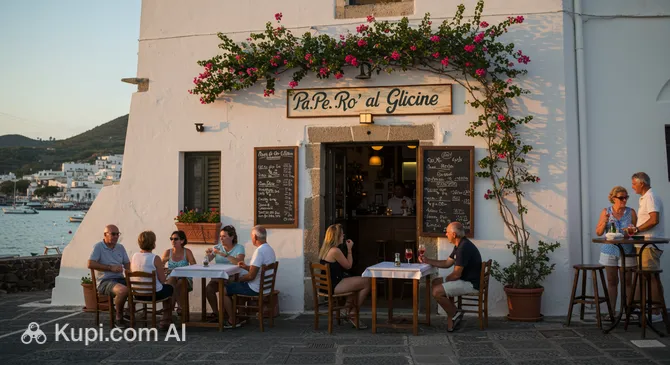
Pa.Pe.Ro' al Glicine. Illustration.
Source: Kupi.com AI

Traveler photos:

In the village of Lingua, you will find the famous salt lake, which gave the entire island its name. A picturesque lighthouse stands nearby, and a walk along the promenade offers total tranquility. To feel the atmosphere of local life and take a short break, you can stop by the Pa.Pe.Ro' al Glicine bar. This colorful establishment is perfect for relaxing after a busy day and enjoying drinks in a cozy setting.

Also worth visiting is the sanctuary of Madonna del Terzito, located in the green Valdichiesa valley. This is Salina's main religious site, built on the site of ancient ruins. The temple is surrounded by vineyards where grapes for the famous Malvasia wine are grown, so a visit to the church can be combined with exploring the region's winemaking traditions.

Local Cuisine

Salina's cuisine is a hymn to the fertile volcanic earth and the generous sea. The island is often called the gastronomic capital of the Aeolian Archipelago, and for good reason: this is where Italy's best capers are grown and unique sweet wine is produced. The food here is simple and rustic, yet incredibly aromatic thanks to the use of the freshest local ingredients.

The main dish that every visitor must try is Pane Cunzato. This is not just bread, but a true work of art: a huge flatbread soaked in olive oil, generously topped with cherry tomatoes, baked ricotta, tuna, olives, and handfuls of local capers. Fresh fish also always features on restaurant menus, with swordfish being particularly popular, whether grilled or served as delicate rolls with breadcrumbs and herbs.

Among drinks, the queen of the table is Malvasia (Malvasia delle Lipari)—an amber-colored dessert wine with notes of honey and apricot. Locals call it "nectar of the gods" and drink it chilled after dinner, often dipping hard sesame cookies into it. Mornings here traditionally start with granita—a dessert made of crushed ice with fruit, coffee, or almonds, served with a warm brioche bun.

The dining culture on Salina is very relaxed and democratic. Family trattorias and street kiosks are popular, where you can grab a bite after the beach. Towards evening, life moves to the open terraces for a long aperitivo. A great example of such a place is the Pa.Pe.Ro' al Glicine bar, where in a cozy setting you can enjoy a cocktail or a glass of wine while observing the slow pace of island life.

Travel Tips

Welcome to the greenest and coziest island of the Aeolian Archipelago! To ensure your trip to Salina is worry-free and leaves only pleasant memories, we have prepared a list of important practical recommendations to help you easily blend into the local rhythm of life.

  1. Clothing and gear. In summer, prefer light natural fabrics, but be sure to bring a windbreaker for evening walks by the sea or boat trips. Since many beaches here are pebbly and rocky (for example, in Pollara), special swimming shoes (water shoes) are a necessity. Comfortable sneakers will also come in handy if you plan to climb the volcanoes.

  2. Transport. Salina is a fairly large island, and it's difficult to get around entirely on foot. The most convenient way to travel is by renting a scooter or a small car, which will give you complete freedom. Also, the public bus system (CITIS) works excellently, regularly running between the port of Santa Marina, Malfa, and Leni. Schedules are usually posted at stops, but it's better to have a photo of it on your phone.

  3. Finance. The official currency is the Euro. Although hotels and large restaurants accept cards, it is extremely important to have cash on the island (especially in small shops, bars, and on buses). ATMs are available in the main villages, but they may not work or may run out of money during peak season, so it’s more reliable to withdraw the necessary amount in advance in Sicily or on the mainland.

  4. Health and Safety. Salina is a very safe place; you can walk peacefully even at night. The main "dangers" are the strong sun and jellyfish that occasionally appear near the shores, so always use high SPF cream and keep an eye on the water before swimming. Pharmacies operate on a schedule with a siesta break, and there are no 24-hour locations, so it's better to pack a personal first-aid kit at home.

  5. Communication. The primary language is Italian. English is understood in tourist areas, but in the heart of the island, communication may be difficult. Download an offline translator and learn a few phrases: "Buongiorno" (good day) and "Grazie" (thank you) will open any door. It's better to buy a SIM card at your arrival airport (in Sicily or Naples), as the choice of operators on the island itself is limited.

  6. Local Etiquette. Life on the island follows the "slow life" philosophy. It’s not customary to rush or hurry the service in restaurants. Respect the siesta time (roughly from 1:30 PM to 4:30 PM): shops close during these hours, and it is customary to keep quiet in the streets. Loud conversations under the windows of residential buildings during this time may cause dissatisfaction among locals.

  7. What to Avoid. Don't waste freshwater—it is a scarce resource on the islands. Also, avoid walking through town centers (Santa Marina, Malfa) in swimwear or with a bare chest; this is only acceptable on the beach and is seen as a sign of disrespect toward residents in town, even in a resort area.

  8. Pro Tip. Be sure to try and buy local capers (Capperi di Salina) and sweet Malvasia wine as souvenirs. It’s best to buy them directly from producers or in small grocery stores ("Alimentari") where the islanders themselves shop—the quality is higher and the prices are better than in the souvenir shops by the port.

By following these simple tips, you will feel not just like a tourist on Salina, but like a welcome guest. Enjoy the silence, the scents of the sea, and the unique measured way of life in this amazing corner of Italy!

Entertainment & Nightlife

Nightlife on Salina is fundamentally different from the noisy parties of neighboring Panarea or Lipari. You won't find booming discos until dawn or overcrowded dance floors here. Evenings on the "Green Island" are dedicated to the art of "dolce vita"—enjoying the moment, delicious food, and pleasant conversation. The main action revolves around the aperitivo ritual, which flows smoothly into a long alfresco dinner and concludes with a cocktail to the sound of the waves.

The center of evening activity is Santa Marina. The main street, Via Risorgimento, comes alive after sunset: numerous boutiques, souvenir shops, and wine bars open here. The crowd is elegant but relaxed; the dress code is "smart casual" or resort chic—linen shirts and light dresses are perfect. Another popular area is the waterfront in Lingua, where it is customary to stroll along the sea, enjoying views of the lighthouse and the lights of the neighboring island of Lipari.

Establishments with open terraces are particularly popular. A great example is Pa.Pe.Ro' al Glicine—a colorful bar where you can try signature cocktails and listen to mellow music. It's also worth visiting the famous Bar Alfredo in Lingua, known throughout the archipelago for its granitas, or spending an evening at the Signum Hotel bar in Malfa, which offers a stunning view of the Stromboli volcano. Prices in these venues are above the Italian average, with cocktails costing between 10 and 15 euros.

Practical tips: life on the island starts late, so it's better not to arrive for dinner before 9:00 PM. In terms of safety, Salina is ideal; you can walk safely at any time of day or night. However, keep in mind that public transport runs rarely at night, so if you plan to travel between villages (for example, from Malfa to Santa Marina), arrange a taxi in advance or rent a scooter—this is the most convenient way to get around at night.

Daytime entertainment on the island is contemplative and educational. Culture lovers can visit the Museum of Emigration in Malfa, which tells the story of the islanders, or head to the Ethno-Anthropological Museum in Santa Marina. For active tourists, trekking routes to Monte Fossa delle Felci are open, while foodies should definitely sign up for a tour of local wineries to learn the secrets of producing the famous Malvasia.

Parks & Museums

Salina is not just about beaches and the sea, but also a rich cultural and natural heritage carefully protected by the locals. The island offers tourists a unique opportunity to combine walks through protected forests with immersion in the history of the Aeolian people through the exhibitions of small but very soulful museums.

The island's main natural treasure is the "Mountains of Ferns and Leeks" Nature Reserve (Riserva Naturale Le Montagne delle Felci e dei Porri). This protected area covers the slopes of the two extinct volcanoes that form Salina's silhouette. There are picturesque trekking routes here, passing through dense thickets of chestnuts, maritime pines, and, of course, giant ferns. For tourists, it's a chance to see rare plant species and enjoy the coolness of the forest even on a hot summer day, while the peaks offer breathtaking panoramas of the entire archipelago.

Another important green area is the territory around the salt lake in Lingua (Laghetto di Lingua). This is not just a historical site that gave the island its name, but also an important natural biotope. The lake serves as a stop for migratory birds, so in spring and autumn, you can spot flamingos and herons here. A walk along the shore allows you to see the remains of ancient Roman salt-harvesting structures and enjoy the silence away from the tourist bustle.

Among cultural institutions, the Museum of Aeolian Emigration (Museo dell'Emigrazione Eoliana), located in the commune of Malfa, holds a special place. The exhibition is dedicated to one of the most dramatic pages in the archipelago's history—the mass departure of residents to America and Australia in the 19th and 20th centuries. Through old photographs, letters, tickets, and personal belongings, the museum tells touching stories of families forced to leave their homes in search of a better life. This place allows for a deeper understanding of the mentality and traditions of modern islanders.

In Santa Marina, the Ethno-Anthropological Museum is well worth a visit. Its collection focuses on the daily life, crafts, and maritime traditions of Salina. It displays the tools of fishermen and farmers, traditional ceramics, and household items from past centuries. The museum vividly demonstrates how islanders lived before the arrival of modern tourism and how they cultivated the land, growing capers and grapes in challenging volcanic conditions.

Insider Tip: Don't view Salina's vineyards only as agricultural land—they are true open-air museums. Many family wineries are happy to conduct tours of their ancient cellars (palmento), where century-old presses and tools have been preserved, allowing you to see the living history of winemaking.

Getting Around

Salina's transport system is simple and logical, fully matching the island's measured pace of life. You won't find a metro, trams, or trains here. The primary and only form of public transport is buses, which connect the three main communes: Santa Marina, Malfa, and Leni, as well as stopping at popular tourist locations like Lingua and Pollara.

Bus services are provided by the local company CITIS. The transport network covers almost the entire island, and buses run quite regularly. The vehicles are usually modern and comfortable, but not too large, so they can easily maneuver the narrow serpentines. Routes are designed so that you can easily get from your arrival port to your hotel or the beach.

The payment system is intuitive. A single-trip ticket costs approximately 1.50 to 2.50 euros, depending on the distance. It is most cost-effective to buy tickets in advance at port ticket offices, tobacco shops (Tabacchi), or bars marked with the carrier's logo. You can also pay the driver directly when boarding, but this often costs a bit more, and only cash is accepted. For those planning to travel a lot, there are weekly passes (abbonamento) that help save significantly.

The transport schedule depends heavily on the season. During the summer period (June to September), buses run frequently, roughly every 30–60 minutes, and service continues until late evening, sometimes until 1:00 AM, to transport tourists after dinner. In the low season, there are significantly fewer trips, and service ends earlier. Current schedules (Orari) are always posted at stops and in tourist offices; we recommend taking a photo of it on your first day.

If you want more freedom and independence from the schedule, the most popular alternative is renting a scooter (motorino). This is perhaps the ideal way to explore the island, enjoying the wind and the views. Rental points are located in the ports of Santa Marina and Rinella. You can also rent a small car, but remember that parking spaces may be scarce during peak season.

There are taxis on Salina as well, but they don't operate like in big cities. Usually, these are comfortable minivans that can be called by phone or found at stands near the port. Apps like Uber do not work here. Taxis are a great option for transfers with suitcases or for group trips in the evening, but the cost will be noticeably higher than the bus.

For active holiday lovers, electric bike rentals are available. Given the island's mountainous terrain and the elevation changes between volcanoes, electric power will be an indispensable aid on the climbs. This is an eco-friendly and pleasant way to reach viewpoints or remote bays.

Accommodation

Accommodation on Salina is characterized by a special charm and coziness, fully matching the "Green Island" atmosphere. Here, you won't find giant chain skyscrapers or noisy all-inclusive hotel complexes. The housing stock consists mainly of small family-run hotels, boutique hotels converted from old villas, and traditional Aeolian houses for rent. The range of accommodation varies from cozy bed & breakfast rooms to luxury resort residences with spas and panoramic pools.

Choosing an area to stay depends largely on your holiday plans and how you intend to get around. The most convenient place in terms of logistics is Santa Marina. This is the island's main port, where most ferries arrive. Staying here puts you in the center of things: shops, restaurants, vehicle rentals, and bus stops are all nearby. This is an ideal choice for those not planning to rent a car.

For those seeking a more secluded and sophisticated atmosphere, the commune of Malfa on the north coast is a great fit. This area is considered the most elegant: many boutique hotels with manicured gardens and sea views are concentrated here. Malfa is conveniently close to the famous Pollara Bay, but it's better to have your own transport for comfortable movement from here.

If your goal is complete peace and relaxation, look into the villages of Leni and Rinella in the south of the island. Rinella is home to Salina's second port and the island's only sandy beach, making it attractive for families with children. Life here flows even slower, and accommodation prices can be a bit more democratic than in fashionable Santa Marina or Malfa.

The price range on the island is generally higher than the average for Sicily, especially during the high season. Budget options (hostels or cheap guest houses) are hard to find, especially in August. The bulk of offers fall into the medium and high price segments. The cost of living depends heavily on having a sea view and the authenticity of the interior.

Main booking tip: plan your trip in advance. Salina is a small island, and the demand for quality housing is very high. The best options with terraces and sea views are booked 4–6 months before the start of summer. If you plan a visit for August (the peak of Italian holidays), you should start looking for accommodation as early as winter. Popular international online platforms are convenient for booking, but many apartment and villa owners also accept direct bookings through their websites.

Nearby Cities

For those looking to explore the surroundings, Salina serves as an excellent starting point for day trips to several interesting nearby locations:

The nearest "window" to the wider world is Milazzo. Most often, tourists perceive it only as a port, but the city deserves individual attention thanks to its majestic castle towering over the historic center and the picturesque cape with the natural "Venus Pools."

Also interesting is a trip to Messina, which is called the "gateway to Sicily." The main point of attraction here is Cathedral Square with its unique bell tower, equipped with the world's largest astronomical clock. At noon, the figures on the tower come to life, performing a show that attracts crowds of spectators.

If you are ready for a slightly longer journey, you can reach Reggio di Calabria on the mainland. This city is famous for its waterfront, which poet Gabriele d’Annunzio called "the most beautiful kilometer in Italy," as well as the National Museum of Magna Graecia, home to the famous ancient statues—the "Riace Bronzes."

CityPopulationDistance
Lipari12 81915 km
Panarea28022 km
Stromboli40042 km
Capo d'Orlando13 32046 km
Patti13 26649 km

These nearby destinations offer a glimpse into the diverse culture and landscapes of the region.

Shopping & Souvenirs

Shopping on Salina is not about chasing global brands or a marathon through huge malls. It is a relaxed and pleasant process that is part of the "slow life" philosophy prevailing in this picturesque corner of Italy. Here, purchases are made unhurriedly, often accompanied by a conversation with the shop owner and a tasting of local products. The island is famous for its craft traditions and, of course, its unique gastronomic specialties.

The heart of the island's commercial life is Santa Marina. The city's main artery, Via Risorgimento, is lined with colorful boutiques, souvenir shops, and ceramic stores. Here you can find stylish resort wear made of linen and cotton, original handmade jewelry, and maritime-style accessories. The second most significant place for shopping is the commune of Malfa, where more elegant boutiques offering designer items and interior pieces are concentrated.

It's important to know that on Salina, there are no large shopping centers, department stores, or outlets. All trade is concentrated in small private shops. If you need a large-scale shopping trip to visit mass-market brands, it's better to plan this during your stay in Sicily (for example, in Milazzo or Messina) before heading to the islands.

Markets on the island are more spontaneous and local in nature. In the mornings at the ports of Santa Marina and Rinella, you can find fishermen selling their freshest catch right off the boats—it’s a real sight and an opportunity to buy fish at the best price. Weekly markets with clothing and household goods rotate between the communes, but they are geared more toward locals than tourists.

The main treasures to bring back from Salina are edible. First and foremost are the famous capers (Capperi di Salina), considered the best in the region. They are sold in salt, in vinegar, and they also offer the fruits of the caper bush—"cucunci." The second essential item is the sweet Malvasia wine. Also, look out for local ceramics: brightly painted plates, bowls, and tiles with traditional Aeolian patterns make excellent home decorations.

When planning your shopping trip, be sure to account for the siesta. Most shops open around 9:00–9:30 AM, but from 1:00 PM to 4:30 PM or even 5:00 PM, life stands still and shop doors close. However, in the evening, trade continues late, often until 10:00 PM or 11:00 PM, especially during high season. Tourist boutiques and wine shops accept cards without problems, but for purchases at the market or in small kiosks, it's worth having cash on hand.

The Tax Free system (VAT refund) operates on the island according to general Italian rules. Note that as of 2024, the conditions have become more favorable for tourists: the minimum purchase threshold for a tax refund has been reduced to 70 euros (it was previously 154.94 euros). This rule applies to citizens of non-EU countries. However, given the nature of small shops, not all of them issue the necessary receipts. Look for the "Tax Free Shopping" sticker in windows or check with the seller in advance.

Reached the end of the page?

That means the route is fully explored