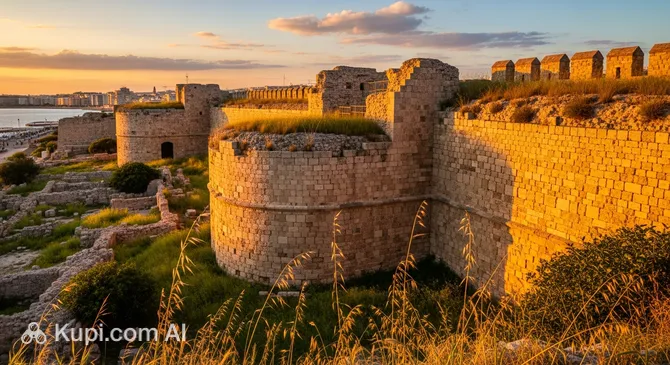
When traveling through the southern regions that were once part of the legendary Magna Graecia, it is impossible to miss the city of Taranto. Here lies the unique Archaeological Park of Ancient Greek Walls—a place where the pages of ancient history come to life. This is not just an open-air museum, but a monumental testament to the former power of the ancient polis.
Ancient Greek Walls Archaeological Park. Illustration.
Source: Kupi.com AI
Traveler photos:
The park's foundation consists of majestic fragments of defensive structures built by Greek colonists in the 4th century BC. These walls served as a reliable shield for the thriving city, protecting it from raids and sieges. Today, Italy carefully preserves this site as one of the most significant monuments of Greek fortification architecture in Puglia.
Walking through the park on Via Venezia, visitors can see the scale of ancient military engineering for themselves. This place is perfect for those who want to feel the atmosphere of antiquity away from busy tourist routes and touch the stones that witnessed the flourishing of a great civilization.
Contacts
To plan your visit to the ancient fortifications, it is useful to have current contact details on hand. Although the site is outdoors, you can check details regarding special events or tours through the city's municipal services.
The main activity in the park is a thoughtful exploration of the remains of ancient fortifications. Walking along the archaeological excavations, you can examine in detail the massive blocks that once made the city virtually impregnable. This is a rare opportunity to see the structural features of Greek ramparts, preserved in their original form after millennia.
Photography enthusiasts will enjoy the play of light on the ancient stone in the rays of the southern sun. The park's grounds allow for impressive shots where ancient ruins sit alongside the modern cityscape. For those interested in history, the information stands will help reconstruct the appearance of the Greek polis in your imagination and understand the strategic significance of the fortifications.
The park's peaceful atmosphere also invites leisurely strolls. Here you can simply relax from the city bustle, enjoying the silence and reflecting on the passage of time, while observing how the ancient heritage is seamlessly integrated into the modern life of the Italian south.
Getting There
The site is located at Via Venezia, 74121 Taranto. Thanks to its central location, the Archaeological Park of Greek Walls can be easily reached on foot from many parts of the city or by using local public transport. Buses running along the waterfront will take you almost to the entrance of the historic zone.
If you prefer comfort, you can use taxi services from the city center—the ride will only take a few minutes. For those traveling by rental car, it is recommended to use the GPS coordinates 17.2750099, 40.4619192 for an accurate navigation route. Finding a parking space in the surrounding blocks is usually not very difficult.
Nearest city: Taranto
History & Facts
The history of this place is inextricably linked to the founding of the polis by Spartans in 706 BC. As the only Spartan colony, the city quickly grew into a powerful economic and cultural center of the region. The construction of massive walls in the 4th century BC was a response to the need to protect the wealth of Magna Graecia from the encroachments of neighboring tribes and rival states.
Notably, these fortifications repeatedly proved their effectiveness in historical battles. One of the striking historical episodes is the siege of the city of Manduria in 338 BC, when the Tarantines, together with their Spartan allies, successfully resisted external threats. The strategic importance of the walls was so great that their condition determined the fate of the entire region for centuries.
Today, the surviving fragments allow scientists to study the methods of ancient engineers. The ashlar masonry made of local limestone, executed without the use of mortar, demonstrates the highest level of craftsmanship. These stones are silent witnesses to an era when the city was one of the brightest pearls of the Mediterranean.
Time Needed
Typically, travelers need about 1 to 2 hours to explore the main archaeological zones of the park. This is quite enough time to leisurely walk around the area, examine the masonry, and read the explanatory plaques.
If you are a passionate fan of antiquity and want to study every fragment of the defensive structures in detail, it is worth allowing a bit more time. In any case, a visit to the park is easily combined with visiting other iconic sites in the central part of the city.
Working Hours
One of the pleasant features of this archaeological site is its accessibility. According to available data, the park is open for visiting 24 hours a day, seven days a week. This allows you to see the ancient walls both in bright daylight and in a more mysterious setting under the night sky.
Nevertheless, before your visit, we recommend checking the official website of the city of Taranto. Access hours to certain sections or scheduled restoration work may temporarily limit entry, so a preliminary check of the information will help avoid inconvenience.
Open 24 hours
Nearby
Exploring the surroundings of the Archaeological Park significantly enriches your trip, as Taranto is literally steeped in the history of different eras. A walk from the ancient ruins to medieval castles and palaces will help you form a complete picture of the development of this unique port city.
Many interesting locations are within walking distance or a short ride away: