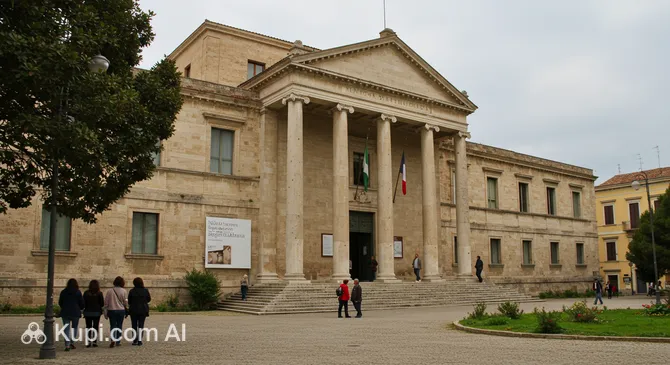
The National Archaeological Museum of Reggio Calabria is rightly considered one of the most significant and prestigious cultural sites that Italy takes pride in. It is not just a repository of artifacts, but a true portal to the era of Magna Graecia, located in the heart of Reggio Calabria. The museum occupies the majestic Palazzo Piacentini, whose austere facade harmoniously blends into the historical look of the square.
National Archaeological Museum of Reggio Calabria. Illustration.
Source: Kupi.com AI
Traveller photos:
The museum's main treasure is the world-famous Riace Bronzes — magnificent ancient statues of warriors discovered on the seabed. These sculptures are considered a benchmark of Greek craftsmanship and attract researchers and art lovers from all over the globe. Beyond them, the rich exposition spans a vast period of time: from prehistoric finds to monuments of the Roman and Byzantine periods.
A visit to the museum offers a unique opportunity to see rare household items, exquisite jewelry, and coins that tell the story of the flourishing of ancient civilizations on the shores of Calabria. The National Archaeological Museum of Reggio Calabria is a place where history comes alive in every detail, making it a must-visit during a trip to the south of the country.
Contacts
To plan your visit to the National Archaeological Museum of Reggio Calabria, it is useful to have contact information at hand. The museum is conveniently located in the city and is open for communication with tourists.
The first thing to do when visiting the National Archaeological Museum of Reggio Calabria is to head to the specially equipped hall housing the famous Riace Bronzes. These athletic warrior figures, striking in their realism and preservation, are the "stars" of the collection. You can take a close look at the finest work of ancient sculptors, from the details of the musculature to the smallest curls of the beard.
As you continue your tour, be sure to dedicate time to the halls with ancient ceramics and jewelry. Here, items once used by the inhabitants of Magna Graecia in everyday life and sacred rituals are displayed. For those interested in the economy of antiquity, the museum offers an extensive collection of rare coins minted in various cities of the region. Interactive panels and multimedia guides will help you better understand the context of each find and learn fascinating facts about archaeological excavations.
In addition to permanent exhibitions, the museum frequently hosts temporary thematic exhibitions and scientific lectures. It is a vibrant cultural space where modern technology meets ancient heritage, making a walk through its halls interesting even for young travelers and families with children.
Getting There
Finding the National Archaeological Museum of Reggio Calabria is quite simple, as it occupies a central position on Piazza Giuseppe De Nava. For those staying in hotels in the central part of the city, a walk to the museum will be a pleasant addition to their sightseeing route.
Travelers arriving by train will find it convenient to walk to the museum from the main railway station — the journey will take no more than 10–15 minutes. There are also public transport stops near the site, served by the city's main bus routes. If you prefer a taxi, the ride from any point in the city center will take only a few minutes.
For tourists traveling by private car, parking areas are provided in the vicinity of the square; however, it's worth noting that during peak hours, the number of free spaces may be limited. Its proximity to the waterfront makes it easy to combine a visit to the exhibition with a stroll along the shore.
Nearest city: Reggio Calabria
History & Facts
The history of this institution began in 1882 with the founding of the Civic Museum, which initially housed numismatic and ethnographic collections. However, the period following the devastating 1908 Messina earthquake was a turning point for the museum. The famous archaeologist Paolo Orsi initiated the creation of a major national center capable of consolidating all the valuable finds discovered during excavations in the Calabria region.
The museum's current building, known as Palazzo Piacentini, was designed by architect Marcello Piacentini in 1932. Construction lasted several years, and the building became one of the few in Italy originally conceived exclusively as a modern museum space. The official opening in its current form took place in 1959.
Over the years, the museum has become more than just a storehouse of antiquities, but a leading scientific center for the study of Magna Graecia. Today, the National Archaeological Museum of Reggio Calabria is recognized worldwide as one of the most important places for understanding the history of the ancient Mediterranean.
Time Needed
To fully enjoy all the collections that the National Archaeological Museum of Reggio Calabria offers, visitors usually need 2 to 3 hours. This is enough time to carefully examine the key exhibits on each floor and soak in the atmosphere of antiquity.
For true archaeology enthusiasts who wish to study the history of Magna Graecia in detail and pay special attention to temporary exhibitions, about half a day may be required. Given the richness of the exposition, it is recommended not to rush so as not to miss unique small details of ancient artifacts.
Working Hours
When planning your visit, keep in mind that the National Archaeological Museum of Reggio Calabria operates on a fixed schedule with one day off per week. Monday is a day off when the halls are closed to the public.
From Tuesday to Sunday, the museum's doors are open to guests from 9:00 AM to 8:00 PM. This wide time range allows you to comfortably fit a visit into any travel plan, whether in the early morning or evening hours before dinner.
Day
Opening hours
Monday
Closed
Tuesday
9:00 – 20:00
Wednesday
9:00 – 20:00
Thursday
9:00 – 20:00
Friday
9:00 – 20:00
Saturday
9:00 – 20:00
Sunday
9:00 – 20:00
Nearby
The museum's excellent location allows tourists to continue their acquaintance with the city's culture and architecture immediately after viewing the exhibits. Exploring the surroundings of Piazza De Nava will enrich your experience and allow you to deeper feel the atmosphere of southern Italy.
Within walking distance of the museum are both historical palazzos and picturesque squares, ideal for relaxation. Below is a list of interesting sites located nearby: