Support

Castello Aragonese

About

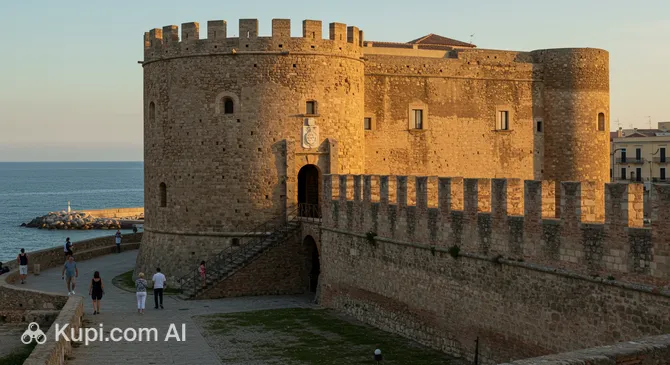
Rising above the historic center of Reggio Calabria, the majestic Aragonese Castle (Castello Aragonese) serves as a living reminder of the region's centuries-old history. This austere yet elegant fortress, located in Italy, is recognized as one of the city's main architectural symbols, embodying features of Byzantine, Norman, and, of course, Spanish defensive architecture.
\n\n
Aragonese Castle
Aragonese Castle. Иллюстрация. Источник: Kupi.com AI
\n\n

Today, the castle is not only a historical monument but also an active cultural space. Its massive cylindrical towers, preserved from the 15th-century reconstruction, stand alongside modern exhibition halls where art openings and historical displays are regularly held. The castle is considered a must-see on any tourist itinerary, along with the legendary Riace Bronzes.

\n\n

The citadel's strategic position on a hill allowed it to control the approaches to the city since ancient times. Although devastating earthquakes and urban reforms have altered the fortress's original appearance, its imposing presence and mighty walls still inspire awe in visitors. It is an ideal spot for those who want to feel the spirit of old Calabria and enjoy views of the sea.

Contacts

For more information about events or to book a group tour, you can use the official contact details. We recommend checking the opening hours before your visit to ensure your trip to the Aragonese Castle is as comfortable as possible.

Below are the main contact methods and the attraction's exact address:

\n\n
How to contactContact
AddressP.za Castello, 89100 Reggio Calabria RC, Italy
Phone+39 0965 362 2514
Websiteturismo.reggiocal.it

What to Do

A visit to the Aragonese Castle is, first and foremost, a chance to touch the military history of the Mediterranean. Visitors can explore the surviving round towers with their characteristic battlements and the deep moat that once protected the city from Saracen raids and Turkish attacks. Exploring the masonry details and massive machicolations (openings used to attack enemies at the base of the walls) will be a true delight for fans of fortification architecture.

\n\n

One of the main highlights of the visit is the panoramic views. Having ascended to the elevation where the castle is located, you will be able to see not only the rooftops of the old city but also the azure of the Strait of Messina, which separates Calabria from Sicily. It is an excellent spot for panoramic photography, especially during the pre-sunset hours when the light falls softly on the ancient stones.

\n\n

Inside the fortress, temporary art exhibitions, photography displays, and cultural events are held regularly. You can peek into the restored halls where contemporary art meets the rugged aesthetic of medieval interiors. Thanks to its proximity to the city's main pedestrian street, a visit to the castle easily becomes a pleasant part of a cultural promenade filled with history and art.

Getting There

Located in the heart of the city, the Aragonese Castle sits on Piazza Castello. Thanks to its central location, it is easy to reach: the fortress is just a couple of blocks from the city's main pedestrian artery, Corso Garibaldi. If you are in the center, a pleasant walk from the cathedral or the waterfront will take no more than 10–15 minutes.

\n\n

For those arriving in the city by train, Reggio Calabria Centrale station is the most convenient point. From there, you can walk to the castle in about 10 minutes, though keep in mind that the path leads slightly uphill. Local buses also run regularly to Piazza Castello or the nearby Piazza Duomo, which is convenient if you want to save your energy for exploring the towers.

\n\n

If your journey begins at the Reggio Calabria airport, a taxi ride will take about 10–15 minutes and cost around 15–20€. For drivers, there are paid parking zones marked with blue lines around the castle and on adjacent streets. Remember that in the summer months, the walk up to the fortress can be tiring due to the heat, so be sure to bring water with you.

Ближайший город: Reggio Calabria

History & Facts

The history of this imposing structure dates back to ancient times. It is believed that the first fortifications on this hill appeared as early as the 6th century AD to protect the city from enemy raids. During the Byzantine era, when the city became an important administrative center, a full kastron was established here—a fortified core that formed the foundation for the future fortress.

\n\n

With the arrival of the Normans in the 11th century under the leadership of Robert Guiscard, the fortress was expanded, and a powerful keep (donjon) was added. Later, during the Swabian period, the castle took on a strict square shape measuring 60 by 60 meters with four corner towers. Every new era and every ruling dynasty—from the Angevins to Queen Joan I—made their own changes to the citadel's appearance, strengthening its walls after endless wars.

\n\n

The castle received its current name in the 15th century when, after conquering the city, Ferdinand of Aragon initiated a large-scale reconstruction. For 15 years, architects built two massive cylindrical towers, dug a deep moat, and constructed an eastern ravelin for protection against artillery. It was during this period that the castle was transformed into an impregnable symbol of the Aragonese Crown's military power.

\n\n

Despite the devastating earthquake of 1908, which caused colossal damage to the city, the castle stood firm. Although part of its structures were demolished in the early 20th century for urban redevelopment, the surviving towers today serve as a reminder of its former grandeur. In 1874, the fortress was purchased by the municipality, which saved it from total oblivion and allowed it to be turned into a key cultural site for the region.

Time Needed

Exploring the main grounds of the Aragonese Castle usually takes about 1–2 hours. This is enough time to stroll leisurely along the preserved walls, study the architecture of the two massive towers, and take excellent panoramic photos of the city.

\n\n

If you plan to visit the temporary art exhibitions or displays often held in the interior rooms, you should allow a bit more time—around 2.5 hours. This will allow you to explore the cultural program without rushing and enjoy the views of the Strait of Messina in the sunlight.

\n\n

In this case, many tourists prefer to combine a visit to the fortress with a walk through the central part of the city. For this, it is best to set aside an entire morning or afternoon for a route that includes the castle, the cathedral, and the waterfront.

Working Hours

The Aragonese Castle is open to visitors throughout the week; however, the schedule has its own specifics, including the typical southern Italian midday break. To avoid arriving when the doors are closed, plan your visit in advance.

\n\n

Current fortress opening hours:

\n
    \n
  • Monday — Friday: from 08:30 to 12:30 and from 14:30 to 18:30
  • \n
  • Saturday: from 14:30 to 18:30
  • \n
  • Sunday: from 09:00 to 12:30
  • \n
DayWorking hours
Понедельник8:30 – 12:30, 2:30 – 18:30
Вторник8:30 – 12:30, 2:30 – 18:30
Среда8:30 – 12:30, 2:30 – 18:30
Четверг8:30 – 12:30, 2:30 – 18:30
Пятница8:30 – 12:30, 2:30 – 18:30
Суббота2:30 – 18:30
Воскресенье9:00 – 12:30

Nearby

A walk to the castle is just one part of discovering the city's rich heritage. Exploring the surrounding streets will allow you to dive deeper into the atmosphere of southern Italy, discovering both ancient ruins and magnificent Art Nouveau palaces.

\n\n

Just a few steps from the fortress walls, you will find the main squares and architectural monuments that form the unique character of the historic center. Below is a list of interesting places within walking distance of the castle:

\n\n
NameDistance
Piazza Duomo0.2 km
Cathedral Basilica of Maria Santissima Assunta in Heaven (Reggio Calabria Cathedral)0.2 km
Piazza Italia0.3 km
Officina del Gusto0.3 km
National Bergamot Museum0.3 km
Palace of Culture0.5 km
Falcomatà Promenade0.5 km

Reached the end of the page?

That means the route is fully explored