Support

Monastero dei Benedettini di San Nicolò l'Arena

About

Benedictine Monastery of San Nicolò l
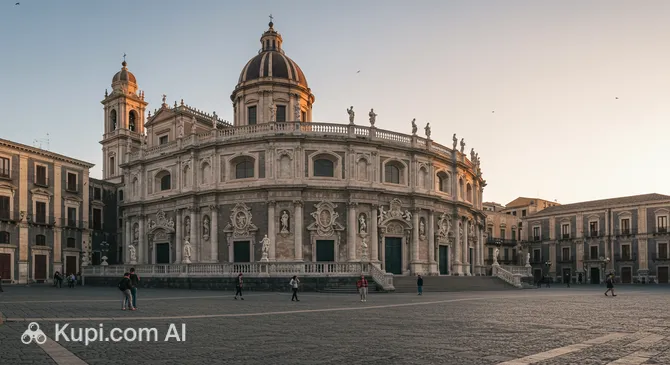
Benedictine Monastery of San Nicolò l'Arena. Иллюстрация. Источник: Kupi.com AI

The Benedictine Monastery of San Nicolò l’Arena is a magnificent architectural ensemble, rightfully considered one of the largest monastic complexes in Europe. Located in the historic center of Catania, this site is a prime example of Sicilian Baroque and is included in the UNESCO World Heritage List. For Italy, this location holds immense significance, blending spiritual history with modern academia.

The complex is striking in its scale: it occupies a vast territory with two symmetrical internal courtyards adorned with marble colonnades and elegant fountains. Walking through its endless corridors, one can feel the atmosphere of the former greatness of the monastic order that once dictated the rules of life throughout the region.

Today, the monastery building serves not only as a museum but also as home to the Department of Humanities of the University of Catania. This proximity of ancient cells and lecture halls creates a unique intellectual atmosphere, turning the historic monument into a vibrant and dynamic space where the past meets the future.

Contacts

To clarify visit details or book tours, you can use the official contact information of the monastic complex.

How to contactContact
AddressPiazza Dante Alighieri, 32, 95124 Catania CT, Italy
Phone+39 095 710 2767
Websitewww.monasterodeibenedettini.it

What to Do

A visit to the monastery offers guests many fascinating locations. First, it is worth exploring the Baroque interiors of the main church, whose facade remains unfinished, giving the building a unique charm. Inside, you will discover a unique 40-meter-long meridian and a magnificent 18th-century organ, which is still considered a masterpiece of engineering for its time.

Be sure to walk through the monastery courtyards, where white Carrara marble contrasts with dark volcanic stone. Don't miss the grand staircase designed by Girolamo Palazzotto—its exquisite stucco work and neoclassical forms deserve special attention. In the corridors of the complex, you can see how ancient cells have been transformed into modern offices, and students preparing for lectures amidst ancient artifacts.

For those who want to peek into the most hidden corners, thematic tours are available in several languages. As part of a tour, you can visit the monastery library, which houses rare manuscripts, and descend to the underground levels to see layers of solidified lava and the remains of Roman buildings upon which the complex was built. Thanks to the active life of the university, open lectures, exhibitions, and classical music concerts are often held here.

Getting There

The Benedictine Monastery is located in the historic center of the city at Piazza Dante Alighieri, 32. Thanks to its central location, it is easily accessible on foot from major tourist landmarks: the walk from Cathedral Square (Piazza del Duomo) takes no more than 10 minutes, and a stroll from the famous Via Etnea takes about 15 minutes.

If you prefer public transport, use AMT bus lines 1-4 or D to the Piazza Dante or San Nullo stops. For those arriving from Fontanarossa Airport, it is most convenient to take the ALIBUS shuttle to the city center and then walk a short distance. If you are coming from the Catania Centrale railway station, a walk through the city's picturesque streets will take approximately 20–25 minutes.

When using a private car, please note that parking spaces in Piazza Dante are limited and often occupied by students and university staff. It is recommended to leave your car in one of the paid parking lots on the edge of the historic center and enjoy a leisurely walk through the ancient quarters.

Ближайший город: Catania

History & Facts

The history of this majestic abbey began in the second half of the 12th century when the Benedictines founded a retreat at the foot of Mount Etna. The name of the monastery — San Nicolò l’Arena — refers to the word rena (sand), a reminder of the characteristic red volcanic sands of the area. Due to constant threats from bandits and destructive earthquakes, the monks were forced to move under the protection of the city walls in 1558.

The fate of the complex was full of trials. The massive eruption of Etna in 1669 and the catastrophic earthquake of 1693 practically wiped the buildings off the face of the earth. However, the Benedictines did not give up: reconstruction began as early as 1702. Over time, the greatest architects of Sicily worked on the project, including Giovanni Battista Vaccarini and Stefano Ittar, who transformed the monastery into a masterpiece of Sicilian Baroque.

In the 19th century, following the unification of Italy and the passage of laws suppressing religious orders, the monks were forced to leave the building. The last abbot, Giuseppe Benedetto Dusmet, made immense efforts to preserve the integrity of the complex. Ultimately, this allowed the monastery to become home to the University of Catania, breathing new life into the ancient walls and ensuring their preservation for future generations.

Time Needed

To leisurely explore the main architectural ensembles, including the courtyards and the church, you will typically need about 1.5–2 hours. This is enough time for a self-guided walk to see the complex's main highlights.

If you plan to join an organized guided tour, which includes a visit to the library with its ancient manuscripts and a descent to the underground levels where ancient Roman foundations are preserved, you should allow at least 3–3.5 hours for your visit. Given the scale of the site and its current role as a university hub, there is always something to see in greater detail.

Working Hours

The monastic complex is open to visitors daily. Standard opening hours are from 9:30 AM to 5:00 PM (Monday to Sunday). This allows tourists to conveniently plan their visit for either the morning or the afternoon.

Please note that since the monastery is an active university building, access to certain halls may be limited on holidays or during important academic events. It is recommended to check the official website in advance to confirm the current tour schedule.

9:30 – 17:00

Nearby

The Monastery of San Nicolò l’Arena is located in the heart of a historic district where every alleyway is steeped in history. A walk around the neighborhood will allow you to see Catania in all its diversity: from ancient ruins to Baroque palazzos and modern entertainment centers.

NameDistance
Roman Theatre of Catania0.4 km
Museum of Contemporary Art of Sicily0.4 km
Ursino Castle0.6 km
Roman Amphitheatre of Catania0.6 km
Elephant Fountain0.6 km
Piazza Università0.6 km
Mad in Italy0.6 km

Reached the end of the page?

That means the route is fully explored