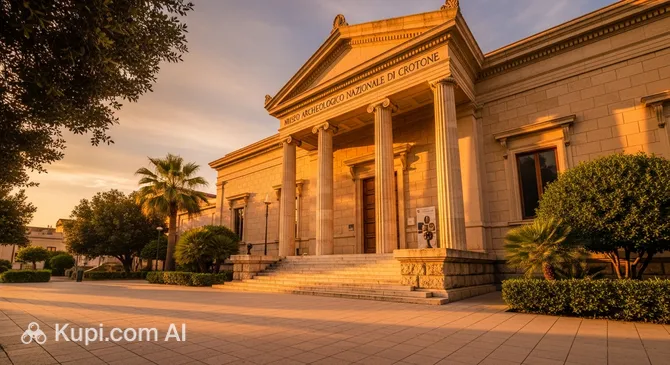
Imagine a place where the legends of Magna Graecia come to life. The National Archaeological Museum of Crotone is one of the most significant cultural treasures of Southern Italy. Located in the historic center of Crotone, it invites travelers on a fascinating journey through the centuries, revealing the glorious past of the Calabria region.
National Archaeological Museum of Crotone. Illustration.
Source: Kupi.com AI
Traveler photos:
This museum is not just a collection of antiquities, but a real bridge to an era when Italy was home to the greatest philosophers and athletes. The exhibition covers a vast period of the region's development, starting from the 8th century BC and ending with the Byzantine period. It houses unique artifacts found during excavations of the ancient polis of Croton, which in ancient times was considered one of the most powerful and prosperous cities in the Mediterranean.
Visitors can expect rare finds that illustrate not only daily life and art but also the religious beliefs of the ancient Greeks. The significance of the collection is highlighted by the fact that it is here that one can feel the spirit of the time when Crotone was the intellectual center of the ancient world.
Contacts
To plan your visit, it is a good idea to save the museum's contact details in advance. The museum is conveniently located and easy to find by following the historical signs in the city center.
In the museum's halls, you can touch history through amazing archaeological collections. Particular attention should be paid to artifacts associated with great names of the past: the shadows of the philosopher Pythagoras, the famous physician Alcmaeon, and the legendary athlete Milo literally come to life here. Studying the objects of their daily lives and achievements allows for a fresh look at humanity's intellectual heritage.
The exhibition is conveniently divided into several thematic sections, each deserving of individual attention. You will see a numismatic collection with rare coins, an art gallery, and a unique underwater archaeology department displaying finds recovered from the seabed. These items tell stories of trade routes and shipwrecks that the waters of the Ionian Sea hid for centuries.
Of particular interest are the sections dedicated to the prehistoric and protohistoric periods. Carefully designed displays with excavation materials not only from Calabria but also from Basilicata and Sicily provide a complete picture of how civilization developed in these lands up until the Byzantine era.
Getting There
The museum is located in the heart of the historic center at Via Risorgimento, 14. This location is extremely convenient for tourists, as the building is situated in close proximity to another iconic landmark — the majestic Castle of Charles V.
You can reach the city by train or long-distance bus, which connect the region with major hubs in the south of the country. If you are already in the city, the best way to reach the museum is on foot, enjoying the atmosphere of the ancient streets. For those who prefer comfort, you can take a taxi from the railway station or remote areas of the city in just a few minutes.
Nearest city: Crotone
History & Facts
The history of this collection began back in 1882, when it existed as a municipal museum. The initial fund was formed from finds transferred from the Museo Civico, reflecting the local interest in the region's rich ancient past.
A new stage of development followed the tragic 1908 Messina earthquake. The scale of destruction in neighboring cities prompted authorities to create a large national museum that could guarantee the preservation of state archaeological finds. The design of the modern building was entrusted to the famous architect Marcello Piacentini in 1932.
Construction lasted almost a decade, until 1941, but the museum only opened its doors to the general public in 1968. Since then, the collection has been constantly enriched thanks to active excavations in Calabria. A major milestone was the 1980s, when scientific discoveries and underwater expeditions brought the museum international fame, significantly expanding its exhibition with unique artifacts from the Ancient Greek era.
Time Needed
To leisurely explore all the halls and delve into the details of the presented exhibits, the average visitor is recommended to set aside 2 to 3 hours. This is enough time to walk through all the thematic departments and pay attention to the most valuable items.
If you are passionate about the history of Magna Graecia or numismatics, your visit might last longer, as the detail in some collections is truly imaginative. In any case, this place is not for rushing — the atmosphere of antiquity invites thoughtful contemplation.
Working Hours
Currently, the exact opening hours of the museum for the current season are not provided in open sources. To ensure your visit goes smoothly and the museum doors are open, we strongly recommend checking the current schedule on the official website or confirming the information by phone before your trip.
Typically, national museums in Italy of this kind follow a standard schedule with Mondays as a closing day; however, opening hours may change during public holidays.
Nearby
Exploring the museum's surroundings will allow you to dive deeper into the atmosphere of the old city and see how different eras succeeded one another on this land. Nearby are aristocratic palaces and military fortifications that create a unique architectural ensemble.