Support

Yoshinogari Historical Park

About

Yoshinogari Historical Park is not just a landmark, but a true journey back in time, located near the city of Fukuoka in Japan. This massive archaeological complex is a meticulously reconstructed ancient settlement from the Yayoi period, which spans approximately from 300 BC to 300 AD. A visit to the park offers a unique opportunity to see how people lived on the Japanese islands over two millennia ago.
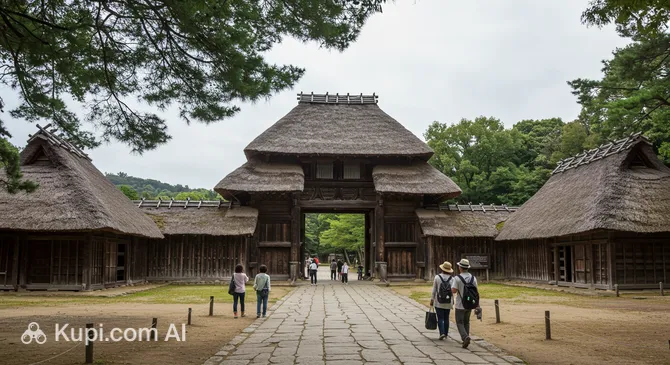
Yoshinogari Historical Park. Illustration.
Source: Kupi.com AI

Traveler photos:

Across the vast territory of the park, which opened in 2001, you will find reconstructed buildings characteristic of the Yayoi period: from imposing watchtowers and authentic pit dwellings to raised-floor storehouses. It is important to note that all buildings, defensive moats, and other elements were recreated based on actual archaeological excavations conducted on this site. This makes Yoshinogari the largest known moated settlement of that period in Japan, allowing visitors to fully immerse themselves in the atmosphere of antiquity.

The significance of Yoshinogari Historical Park is confirmed by its status as a Special National Historic Site. Many artifacts discovered here during excavations—including an ancient bronze sword with an elaborately crafted hilt and a rare glass bead—are recognized as important National Cultural Properties of Japan. For tourists, this is not just a walk through a historical site, but a deep immersion into the culture and daily life of the ancient Japanese, providing a better understanding of the origins of modern Japanese civilization.

Contacts

Since Yoshinogari Historical Park is a major tourist attraction, we recommend visiting the official website for the most up-to-date information on opening hours, ticket prices, available tours, and contact details. Detailed information on how to reach the park from Fukuoka or other cities can also often be found on Japan travel portals or directly on the park's website.

How to contactContact
Address1843 Tade, Yoshinogari, Kanzaki District, Saga 842-0035, Japan
Phone number+81 952-55-9333
Websitewww.yoshinogari.jp

What to Do

A visit to Yoshinogari Historical Park offers a complete immersion into the Yayoi era. Guests can explore carefully reconstructed structures such as watchtowers, pit dwellings, and raised-floor storehouses, which provide a vivid picture of the daily life of ancient Japanese people. A special exhibition building displays authentic archaeological artifacts found on the park's grounds, accompanied by information boards, some of which are available in English. This allows for a deeper understanding of the historical context and significance of this unique place.

Of particular interest to visitors are the demonstrations of historical crafts regularly held by park staff. You can observe the art of weaving or wood carving, recreating ancient techniques. Furthermore, the craft center offers the opportunity to participate in engaging workshops. Here, anyone can try their hand at creating something, such as carving a traditional ocarina musical instrument or making a metal casting. Even if you do not speak Japanese, the staff uses visual aids and instructions, making the process accessible and interesting for everyone.

In addition to viewing historical reconstructions and participating in workshops, you can have a bite to eat on the park grounds. There is a restaurant here serving local cuisine. While prices may seem slightly above average, the portions are generally quite large. It is important to note that the park is well-equipped for visitors with physical disabilities: most of the reconstructed buildings are wheelchair-accessible, and the paths are wide enough for comfortable movement. However, please note that access to the tops of the watchtowers is not provided for wheelchair users.

Getting There

There are several ways to reach Yoshinogari Historical Park from Fukuoka, making it accessible for most travelers. One popular option is taking the "Midori" bus, which departs from Hakata Station in Fukuoka. If you prefer traveling by train, the nearest railway station to the park is Yoshinogari. From the station to the park itself, it is about a 750-meter walk. The route is well-marked with signs, which significantly eases navigation.

For those who prefer a more comfortable way to travel or do not wish to walk from the station, there is a taxi stand at Yoshinogari Station. By taking a taxi, you can quickly and conveniently reach the entrance of Yoshinogari Historical Park. This is especially convenient if you are traveling with children or have bulky luggage.

If you plan to visit by private car, there is dedicated parking for visitors on the park grounds. This allows you to visit without worrying about finding a parking spot, making your trip even more convenient. For navigation systems, you can use the following address: 1843 Tade, Yoshinogari-cho, Kanzaki-gun, Saga-ken.

Nearest city: Fukuoka

History & Facts

The history of the Yoshinogari settlement dates back to ancient times, beginning in the 5th–2nd centuries BC when the first village emerged on this site. However, its true peak occurred in the 1st–2nd centuries AD, during the latter half of the famous Yayoi period. This is when the settlement transformed, acquiring an impressive circular moat. Protected by not only the moat but also earthen embankments and fences, this large village is today considered one of the prototypes for Japanese castles of later eras, showcasing early forms of defensive architecture and engineering.

The internal organization of ancient Yoshinogari testifies to its significance and complex structure. In its northern part, key buildings were likely located, such as a watchtower and the chieftain's residence with a large ceremonial hall that may have served as a center for important decision-making. The southern part of the settlement was reserved for a religious and political center and a bustling market, indicating a developed social, economic, and spiritual life. Researchers suggest that Yoshinogari functioned as a kind of "city of the Yayoi period," serving as the administrative center for a vast surrounding territory.

Many centuries later, thanks to large-scale archaeological excavations, the unique heritage of Yoshinogari was rediscovered by the world. The culmination of these years of research was the grand opening of Yoshinogari Historical Park in 2001. On the site of the ancient settlement, the main elements of a Yayoi period village were meticulously recreated, including houses, storehouses, and defensive structures. This has turned the site into an important cultural and educational center where modern visitors can not only see reconstructions but also gain a deeper understanding of the daily life, beliefs, and social structure of the ancient Japanese, touching the very origins of Japanese civilization.

Time Needed

To fully explore Yoshinogari Historical Park and immerse yourself in the atmosphere of ancient Japan, you should set aside at least 2–3 hours. The park's territory is quite extensive and features many reconstructed Yayoi period buildings, including watchtowers, dwellings, and utility structures. Simply walking through the different zones of the park and viewing the main objects will take this much time, allowing you to get a general impression of the scale and layout of the ancient settlement.

If you plan a more in-depth introduction to Yoshinogari Historical Park—for example, visiting the exhibition hall with archaeological finds, carefully studying the information boards, watching demonstrations of ancient crafts, or even participating in one of the workshops—your visit could easily extend to half a day (about 4–5 hours). You should also factor in time for a possible lunch at the local restaurant or simply for a leisurely rest on the grounds of this unique complex to fully enjoy its atmosphere.

Working Hours

When planning your visit to Yoshinogari Historical Park, it is important to keep in mind that operating hours may vary depending on the season or day of the week. As precise information regarding the current schedule is not available to us, we strongly recommend checking the park's official website or contacting local tourist information centers in Fukuoka for the most up-to-date data. Generally, large historical complexes like Yoshinogari Historical Park are open to visitors year-round, though changes in the schedule due to holidays or special events are possible.

Regarding the need for ticket reservations: for individual visits to Yoshinogari Historical Park, advance purchase or booking is usually not required. However, if you plan to visit as part of a large group or are interested in participating in special programs or tours, it is best to confirm this information in advance on the park's official resource. This will help you plan your trip in the best possible way and avoid any potential inconvenience.

9:00 – 17:00

Nearby

A visit to Yoshinogari Historical Park will certainly be a highlight of your trip to Fukuoka. However, to make your journey even more fulfilling and complete, it is worth exploring other interesting sites located nearby. Studying the surroundings will allow you to dive deeper into the culture and atmosphere of the region, discovering new facets of Japan.

The Kyushu region, and specifically the area around Fukuoka, is rich in diverse attractions, ranging from natural beauty to modern cultural centers. Below is a list of some sites located within a reasonable distance of Yoshinogari Historical Park that could complement your itinerary.

NameDistance
Yoshinogari Historical Park0.4 km
Kurume City Art Museum13.2 km
Nakatomi Memorial Medicine Museum14 km
Daikozenji Temple15.3 km
Tachiarai Peace Memorial Museum23.5 km
Iwaya Castle Ruins25.5 km
Kyushu National Museum25.6 km

Have you reached the end of the page?

So the route has been studied inside and out