Support

Oita Airport

About the Airport

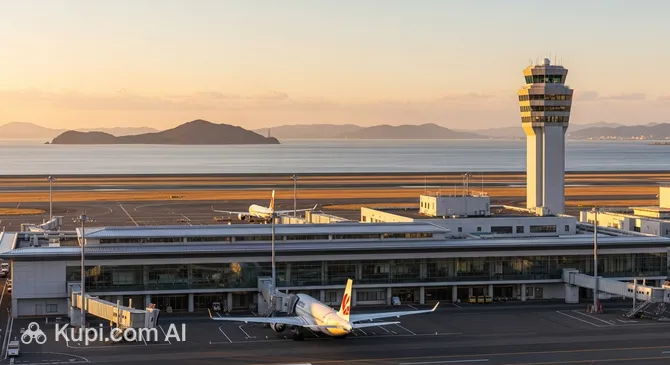
Oita Airport. Source: Kupi.com Binoculars

Oita Airport is not merely a transport hub, but a true "gateway" to Japan's famous "Hot Spring Prefecture". Located on a scenic artificial island off the coast of the Kunisaki Peninsula, it immerses travellers in an atmosphere of relaxation and Japanese hospitality from the very first minute. Here, the sea breeze mingles with the aromas of local cuisine, and unique services right inside the terminal suggest that your wellness journey has already begun. It is one of the few airports in the world where waiting for a flight can become a spa procedure.

IATA Code OIT
ICAO Code RJFO
City Oita (located in Kunisaki City)
Distance to Centre ~50 km (about 60 minutes by bus)
Status International / Domestic
Passengers per Year About 1.8 million (2023 data)
Schedule

Airport Features and Highlights:

Oita Airport is renowned for its creative approach to passenger comfort and unique features that are hard to find anywhere else:

  • Footbath Onsen (Ashiyu): The main highlight of the terminal is a free footbath filled with genuine thermal water from hot springs. Located on the first floor in the arrivals area, it allows you to relax immediately after your flight while enjoying the scent of the cypress wood used in the interior.
  • "Sushi Carousel" at Baggage Claim: The baggage claim area here has been transformed into a giant art object. Alongside suitcases, huge models of sushi with shrimp and sea urchins "float" along the belt, promoting the region's fresh seafood. This is one of the most photographed spots in the airport.
  • Unique Transport: The airport is known for having long been one of the few in Japan accessible by hovercraft. This mode of transport is considered a local attraction, significantly reducing travel time to Oita City across the bay.
  • Gastronomy: In the airport restaurants, you can taste the prefecture's main delicacies without going into the city. It is definitely worth ordering Toriten (Oita-style chicken tempura) or dishes made from the famous Bungo beef.

Contact Information

  • Official Website: www.oita-airport.jp — here you will find the current flight schedule, terminal maps, and other useful information for travellers.
  • Information Desk Phone: +81 978 67 1177. This is the main number for enquiries regarding airport operations.
  • Airport Address: 13 Aki, Kunisaki, Oita 873-0231, Japan. The airport is located in the city of Kunisaki and serves the entire prefecture of Oita.
  • Email: To contact airport representatives, it is recommended to use the contact form available on the official website, as a public email address is not provided.
  • Social Media: You can find out about news and special events on Oita Airport's official social media pages, including Facebook and Instagram.
  • Lost and Found Information: If you have left items in the terminal building, please contact the Lost & Found office at +81 978 67 3450. In case of lost luggage or items left on board the aircraft, you should contact your airline directly.
  • Passenger Support Contacts: For general questions requiring immediate attention, you can call the main airport information desk.

How to Get to the Airport

Oita Airport (OIT) is situated on a picturesque coast, approximately 30 kilometres northeast of the city centre. Despite some distance, the transport infrastructure is well-developed, offering travellers several convenient ways to get to the city or, conversely, to the airport.

Public Transport: Limousine Bus

The most popular and economical method is to use the comfortable Oita Kotsu express buses. Often referred to as "limousines", these are actually modern coaches with spacious luggage compartments. They operate on several routes, connecting the airport with the centre of Oita (including JR Oita Station) and the famous hot spring resort of Beppu.

  • Travel Time: About 60 minutes from Oita Station.
  • Cost: A one-way trip costs approximately 1,550 JPY. Tickets can be purchased at vending machines at bus stops or inside the airport terminal.
  • Features: The bus schedule is coordinated with flight arrivals and departures, making it a very convenient option. It is important to remember that there is no direct train or metro connection to Oita Airport.

Taxi and Transfer

For those who value comfort, travel with children, or have a large amount of luggage, a taxi ride will be the best choice. This is the most convenient but also the most expensive option.

  • Travel Time: Approximately 45-50 minutes, but this may vary depending on traffic.
  • Cost: A trip from the city centre to the airport can cost between 15,000 - 18,000 JPY. It is recommended to confirm the approximate price with the driver before starting the journey.
  • Recommendation: You might consider booking a fixed-price transfer (shared taxi or charter taxi), which sometimes works out slightly cheaper, especially if booked in advance online.

Car Rental and Parking

If you plan to explore Oita Prefecture and other parts of Kyushu Island, renting a car will provide you with maximum freedom of movement. Several major rental companies have counters at the airport. To rent a car, most international drivers will require an International Driving Permit (IDP). For those arriving at the airport in a private or rented car, convenient parking with short-term and long-term rates is provided.

Although Oita Airport is the primary gateway for visiting the city and its surroundings, depending on your itinerary across Japan, you might consider other regional airports. For example, travellers sometimes arrive at Kitakyushu Airport or Kumamoto Airport, however, for travel directly to Oita, the local airport offers the most direct and convenient connection.

Terminals and Map

Oita Airport (OIT) is distinguished by a simple and clear structure, making it very convenient for travellers. There is one passenger terminal operating here, which serves both domestic and international flights. Thanks to this, you won't have to worry about complicated transfers or searching for the right building — all procedures are concentrated in one facility.

The terminal layout is logical and intuitive. The First Floor is entirely dedicated to the arrivals area. Here you will find car rental counters, tourist information, and exits to bus stops and taxis. The Second Floor is the departure zone. Airline check-in counters, security checkpoints, and the main waiting lounge with boarding gates are located here. On the Third Floor, there is an observation deck offering views of the runway, as well as several restaurants.

One of the unique features of Oita Airport is the free ashiyu — a footbath with water from hot springs, located right inside the terminal building. This is a wonderful opportunity to relax before or after a flight and immediately immerse yourself in the atmosphere of a region famous for its onsens. There are also shops in the terminal selling local souvenirs and products, where you can buy famous shiitake mushrooms or kabosu citrus fruits.

Check-in and security procedures at Oita Airport usually proceed quite quickly due to its compact size. Nevertheless, it is recommended to arrive at the airport at least 1-1.5 hours before a domestic flight and 2-3 hours before an international one. This time will be sufficient to check in luggage without rushing, pass through security control, and rest a little in the departure zone.

To navigate the terminal, follow the clear signs, which are duplicated in English. Thanks to the thoughtful layout, getting lost here is practically impossible. All key zones — from check-in to boarding gates — are within walking distance of each other, making your stay at Oita Airport comfortable and stress-free.

Airport History

The history of Oita Airport (OIT) is a tale of bold engineering decisions and a constant striving towards the future. Although the original airport opened at a different location in 1957, the modern history of the air harbour began in October 1971. It was then that the new airport opened at its current site in Kunisaki City, on reclaimed land specifically created off the coast. Such an ambitious decision was made to accommodate larger jet aircraft and ensure the possibility for further expansion, which was impossible at the old site.

One of the most memorable and unique facts in the airport's history was the high-speed hovercraft line that connected it to Oita city centre. For many years, this was the fastest and most convenient way to reach the terminal, and the line itself became one of the busiest in the world for this type of transport. Although the hovercraft service was discontinued in 2009, it remains a vivid chapter in the transport history of Japan and a symbol of the region's innovative approach.

Since its opening, the airport has been modernized repeatedly. In the 1990s, the servicing of international flights began, which required the expansion of the terminal and relevant infrastructure. In subsequent decades, reconstructions were carried out aimed at improving passenger comfort and operational efficiency. For instance, waiting lounges were updated, the number of shops and restaurants increased, and modern technologies for check-in and screening were introduced.

The newest chapter in Oita Airport's history is linked to space. It has been selected as Asia's first horizontal spaceport for satellite launches. This achievement underscores its strategic importance and opens up entirely new perspectives, transforming it from a regional transport hub into a gateway not only to the world but also to near-Earth space.

Services and Amenities

Oita Airport (OIT) offers passengers everything necessary for a comfortable wait for their flight. Despite its relatively small size, the terminal is thought out to the smallest detail so that your journey begins and ends with pleasant impressions. Here you will find a wide range of services, from restaurants with local cuisine to comfortable rest areas.

Before departure, you can have a meal in one of the airport's restaurants or cafes. There are establishments serving both Japanese dishes and familiar Western snacks. If you want to explore the region's gastronomy, make sure to try the local delicacies. In the shops, you can purchase souvenirs unique to Oita Prefecture, as well as daily necessities. A duty-free shop is also available.

Free Wi-Fi is available to all passengers throughout the terminal, allowing you to stay connected or work while waiting for your plane. Numerous charging stations for electronic devices are also provided. For those who value enhanced comfort, the paid "Kunisaki" lounge is open, where you can relax in a quiet atmosphere, enjoy beverages, and have a snack.

Oita Airport has ATMs where you can withdraw cash from international payment cards. There is also a currency exchange counter, which is convenient for foreign tourists arriving in the region.

The airport takes care of passengers with children and people with reduced mobility. For families, there are special nursing rooms equipped with everything necessary for baby care. The terminal is fully accessible for passengers with limited mobility: there are ramps, elevators, and specially equipped restrooms. Staff are always ready to provide necessary assistance.

In case of feeling unwell, passengers can visit the medical station for first aid. Although there is no hotel within the airport building itself, there are many accommodation options in the immediate vicinity and in nearby cities such as Oita and Beppu. For business travellers, basic business services may be available, and the quiet atmosphere of the lounges is suitable for work.

Where to Eat

At Oita Airport, travellers will find several excellent options for a snack or a full lunch, most of which focus on introducing unique local cuisine. The majority of establishments are located on the third floor of the main terminal, in the public area before security control.

We highly recommend not missing the opportunity to try the gastronomic hits of Oita Prefecture. Many airport restaurants take pride in offering dishes such as Toriten (tender chicken tempura, often served with ponzu sauce) and Dangojiru (a hearty soup with noodle dumplings and vegetables). This is a wonderful way to experience the culinary traditions of Japan right before departure.

For a leisurely lunch with a panoramic view of the runway, the "Sky Line" restaurant is ideal. It presents a diverse menu including both Japanese and Western dishes. If you are looking for a more authentic experience, visit the "Nagomiya" restaurant, which specialises in traditional Japanese cuisine and local delicacies. Prices in the restaurants can be described as average for Japanese airports: the cost of a main dish ranges from 1,000 to 2,000 Yen.

If time is limited, coffee shops such as Tully's Coffee are suitable for a quick bite, where you can grab coffee, pastries, or a sandwich. After passing security control (in the "sterile" area), the choice of establishments is more modest and is usually limited to small kiosks offering drinks and snacks. Most establishments operate according to the flight schedule, opening in the morning and closing after the departure of the last plane.

Passengers with specific dietary preferences, such as vegetarians, should look for dishes with vegetables or tofu. However, given the specifics of Japanese cuisine, where fish stock is often used, it is recommended to clarify the ingredients with staff in advance. Specialised Halal or gluten-free menus are generally not available, so it is best to consult directly at the specific restaurant.

Travel Tips

To ensure your journey through Oita City Airport goes smoothly and without unnecessary stress, make use of our tips. This guide will help you navigate the airport and save time and nerves.

Arrival Time and Check-in. For domestic flights within Japan, it is recommended to arrive at the airport 1.5-2 hours before departure, and for international flights — at least 3 hours prior. This will give you enough time for check-in, baggage drop, and security screening. Many airlines offer online check-in, which can significantly speed up the process. Security checkpoints at Japanese airports work efficiently, but queues are possible during peak hours or the tourist season.

Hand Luggage and Seat Selection. Rules for carrying liquids in hand luggage are standard: all containers must be no more than 100 ml in volume and packed in a transparent bag. Sharp objects are, naturally, prohibited. When choosing a seat on the plane, consider that window seats offer beautiful views of the coast, while an aisle seat provides more freedom of movement during the flight.

Customs Control and Transfers. Upon entering the country, you will need to fill out a customs declaration. The process usually goes quickly and without problems if you do not have goods subject to declaration. If you have a connecting flight in Oita, verify with your airline in advance whether you need to collect and re-check your luggage. Leave sufficient time between flights to move calmly between terminals.

How to Save Money. It is better to plan your transfer from the airport to the city or resorts in advance. Shuttle buses are often the most cost-effective option. Prices for food and drinks inside the airport may be higher, but here, as in many airports in Japan, you can find shops like Lawson, which sell high-quality and affordable bento (ready-made meals) and snacks.

If the Flight is Delayed. In case of a flight delay, first contact your airline's counter for information about the new departure time and your rights to food or accommodation. Fortunately, Oita Airport offers a unique way to pass the time — there is a free footbath (ashiyu) with hot spring water, which will help you relax while waiting for your flight. There are also cafes, shops, and free Wi-Fi in the terminal.

Reached the end of the page?

That means the route is fully explored