Support

Fukuoka Airport

About the Airport

Fukuoka Airport (FUK) is not just an aerial gateway to the city of the same name and the entire island of Kyushu, but a unique example of how harmoniously a transport hub can be integrated into urban life. Located remarkably close to the centre, it allows travellers to reach key points of the city in a matter of minutes, eliminating the long and tiring journey after a flight. It is the fourth busiest airport in Japan, serving as the main hub for exploring the rich culture and picturesque nature of the country's southern region.
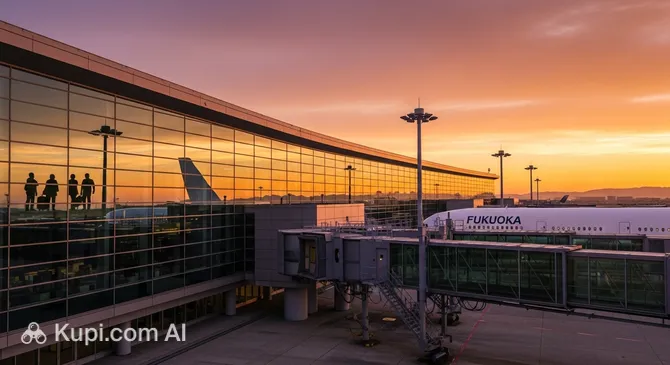
Fukuoka Airport. Source: Kupi.com Binoculars
IATA Code FUK
ICAO Code RJFF
City Fukuoka
Distance to Centre approx. 3-4 km
Status International
Annual Passengers over 14.8 million (2022)
Popular Airlines All Nippon Airways, Japan Airlines, Peach
Schedule Online Board "Fukuoka Airport"

The main feature of Fukuoka Airport is its incredible proximity to the city. The domestic terminal is directly connected by a subway line, making the trip to Hakata central railway station take only about 5 minutes, and to the Tenjin business district about 11 minutes. This makes it one of the most convenient airports in the world for tourists and business travellers.

The airport consists of two main terminals: Domestic and International, with a free shuttle bus running between them. It is worth noting that due to its location within the city limits, the airport operates with restrictions: flights are not conducted from 22:00 to 07:00. The airport's infrastructure is modern and offers passengers all necessary services, including shops, restaurants, and comfortable lounges, confirmed by its inclusion in the Skytrax list of the world's top 100 airports.

Contact Information

You can contact Fukuoka Airport representatives in several ways. Below you will find the main contact details for resolving various issues.

  • Official Airport Website: The most complete and up-to-date information can be found on the official website: www.fukuoka-airport.jp. The site is available in several languages, including English.
  • Information Service Phone: For general information, flight schedules, and other inquiries, you can call: +81-92-621-6059.
  • Airport Address: 778-1 Shimousui, Hakata-ku, Fukuoka, 812-0003, Japan.
  • Email: The airport does not provide a direct email address for general inquiries. It is recommended to use the contact form on the official website to send messages.
  • Social Media: Fukuoka Airport actively maintains pages on popular social networks. Links to official accounts can be found in the corresponding section on their website.
  • Lost and Found Information: If you have lost items within the terminal building, please contact the airport's lost and found centre. If luggage or personal items were lost on board the aircraft, you must contact your airline directly.
  • Passenger Support Contacts: For assistance directly at the airport, you can approach the information desks located in the terminals. Staff will help you orient yourself and answer your questions.

How to Get to the Airport

Getting to Fukuoka Airport (FUK) is one of the simplest tasks for a traveller in Japan, as it is rightfully considered one of the most conveniently located airports in the world. Thanks to its proximity to the city centre, you have several fast and accessible ways to reach the terminals.

Subway is the most popular and efficient option. The Kuko Line (Airport Line) directly connects the international and domestic terminals with key points in the city. A trip from the central station Hakata (the largest railway hub) will take only about 5 minutes (2 stops), and from the business and shopping district Tenjin — approximately 11 minutes. The ticket cost is around 260 yen. This is an ideal choice for those travelling light and valuing their time.

Buses are also a convenient mode of transport. Numerous city routes connect the airport with various districts of Fukuoka. Additionally, intercity buses depart from the airport, allowing you to reach other cities in the prefecture and Kyushu island. This is a good option if your location is far from subway stations. The cost of a city bus ride is comparable to the subway, while travel time depends on the route and traffic conditions.

Taxi and Transfers are the most comfortable, but also the most expensive method. A taxi ride from Hakata Station to the airport will take 10–15 minutes and cost approximately 1500–2000 yen, depending on traffic. This option is excellent for travellers with a lot of luggage, families with children, or those arriving late at night when public transport is no longer running. You can also book a private transfer in advance.

If you are travelling by rental car, the airport has numerous parking zones for both short-term and long-term parking. Road signs on the approach to the airport are very clear. Please note that parking fees apply and can be quite expensive for long-term stays.

For travellers planning routes throughout the Kyushu region, it is worth noting that there are other airports nearby. For example, Saga Airport is located 50 km away, and slightly further are Kitakyushu Airport and Nagasaki Airport, which may be convenient for flights to other parts of Japan.

Terminals and Map

Fukuoka Airport (FUK) consists of two main passenger terminals: the Domestic Terminal and the International Terminal. It is important to know that they are located on opposite sides of the runway and are not connected by a pedestrian walkway. A free shuttle bus runs between them, with the trip taking about 10–15 minutes. Be sure to account for this time when planning connections.

The Domestic Terminal handles flights within Japan. It is a modern, recently renovated building with direct access to the subway station (Kuko Line). Thanks to this, you can reach the centre of Fukuoka, specifically Hakata Station, in just 5 minutes. The first floor houses the arrival area and subway access; the second floor features the departure area with numerous check-in counters, shops, and a food court, including the famous "Ramen Runway"; and the third and fourth floors contain restaurants and an observation deck.

The International Terminal, as the name suggests, serves all flights outside the country. It does not have direct subway access — to get to the underground, you need to take the shuttle to the Domestic Terminal. Alternatively, direct buses to key city points are available. The terminal structure is simple: the first floor houses the arrival area, and the third floor features a spacious departure hall with check-in counters, security checkpoints, passport control, and Duty-Free shops.

Check-in and security procedures at Fukuoka Airport are organized very efficiently. For domestic flights, it is recommended to arrive 1–1.5 hours before departure. For international flights, it is better to allow more time — 2.5–3 hours, especially during peak seasons. This will allow you to complete all formalities, including passport control, without rushing.

Navigation in both terminals is intuitive thanks to clear signs in Japanese, English, Korean, and Chinese. The main advice is to check in advance which terminal your flight departs from. If you have a connection between a domestic and international flight, allow at least 30 minutes for the shuttle transfer, not counting the time for re-check-in and security screening.

History of the Airport

The history of Fukuoka Airport (FUK) dates back to the war years. It was founded in 1943 as an airbase for the Imperial Army of Japan under the name Mushiroda. After the end of World War II, in 1945, the airfield came under the control of American armed forces and received its modern name. It was during this period that its transformation into a civil transport hub began.

The first regular passenger flights were launched in 1951, and in 1972, the airport was fully returned to Japanese administration, marking a new stage in its development. Over the following decades, the infrastructure was constantly modernized. In 1969, the first terminal for domestic lines was built, and in 1999, a modern international terminal opened, significantly increasing passenger capacity.

One of the most significant events in the airport's history was the opening of a direct connection to the city subway system in 1993. This made Fukuoka Airport one of the most convenient and accessible in the world, as the trip to the central business district of Hakata takes only about 5 minutes.

Interesting fact: despite having only one runway, Fukuoka Airport has consistently ranked among the busiest airports in the country for many years. Its unique location practically in the city centre is both its main advantage for travellers and the reason for strict restrictions on night flights. Today, the airport continues to develop, implementing projects for further expansion and efficiency improvement to serve millions of passengers annually.

Services and Amenities

Fukuoka Airport (FUK) offers passengers modern and diverse services, making the wait for a flight as comfortable as possible. Here you will find everything you need, from places to rest and work to entertainment and shopping.

The terminals host numerous restaurants and cafes where you can try both traditional Japanese dishes and international cuisine. For shopping enthusiasts, there are duty-free shops, souvenir stalls offering unique regional goods, and boutiques of famous brands. If you need something for the road, you can always visit the convenience stores.

For a comfortable wait, you can use the services of premium lounges. Some belong to airlines and are available for business class passengers, while others are open to everyone for an additional fee. Lounges typically offer snacks, beverages, fresh newspapers, and a quiet atmosphere away from the bustle of the main hall.

Free Wi-Fi is available throughout the airport, and numerous power outlets and charging stations are provided for charging gadgets. For financial transactions, the terminals have bank branches, ATMs, and currency exchange points. In case of illness, you can seek qualified help at the medical centre.

The airport is well-equipped for passengers with special needs. For families with children, there are nursing rooms with changing tables and feeding areas, as well as small play zones. For passengers with reduced mobility, a barrier-free environment has been created: ramps, elevators, specially equipped restrooms, and an assistance service, which is recommended to be booked in advance through your airline.

Although there are no hotels directly inside the terminal buildings, many hotels to suit any taste and budget are located within walking distance or a few minutes' drive by shuttle or taxi. For business travellers, business centres and conference rooms are available where you can work or hold a meeting.

Dining

Fukuoka Airport (FUK) is a true paradise for gourmets, offering a wide selection of dishes, from quick snacks to full restaurant meals. Here you can discover the gastronomic traditions of Japan without leaving the terminal. Most establishments are concentrated in the landside area (before security control), so we recommend eating before checking in for your flight.

The Domestic Terminal is where the largest concentration of restaurants and cafes is found. Its gem is the famous "Ramen Runway" (Ramen Kassoro) on the 3rd floor. This is an entire food court with branches of nine popular ramen shops from across the country. Naturally, here you can try the local speciality — Hakata Ramen, a thick soup based on pork broth with thin noodles. It is an ideal place for a full and authentic lunch. (Please note that this traditional dish contains pork). Apart from ramen, on the 3rd and 4th floors (near the observation deck), you will find restaurants offering sushi, udon, and tempura. For a quick snack, numerous cafes and convenience stores (konbini) on the 1st and 2nd floors sell sandwiches, onigiri, and fresh pastries.

The International Terminal offers a more modest selection, but you certainly won't go hungry. The main establishments are located on the 3rd floor (departure area, landside). There is a food court with Japanese (udon, curry) and Asian cuisine corners, as well as separate cafes. After passing security control (in the airside area), the choice is limited to a few cafes where you can have coffee with a sandwich, and Duty-Free shops with snacks.

For passengers with specific dietary preferences, there are several options at the airport:

  • Vegetarians and Vegans should look for vegetable tempura dishes (checking the broth ingredients) or visit cafes for salads. In convenience stores, you can find onigiri with vegetable fillings, such as pickled plum (umeboshi).
  • Halal: The Sora Terrace restaurant in the International Terminal operates with a Halal certificate.
  • Gluten-free dishes: Finding certified gluten-free dishes is difficult due to the widespread use of soy sauce. The safest options would be sashimi or simple salads without dressing.

Prices at Fukuoka Airport can be considered moderate for Japan. A cup of coffee will cost approximately 500–700 yen, a quick snack up to 1000 yen, and a full lunch, such as a portion of ramen, will cost about 1200–1800 yen. Most establishments open early in the morning (around 7:00) and work until late evening (21:00–22:00).

Travel Tips

To ensure your journey through Fukuoka Airport goes smoothly, make use of these tips. Planning ahead will help avoid stress and save time for pleasant moments while waiting for your flight.

Arrival Time at the Airport: For international flights, arrive 2.5-3 hours before departure, and for domestic flights — 1.5-2 hours. Although Fukuoka Airport is known for its efficiency, extra time will allow you to calmly go through all formalities, especially during peak seasons such as Golden Week or the New Year holidays.

Check-in and Security Control: To speed up the process, complete online check-in if your airline provides this option. Have your passport, boarding pass, and other necessary documents ready. Security staff in Japan are very polite and thorough, so prepare your electronic devices and liquids for screening in advance.

Seat Selection on the Plane: Want to enjoy the views during takeoff or landing? Choose a window seat. If comfort and the ability to easily stand up and stretch are important to you, an aisle seat is better. For long-distance flights, consider seats with extra legroom, which can often be booked for an additional fee.

Hand Luggage: Standard rules prohibit carrying liquids in containers larger than 100 ml, as well as sharp and pointed objects. All liquids must be packed in a single transparent bag. Be sure to check your airline's rules, as there may be additional restrictions on the weight and dimensions of hand luggage.

For Transfer Passengers: At Fukuoka Airport, the international and domestic terminals are located in different buildings. A free shuttle bus runs between them (travel time is about 10-15 minutes). Check at registration whether you will need to collect and re-check your luggage during the transfer.

Customs Control: Upon entering Japan, you will need to fill out a customs declaration. Be attentive: it is strictly forbidden to bring meat, fruits, vegetables, and plants into the country without special permission. To avoid problems, it is better not to bring such products with you.

Saving Time and Money: The fastest and most convenient way to get to the airport is the subway, the station of which is connected directly to the domestic terminal. Having lunch or buying souvenirs is often cheaper in the general area before passing security control.

In Case of Flight Delay: First, contact your airline representative for information on the flight status and possible options (e.g., provision of meals or accommodation). The airport has many shops, restaurants, and comfortable waiting areas where you can spend time. Also, check the terms of your travel insurance — it may cover expenses related to the delay.

Reached the end of the page?

That means the route is fully explored