Support

Kitakyushu Airport

About the Airport

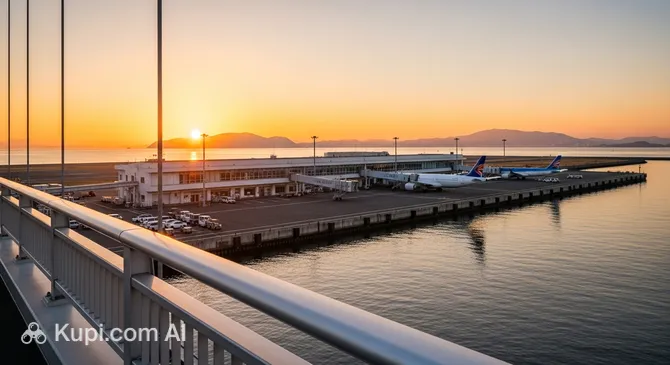
Kitakyushu Airport. Source: Kupi.com Binoculars

Kitakyushu Airport is a modern aerial gateway serving not only the city of Kitakyushu but also the entire Fukuoka Prefecture. Built in 2006 on an artificial island in the Seto Inland Sea, it has become a true engineering marvel and a symbol of innovation. The airport was created to replace the old Kokura Airport, which frequently suffered from fog and had flight restrictions. Thanks to its unique location 3 km off the coast, it is one of the few airports in Japan that operates 24 hours a day. Furthermore, it serves as the base for the stylish Japanese airline, StarFlyer.

IATA Code KKJ
ICAO Code RJFR
City Kitakyushu
Distance to Centre Approx. 23 km
Status International
Annual Passengers Approx. 1.8 million (pre-2020)
Popular Airlines Star Flyer, ANA (All Nippon Airways), Japan Airlines
Schedule "Kitakyushu Airport" online departure board

The main feature of Kitakyushu Airport is its 24-hour operation, which distinguishes it favourably from many other Japanese airports limited by noise regulations. This allows airlines to offer convenient early morning and late-night flights, and for passengers on such flights, there are even special offers, such as complimentary accommodation in nearby hotels. The airport is located on an artificial island connected to the mainland by a bridge 2.1 km long, ensuring convenient transport accessibility.

Comfortable conditions have been created here for travellers: a modern and spacious terminal offers all necessary services, including shops, restaurants, and free Wi-Fi. Excellent transport connections, including express buses, allow you to quickly reach both the centre of Kitakyushu and other major cities in the region. Thanks to its efficiency and well-thought-out infrastructure, Kitakyushu Airport is an excellent starting point for exploring the northern part of Kyushu Island.

Contact Information

To contact representatives of Kitakyushu Airport, please use the following contact information. We recommend checking the data on the official website before your trip.

  • Official Website: www.kitakyu-airport.co.jp
  • Information Service Phone: +81 93 475 4195 (for calls from outside Japan)
  • Address: 1-chome-1 Kukokitamachi, Kokuraminami-ku, Kitakyushu, Fukuoka 800-0306, Japan
  • Email: To contact the airport, it is recommended to use the feedback form on the official website.
  • Lost Luggage Information: If your luggage was lost during the flight, you must first contact your airline's baggage tracing service. For items left in the terminal, please contact the airport information centre.
  • Passenger Support: For general questions related to the airport's operation, you can contact the information centre at the phone number listed above.

How to Get to the Airport

Getting to Kitakyushu Airport, located on a picturesque artificial island, is quite simple thanks to well-established transport links with the city of Kitakyushu and its surroundings. The choice of transport depends on your budget, amount of luggage, and personal preferences.

Public Transport: Bus

The most popular method, balancing price and convenience, is the Airport Limousine Bus. Special routes connect the airport with key railway stations in the city, such as Kokura and Kurosaki. The trip from Kokura Station, the city's main transport hub, takes approximately 35-40 minutes depending on traffic conditions. Buses run regularly throughout the day, making them a reliable option. This is the most recommended method for most tourists.

Taxi or Private Transfer

For those who value comfort, travel with a large amount of luggage, or are in a small group, a taxi is the ideal choice. The trip from the city centre to the airport will take about 30-40 minutes. Although this is the most expensive option, it provides "door-to-door" convenience. You can book a taxi in advance via online services or take a car at special stands in the city.

Car Rental and Parking

If you plan to actively travel around the Kyushu region, renting a car can be an excellent solution. Several major rental companies have offices at Kitakyushu Airport. It is recommended to book a car in advance, especially during the tourist season. The road to the airport crosses a bridge offering beautiful views. For those arriving in their own vehicle, the airport grounds feature spacious parking, offering rates for both short-term and long-term stays.

When planning your trip to Japan, it is also worth considering other air hubs in the region. The largest nearby hub is Fukuoka Airport (FUK), from where you can easily reach Kitakyushu by high-speed train. Other alternatives include Yamaguchi Ube Airport (UBJ) and Oita Airport (OIT), which also have good transport links to the region.

Terminals and Map

Kitakyushu Airport (KKJ) is distinguished by a compact and well-thought-out structure, making it very convenient for passengers. There is only one passenger terminal here, which serves both domestic and international flights. This completely eliminates the need to move between different buildings and makes navigation intuitively clear.

The terminal layout is logical and simple. The first floor (1F) is designed for arriving passengers. The baggage claim area, customs control, information counters, as well as exits to bus stops and taxis are located here. The second floor (2F) is the departure zone. Here you will find airline check-in counters, security checkpoints, and the main departure lounge with boarding gates.

Because the airport is small, completing all pre-flight formalities usually does not take much time. Check-in and security screening proceed quite quickly, especially compared to major international hubs in Japan. Nevertheless, it is recommended to arrive at the airport in advance: 1.5 hours before a domestic flight and 2-3 hours before an international one, to go through all procedures without haste.

Despite its size, the terminal offers all necessary amenities. In the departure and arrival zones, there are shops, cafes, and restaurants where you can try local dishes. One of the pleasant features of the airport is the free foot bath (ashiyu) with natural hot spring water, located on the observation deck, which offers an excellent view of the runway. For navigation, simply follow the signs in English and Japanese — it is practically impossible to get lost here.

Airport History

The history of Kitakyushu Airport is an example of a modern approach to infrastructure development. The current airport, opened on 16 March 2006, was built to replace its predecessor, the old Kokura Airport. The former airport, located in a different place, suffered from frequent fog and had a runway that was too short, which limited its ability to receive large aircraft and created regular flight delays.

The solution to these problems was the construction of a completely new aviation hub on an artificial island in the western part of the Seto Inland Sea (Suo-nada Sea). This ambitious project allowed for the creation of a modern complex with a 2,500-metre runway capable of accepting larger aircraft. Upon opening, the airport was named "New Kitakyushu Airport", but was later renamed simply Kitakyushu Airport to avoid confusion.

One of the key achievements and advantages of the new airport was the capability for 24-hour operation, making it the third in Japan with such a regime after Kansai and Chubu airports. This feature attracted not only passenger airlines but also cargo carriers, turning Kitakyushu into an important logistics centre. The airport's role became particularly significant for local industrial giants, such as automotive factories, which gained the ability to promptly ship and receive cargo at any time of day.

Since its opening, the airport has constantly developed. An important milestone was the emergence of the local airline StarFlyer, which established its headquarters here and began operating flights to Tokyo, and later international charter flights. The geography of flights gradually expanded, including regular international routes to South Korea and other Asian countries. The airport has not undergone massive reconstructions, as it was originally built to modern standards, but its infrastructure is maintained and updated for passenger comfort.

Interesting fact: Kitakyushu Airport is often called the "Marine Airport". It is connected to Kyushu Island by a bridge 2,100 metres long, which carries vehicular traffic. This engineering solution not only ensures convenient access to the terminal but also serves as a distinctive landmark of this modern and strategically important transport hub of the region.

Services and Facilities

Kitakyushu Airport (KKJ) offers its guests a well-thought-out set of services to make waiting for a flight as comfortable and productive as possible. Regardless of the purpose of your trip, here you will find everything necessary for a pleasant start or end to your journey through Japan.

Various dining outlets are located within the terminal: from restaurants where you can experience local cuisine to cosy cafes offering light snacks, desserts, and aromatic coffee. For those wishing to shop, there are stores with souvenirs, travel goods, and Duty Free products. Here you can purchase memorable gifts for loved ones as well as useful items for your journey.

For passenger convenience, free Wi-Fi is available throughout the airport, and numerous charging stations for gadgets allow you to stay connected at all times. If you value enhanced comfort, lounges are at your service where you can relax in a quiet atmosphere, enjoying beverages and snacks. Access may be provided for an additional fee or as part of airline loyalty programmes.

Kitakyushu Airport provides all necessary financial services, including ATMs and currency exchange points. In case of need, a medical station operates in the terminal, ready to provide first aid. For travellers with children, nursing rooms are equipped, and for passengers with reduced mobility, a barrier-free environment is created, with special assistance available upon prior request.

Business travellers can utilise business services, including the rental of conference rooms for meetings. Although there is no hotel located directly within the terminal building, several hotels are situated in the immediate vicinity of the airport, which can be easily reached by taxi or shuttle.

Where to Eat

At Kitakyushu Airport, despite its compact size, passengers will find several decent options for a snack or a full meal. Most dining establishments are concentrated in the main area of the terminal, before security control (landside), on the second and third floors. This is convenient, as both departing passengers and those seeing them off or meeting them can have a meal.

If you want to experience local cuisine, you are in luck. The airport has establishments specialising in regional dishes. Be sure to visit the Soramen restaurant on the second floor to try the famous Fukuoka Prefecture ramen. For a more substantial lunch, the Kitatei restaurant is suitable, serving traditional Japanese set meals (teishoku) and other local hits, for example, yaki-udon (fried udon noodles), which is considered a culinary invention of this very region.

For those in a hurry, a food court is located on the third floor, offering a variety of dishes in a quick-service format. This is an excellent choice if time is limited. Also on the second floor, you can find a Starbucks coffee shop for familiar coffee with pastries or sandwiches, and the local cafe Ushio, where you can drink a cup of tea in a calm atmosphere. These places are ideal for a light snack before departure.

The price range in the airport establishments is moderate, although slightly higher than in the city. Expect the cost of a main dish, such as a portion of ramen, to be around 1000-1500 yen. Most restaurants and cafes open in the morning and operate until the departure of the last evening flights. Regarding special dietary needs (vegan, gluten-free, or halal dishes), the choice may be limited. It is recommended to carefully study the menu or directly ask the staff for assistance in selecting suitable items.

Travel Tips

To ensure your journey through Kitakyushu Airport goes as smoothly and comfortably as possible, take advantage of our tips. These recommendations will help you save time, stress, and even money at various stages of your journey.

Arrival Time: For international flights, it is recommended to arrive at the airport 2.5-3 hours before departure, and for domestic flights within Japan1.5-2 hours prior. This time buffer is sufficient for calmly passing through check-in, baggage drop, and pre-flight security checks, even during busy periods.

Check-in and Security: If possible, complete online check-in for your flight in advance — this will significantly save your time. Security checkpoints here work efficiently, but to speed up the process, prepare your passport and boarding pass in advance, and remove laptops and other large gadgets from your hand luggage.

Seat Selection: If you want to enjoy the views during the flight, choose a window seat. If freedom of movement and extra legroom are more important to you, your choice is an aisle seat. Many airlines allow you to select a seat during online check-in.

Hand Luggage: Remember the standard rules: liquids can be carried in containers of no more than 100 ml each, packed in a single transparent bag. Sharp, piercing objects and flammable substances are strictly prohibited. Be sure to check the hand luggage and baggage allowance rules on your airline's website, as they may vary.

Transfer Passengers: If you have a connecting flight, clarify with the airline whether your luggage will be transferred automatically or if you need to collect it and check it in again. In the transit zone, follow signs for "Connections" or "Transfer" to quickly find the way to your next boarding gate.

Customs Control: When arriving from abroad, you will have to go through customs control. A declaration form is usually handed out on the plane. Fill it out honestly and in advance to avoid wasting time in the arrival zone. Be prepared to present your luggage for inspection upon the request of a customs officer.

Saving Time and Money: To save money, take an empty reusable bottle with you and fill it with drinking water after passing security control. Transfers to the city or parking are often cheaper to book online in advance. Compare prices in Duty Free — they are not always lower than in city shops.

In Case of Flight Delay: First, find a representative of your airline to get current information. Find out about your rights to the provision of beverages, food, or even a hotel in case of a long delay. Use this time to relax in the lounge area, go shopping, or have a leisurely lunch in one of the airport restaurants.

Reached the end of the page?

That means the route is fully explored