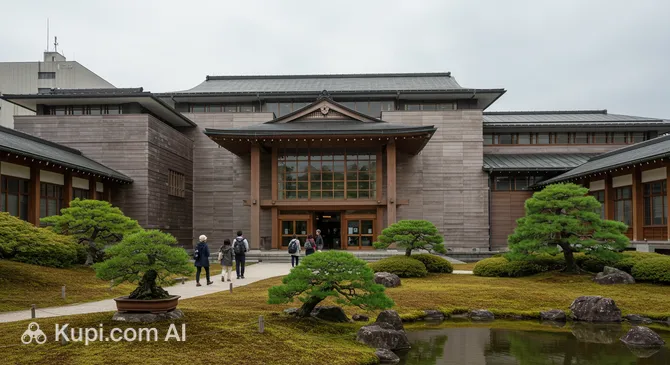
A journey into the history of one of the region's most significant cultural centers should begin where the past comes to life in detail. The Sakai City Museum is a modern educational and research institution located in the city of Sakai, Osaka Prefecture. It is dedicated to the rich heritage of this land, spanning thousands of years: from the era of ancient burial mounds to the heyday of international trade in Japan.
Sakai City Museum. Illustration.
Source: Kupi.com AI
Traveller photos:
The museum acts as the primary guardian of the secrets of the famous kofun—gigantic keyhole-shaped tombs that are listed as a UNESCO World Heritage site. The exhibits are arranged to allow visitors to trace the region's transformation from a fishing village into a powerful industrial and trading hub, renowned for its master craftsmen and traditions.
The museum building is harmoniously integrated into the landscape of the vast Daisen Park, creating the perfect environment for thoughtful immersion into the culture. Educational programs are held here regularly, and the museum's architecture itself emphasizes the significance of the archaeological finds and everyday objects from various eras presented within.
Contacts
For more details about your visit or to get the latest information on special exhibitions, you can use the institution's official contact information.
Inside the museum's halls, guests are treated to a fascinating journey through the centuries. The main focus is on archaeological finds: you can see ancient haniwa clay figurines, everyday items, and pieces of weaponry discovered during the excavation of the burial mounds. Special attention is given to the detailed models and reconstructions, which help you imagine how the massive kofun tombs looked when they were first created.
For those who prefer active participation, there are interactive zones. Here, you can feel like a real archaeologist or try your hand at traditional crafts for which the region is famous. For example, the museum often hosts demonstrations and workshops on knife-making or working with washi Japanese paper.
Families with children will appreciate the special educational programs that turn learning about history into an exciting quest. After touring the exhibits, be sure to take a stroll through the adjacent park to see those same majestic burial mounds discussed in the museum in their actual scale.
Getting There
The museum is conveniently located in the central part of the city, making it accessible to most travelers. The most popular way to get here is by train. The nearest station to the site is Mozu Station (JR Hanwa Line), from which you can reach the museum entrance on foot in 10–15 minutes through the scenic grounds of Daisen Park.
If you prefer buses, public transport routes pass through the central districts and stop in the immediate vicinity of the park area. For those who value comfort, a taxi is always available from the central station or any other point in the city.
For travelers in rental cars, there is spacious parking next to the museum complex. When using a navigator, it is recommended to search for Daisen Park coordinates or the museum's address to quickly find a convenient entrance.
Nearest city: Sakai
History & Facts
The history of the area where the museum welcomes guests today dates back to the Kofun period (3rd–7th centuries AD). It was during this time that colossal burial mounds were constructed, becoming a symbol of ancient Japanese statehood. The most famous of these—Daisen Kofun, the largest tomb in the world—is considered the final resting place of Emperor Nintoku.
During the Middle Ages, the city became the "Venice of Japan"—an independent port and a wealthy trading hub. The production of weapons and knives flourished here, and many traditions of the tea ceremony were born. The museum was specifically established to bring together the scattered evidence of this glorious past under one roof.
Today, the museum's collection includes not only archaeological artifacts found during the study of the mounds but also unique documents, photographs, and traditional craft items. The institution carefully preserves the memory of the city's outstanding residents and the key events that have shaped the region's identity over many centuries.
Time Needed
To take your time exploring the main exhibition, studying the details of the ancient burial mound models, and getting acquainted with the collection of craft items, a typical visitor will need 1.5 to 3 hours. This is enough time to gain a complete understanding of the region's history.
If you plan to visit temporary exhibitions or take part in one of the interactive workshops, it's better to set aside half a day for your visit. Also, consider time for a walk through Daisen Park, where the museum is located, as this place is worth seeing in its own right.
Working Hours
The museum is open to visitors throughout the week, except on Mondays. Standard opening hours are from 9:30 AM to 5:15 PM; however, please note that entry for new guests usually stops half an hour before closing.
Please note the schedule: the museum is closed on Mondays. If a national holiday falls on a Monday, the museum may be open, in which case it will be closed the following Tuesday instead.
Day
Opening hours
Monday
Closed
Tuesday
9:30 – 17:15
Wednesday
9:30 – 17:15
Thursday
9:30 – 17:15
Friday
9:30 – 17:15
Saturday
9:30 – 17:15
Sunday
9:30 – 17:15
Nearby
Exploring the museum's surroundings will allow you to dive deeper into the atmosphere of ancient Japan, as it is located in the heart of a historical district. Just a few steps away are the famous burial mounds that create a unique cultural landscape.
A stroll through the surrounding area will give you the chance to see both ancient tombs and modern family recreation spots. Below is a list of interesting sites located nearby: