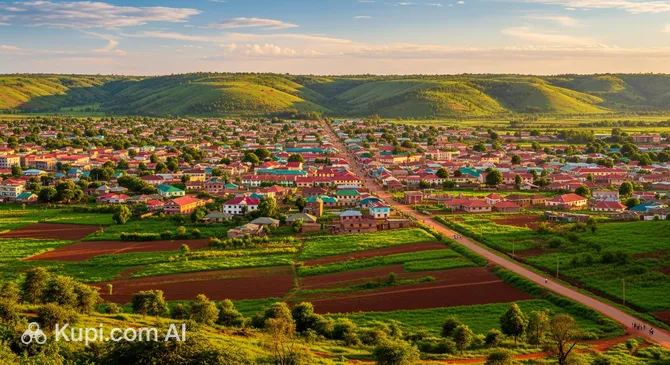
Migori is the bustling administrative center of the county of the same name, located in the southwestern part of Kenya. The city is situated at an altitude of over 1,300 meters above sea level, which gives it a milder and more pleasant climate compared to the coastal regions. Although Migori is not a classic tourist resort, its dynamic atmosphere and role as an important trading hub make it interesting for those who want to see the authentic life of East Africa.
Migori. Illustration.
Source: Kupi.com AI
The city's geographical location is unique: it lies just 22 kilometers from the border with Tanzania and 50 kilometers from the majestic Lake Victoria. It is a multinational center where the Luo people predominate, whose traditions and hospitality shape the unique character of the city. Migori's population is growing rapidly, transforming the former settlement into a major urban hub with developing infrastructure.
If you delve into the history of this region, you can learn how the city transformed from a transit point into a key economic center of the region. Today, travelers often use it as a base camp before heading to the famous Maasai Mara National Reserve or to the shores of Lake Victoria. We invite you to feel the rhythm of this developing city, stroll through its noisy markets, and discover hospitable Kenya in its true form.
Weather Overview
The climate in Migori is classified as tropical; however, due to the city's location at a significant altitude (1,322 meters), moderate and comfortable temperatures are maintained throughout the year. Average daytime figures usually range between 24–28°C, while nights bring a pleasant coolness with temperatures around 16–18°C. This makes walking around the city pleasant even on sunny days.
When planning your trip, it is important to consider the seasonality of precipitation. Migori has two main wet periods: the "long rains" from March to May and the "short rains" in October and November. During this time, showers can be intense but are usually short-lived. The driest and sunniest months are June, July, and August, making this period the most favorable for visiting natural attractions.
For more detailed information on what weather in the city awaits you in a specific month, you should check before the trip itself. In the dry season, the central part can be dusty due to the nature of local roads, so travelers are recommended to have a light scarf with them. Overall, the mild climate of the region is one of its main advantages.
Average monthly temperature
Average monthly precipitation
Interesting Facts
High-altitude status: Migori is located at an altitude of 1,322 meters above sea level, so it never experiences the exhausting heat characteristic of the lowlands.
Demographic explosion: Over the past ten years, the city's population has grown nearly threefold—from 39,000 to more than 111,000 people.
Cross-border hub: Due to its proximity to the border with Tanzania (only 22 km), the city is a vital center for international trade in western Kenya.
Gateway to the wild: Despite its industrial appearance, Migori remains one of the key transit points on the way to the famous Maasai Mara Reserve.
Luo cultural heart: The city is considered one of the strongholds of Luo culture, which is manifested in local customs, language, and gastronomy.
How to Get There
The transport accessibility of Migori makes it an important link between Kenya and neighboring Tanzania. The city does not have its own major air hub, so travelers often combine different modes of transport to reach this regional center. Detailed information on routes can be found on the page dedicated to how to get to the city.
The closest option for air travelers is Kisii Airport, located about 80 kilometers from the city. From there, you can reach Migori by taxi or public transport. Most tourists prefer to get there from Nairobi by comfortable buses or minibuses called "matatus." The trip from the capital takes from 8 to 10 hours, and the road passes through the picturesque landscapes of the Kenyan countryside.
Railway communication in this area is currently poorly developed, so the main focus is on road transport. Regular matatu flights connect Migori with the neighboring city of Kisii (travel time about 2 hours) and the Sirari border point. If you are planning a trip from Tanzania, the border crossing at Taniade takes very little time, as the distance to it is only 22 kilometers.
Station
Passenger traffic
Distance
Mwanza Central Train Station
1
238 km
Nairobi railway station
5
263 km
Nairobi Terminus
5
272 km
Main Attractions
Migori is a city that reveals itself not through majestic monuments, but through everyday energy and proximity to natural treasures. The main hub of local life is the Migori Central Market. This is the perfect place for those who want to immerse themselves in the authentic atmosphere of African trade, see the variety of local products, and artisan crafts.
In the city itself, it is worth paying attention to the main shopping street, where modern commercial buildings coexist with traditional structures. The city's religious buildings, such as local mosques and churches, emphasize its multinational and tolerant character, reflecting the peaceful coexistence of different cultures and faiths.
Many tourists value Migori for its strategic location. Just 50 kilometers to the west are the waters of Lake Victoria, where you can enjoy fishing or boat trips. The city also serves as a convenient starting point for trips to the legendary Maasai Mara National Reserve, although the journey there can be quite an adventure due to the terrain. Visiting local Luo communities allows you to get acquainted with unique traditions that are carefully preserved by the inhabitants of this region.
Local Cuisine
A gastronomic journey to Migori is impossible to imagine without experiencing the culinary traditions of the Luo people. Proximity to Lake Victoria has predetermined the main star of the local table—fresh fish, most often tilapia, which is fried or stewed with vegetables here. Try it in combination with ugali—a thick cornmeal porridge that serves as the base for most Kenyan dishes.
The city's street food is a separate kind of pleasure. Be sure to try hot chapati flatbreads, roasted corn, or meat-filled samosas. For meat lovers, local eateries always have tender beef or goat meat cooked with local spices. Rice with beans or stewed greens known as sukuma wiki are often served as a side dish.
As for drinks, Kenyans are great tea lovers. In Migori, it is traditionally served with plenty of milk and sugar. Freshly squeezed tropical fruit juices and local beer are also popular. The food culture here is simple and democratic: most residents prefer to dine at markets or in small cafes where portions are generous and prices remain affordable for every guest.
Travel Tips
A trip to Migori will be a bright and comfortable adventure for you if you take into account a few practical features of life in this region in advance.
Clothing and belongings: Choose light clothing made from natural fabrics, but don't forget to bring a windbreaker or a light sweater for cool evenings, as the city is located on an elevation. Comfortable closed shoes are a must for walking.
Transport: To move around the city, it is most convenient to use taxis or matatus. Always agree on the price of a taxi ride before getting into the car.
Finances: The main currency is the Kenyan shilling. Cards are only accepted in large supermarkets and hotels, so always have a supply of cash for markets and transport.
Health and safety: Use only bottled water and avoid ice in drinks. After dark, it is better to travel by taxi and avoid unlit areas.
Communication: English is widely spoken, but a couple of phrases in Swahili (e.g., "Jambo" — hello, "Asante" — thank you) will significantly endear you to the locals.
Local etiquette: It is customary to take off your shoes when entering homes or mosques. Always ask permission before photographing locals.
What to avoid: Do not openly display large amounts of money and expensive equipment in crowded places. Avoid arguments on political topics.
Extra tip: If you plan a trip to Lake Victoria, be sure to use insect repellent, especially in the evening.
May your acquaintance with Migori be filled only with positive emotions and interesting discoveries!
Entertainment & Nightlife
The entertainment scene in Migori is primarily local in character, offering guests simple and sincere fun. Nightlife here is concentrated in several popular bars and small nightclubs, where modern Kenyan music and world hits play in the evenings. Locals love to gather in these establishments to socialize, dance, and enjoy refreshing drinks after a hot day.
On weekends, the city becomes noticeably livelier: public spaces and markets turn into meeting spots. For those who prefer more active daytime recreation, sports events are popular—football and volleyball are held in high regard here. The cultural program often includes performances by local musical groups playing traditional Luo melodies.
If you are looking for a wider range of entertainment, it is worth looking at neighboring cities or natural locations. For example, a trip to the shores of Lake Victoria will provide excellent daytime leisure with boat trips. Travelers are recommended to follow basic safety measures: visit establishments in groups and use official taxis for travel during dark hours.
Parks & Museums
While Migori cannot boast an abundance of classic museums with glass display cases, the city itself is a living exhibition of Luo culture. The lack of formal exhibition halls is compensated for by the opportunity to visit local craft workshops and traditional communities. Here you can see with your own eyes the process of creating household items and learn about centuries-old traditions that still play a key role in the lives of the townspeople.
Migori's natural "parks" are primarily its surrounding countryside with picturesque wooded vegetation. There are few green areas for recreation in the city itself yet; however, small squares and plazas serve as places for meetings and leisurely conversations. For a full-scale nature holiday, travelers usually head to the shores of Lake Victoria, where the natural landscapes have preserved their pristine beauty.
The lack of developed city parks is a typical feature of fast-growing centers, but the outskirts of Migori more than make up for it. Literally just outside the city limits, hills and valleys begin that are ideal for easy walks. This gives tourists a chance to see Kenya off the tourist trails, enjoying the peace and quiet of the African province.
Getting Around
The transport system in Migori is typical of a dynamically developing Kenyan city, where maneuverability and accessibility play a leading role. The main form of public transport here is the matatu—minibuses that run on specific routes. This is the cheapest way to get around: a trip around the city usually costs 20–50 Kenyan shillings. However, keep in mind that matatus can be very crowded during peak hours.
For faster and more individual trips, locals and tourists often choose boda-bodas—motorcycle taxis. This is a very popular way to move around, allowing you to quickly reach any point in the city even in heavy traffic. Nevertheless, tourists should remember safety and always ask for a helmet. Regular car taxis are also available in Migori, and it is better to agree on the fare in advance.
Payment for public transport is made in cash in the local currency. If you plan to travel to the outskirts of the city, keep in mind that the roads there may be unpaved, and travel may slow down during the rainy season. In the central part of Migori, the quality of the road surface is good, which makes walking and driving quite comfortable. For maximum convenience when exploring the surroundings, you could consider hiring a private driver for the whole day.
Accommodation
The hotel sector in Migori is mainly focused on business travelers and transit tourists, which dictates its accommodation features. You won't find huge luxury chain hotels here, but the city offers a decent choice of budget guesthouses and mid-range hotels. Most accommodation options are concentrated in the city center, which is convenient for access to transport links and markets.
The typical price range varies from modest 500-2,000 Kenyan shillings per night in basic hotels to 5,000 shillings in more comfortable hotels offering amenities such as Wi-Fi and breakfast. Travelers are recommended to check reviews in advance, as service standards can vary significantly even in establishments of the same price category.
If you plan to stay in Migori for a long term, you might consider renting apartments, which are popular among specialists working in the region. During peak seasons, when the flow of tourists to Maasai Mara passes through the city, places in the best hotels may be limited, so booking should be taken care of in advance. By choosing accommodation in the center, you will be in the heart of the action, within walking distance of the main shopping areas and restaurants.
Nearby Cities
Migori serves as an excellent starting point for exploring the southwestern region of Kenya and even neighboring Tanzania. Thanks to its convenient location, you can easily make several fascinating trips from here, discovering the diversity of African nature and urban life.
Just 20 kilometers away is the Tanzanian city of Sirari, which provides an opportunity to get acquainted with the culture of the neighboring country in just one day. Another important destination is Kisii—a major regional center with developed infrastructure where you can find excellent restaurants and shopping complexes. For those looking for peace by the water, a trip to Homa Bay, located on the shores of a Lake Victoria gulf, is ideal.
Equally interesting are smaller settlements such as Karungu or the Kichwa Tembo area, which is often associated with luxury safari camps. Exploring the surroundings of Migori will allow you to see the real life of the Kenyan countryside and enjoy the change of landscapes from hilly plains to endless water expanses.
Shopping & Souvenirs
Shopping in Migori is primarily about immersion into the colorful world of local markets. The main attraction for shoppers is the Migori Central Market. There are no air-conditioned boutiques here, but there are endless rows of fresh fruit, spices, and handmade goods. This is the best place to purchase fabrics with bright African prints or wooden items created by local craftsmen.
The city's main shopping street offers a more familiar shop format. Here you'll find supermarkets and small stalls where you can buy everything you need—from clothes to electronics. For tourists, items of traditional crafts are of particular interest: woven baskets, traditional bead jewelry, and soapstone souvenirs, which are mined in neighboring regions.
Please note that cash is the predominant method of payment in Migori, so you should always have Kenyan shillings with you. Shop opening hours are usually standard—from early morning until sunset—but markets begin to hum as early as dawn. And don't forget the tradition of bargaining: in the markets, it's not just a way to lower the price, but an important part of social interaction. Be friendly, and you will definitely leave with interesting purchases at a great price.