Support

Hwaseomun Gate

About

Hwasomun Gate is the majestic west gate of the famous Hwaseong Fortress, located in the city of Suwon, South Korea. As one of the four main entrances to this historical defensive complex built in the late 18th century, Hwasomun played a key role in the city's defense and today stands as a striking example of Korean architecture.
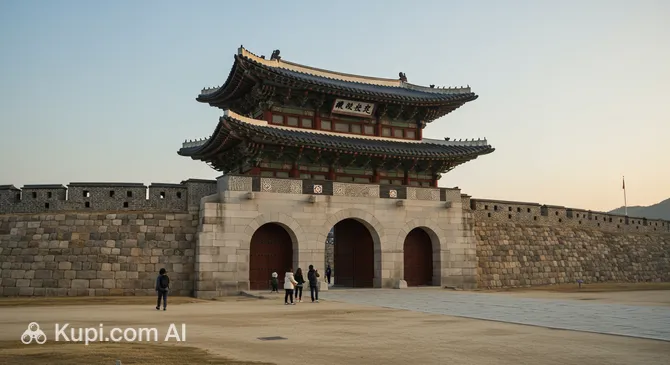
Hwaseomun Gate. Illustration.
Source: Kupi.com AI

Traveller photos:

Architecturally, Hwasomun Gate is notable for its one-story pavilion that crowns a massive stone structure. A miniature fortress surrounding the gate once served as a post for guards, highlighting its defensive significance. Along with the other gates – Janganmun (North), Paldalmun (South), and Changnyongmun (East) – Hwasomun forms an integral part of this grand structure.

Hwaseong Fortress, including Hwasomun Gate, is recognized as a UNESCO World Heritage site due to its unique blend of traditional Korean architectural techniques with elements of Western fortification art. This makes the gate not just a historical monument of the Joseon Dynasty era, but also an important cultural symbol of Suwon, attracting tourists with its beauty and rich history.

Contacts

As Hwasomun Gate is a historical monument, direct contact details are usually not provided. For up-to-date information on opening hours, visiting conditions, and potential guided tours, it is best to check the official tourism portals of the city of Suwon or the information centers at Hwaseong Fortress, of which the gate is a part. There, you can also find information on the most convenient ways to reach this attraction.

How to contactContact
Address334 Jangan-dong, Paldal-gu, Suwon, Gyeonggi-do, South Korea
Phone+82 31-290-3600
Websitewww.swcf.or.kr

What to Do

A visit to Hwasomun Gate in Suwon offers travelers a unique opportunity to touch the history of South Korea. The main thing to do here is to inspect the impressive architecture of the pavilion itself. Visitors can admire the craftsmanship of ancient builders, the details of the wooden structures, and the strength of the stonework. A walk along the fortress walls, of which the gate is a part, offers picturesque views of modern Suwon and the surrounding landscape. This place seems designed for slow contemplation and immersion in the atmosphere of the past.

Hwasomun Gate is an excellent location for photo shoots. Particularly expressive shots are captured in the morning or evening hours when soft lighting advantageously highlights the texture of the ancient stones and the elegance of the wooden elements. The peaceful atmosphere is perfect for walks, allowing you to fully appreciate the majesty of this historical structure.

Various cultural events are often held on the grounds of the fortress, including Hwasomun Gate. These may include historical reconstructions recreating scenes from the Joseon era, festivals, or interactive programs introducing the life and traditions of that time. Such events make the visit even more informative and exciting, providing a deeper understanding of the monument's significance.

For those who want to learn more, information centers are often located near the gate. Here, you can find detailed information about the restoration process of the gate and the entire Hwaseong Fortress, its rich history, and the unique features of the defensive system. This is a great opportunity to complement visual impressions with interesting facts and deepen your knowledge of Korean heritage.

Getting There

You can reach Hwasomun Gate, located in the city of Suwon, from the capital of South Korea, Seoul, which is about 30 kilometers away. This makes it an accessible destination for a day trip. The most convenient and popular method is by subway. You will need to take Line 1 of the Seoul Metropolitan Subway to Suwon Station (수원역).

After arriving at Suwon Station, you have several options for getting directly to Hwaseong Fortress, of which Hwasomun Gate is a part. You can use local buses with routes passing by the fortress or take a taxi. A taxi ride is faster and more comfortable, especially if you are traveling in a group. Hwasomun Gate is located on the western side of the fortress wall and is typically well-marked on all tourist maps and signs in Suwon.

For those who prefer to travel by personal or rental car, parking spaces are provided near Hwaseong Fortress. This is a convenient option if you plan to explore not only the gate but also other parts of the expansive fortress and the Suwon area. Additionally, organized tours from Seoul often include a transfer to Hwaseong Fortress and guide services. This can be a great choice for those who want to get as much information as possible without worrying about logistics.

Nearest city: Suwon

History & Facts

Hwasomun Gate, located in the city of Suwon, is an integral part of the famous Hwaseong Fortress. Its construction took place between 1794 and 1796 and was commissioned by King Jeongjo. This massive project had a dual purpose: to relocate the remains of his father, Prince Sado, to a more honorable site and to significantly strengthen the defensive capabilities of the region, which was crucial for South Korea at that time.

The architectural appearance of Hwasomun Gate and the entire fortress was designed by the leading minds of their time – Jeong Yak-yong and Yu Hyeong-won. They successfully harmonized traditional Korean defensive construction methods with advanced Western fortification ideas. One of the characteristic features of Hwasomun, like other gates of the fortress, is the presence of an "ongseong" – a semicircular mini-fortress attached to the main gate for enhanced protection and to house guards.

To this day, Hwasomun Gate remains in excellent preservation, making it one of the finest examples of defensive architecture from the late Joseon Dynasty. Its historical and cultural value has been recognized globally: in 1997, the entire Hwaseong Fortress, including this majestic gate, was added to the prestigious UNESCO World Heritage list, confirming its uniqueness and significance to world history.

Time Needed

When planning a visit to Hwasomun Gate in the city of Suwon, keep in mind that the time required for exploration can vary. If your goal is to see the gate itself and its immediate surroundings, as well as the adjacent part of the fortress wall, it usually takes about 30 minutes to 1 hour. This is enough time to appreciate the architecture, take photos, and soak in the atmosphere of this historical site.

However, Hwasomun Gate is part of a larger complex – the famous Hwaseong Fortress. If you want to do more than just see the gate and wish to take a longer walk along the entire fortress, explore other sections, or perhaps visit the museums and pavilions located on its grounds, you should set aside significantly more time. In this case, for a fuller immersion into the history and culture of this South Korean site, it is recommended to allow 2–3 hours or even more, depending on your pace and interest in the details.

Working Hours

Hwasomun Gate, part of the famous Hwaseong Fortress in the city of Suwon, is generally open to the public daily. Standard opening hours are typically from 09:00 to 18:00. This allows tourists to plan their visit during daylight hours to fully enjoy the beauty of this historical site.

However, it is important to remember that operating hours may change depending on the season or weather conditions. Before traveling to Hwasomun Gate in Suwon, it is recommended to check for current information on the attraction's official website or contact local tourist information centers. Generally, no advance booking is required to view the gate itself, but if you plan to attend special events or guided tours within Hwaseong Fortress, it is best to check this in advance.

Open 24/7

Nearby

A visit to the majestic Hwasomun Gate in Suwon is undoubtedly a highlight, but it can also be the starting point for a deeper immersion into the history and culture of this amazing South Korean city. To truly feel the atmosphere of Hwaseong Fortress and its surroundings, it is worth taking the time to explore the nearby attractions.

Such a walk will not only enrich your experience but also allow you to discover other interesting sites, each holding its own piece of history. Below is a list of some attractions located in the immediate vicinity of Hwasomun Gate that may interest you.

NameDistance
Janganmun Gate0.5 km
Seojangdae (Western Command Post)0.5 km
Suwon Museum of Art0.6 km
Hwahongmun Gate0.7 km
Banghwasuryujeong Pavilion0.8 km
Suwon Hwaseong Museum0.9 km
Yeonmudae (Eastern Command Post)1.2 km

Reached the bottom of the page?

Looks like you know this route inside out